
Feedback Needed on House Bill Proposing Social Media Research Project with Red Cross
Representative Thompson from Mississippi introduced a bill to the House of Representatives for the American Red Cross (ARC) to conduct a pilot research project to better leverage social media in disasters. The language in the bill is fairly vague, but I gather they want the ARC to implement something tangible and then evaluate its usefulness and performance.
A study like this could be very useful to the wider social media in emergency management (SMEM) community. I particularly like how the bill incorporates the use of social media to help deliver response supplies to affected areas, a form of operational intelligence. And social media for operations and intelligence is the next frontier of social media research that will enable disaster decision makers to make better decisions faster and more accurately.
I will be providing feedback on this bill and am curious about others' thoughts. What other components of SMEM should be researched? Will this be useful to you? How so?
You can track the bill here. Here are the quick and dirty details of the bill:
Representative Thompson from Mississippi introduced a bill to the House of Representatives for the American Red Cross (ARC) to conduct a pilot research project to better leverage social media in disasters. The language in the bill is fairly vague, but I gather they want the ARC to implement something tangible and then evaluate its usefulness and performance.
A study like this could be very useful to the wider social media in emergency management (SMEM) community. I particularly like how the bill incorporates the use of social media to help deliver response supplies to affected areas, a form of operational intelligence. And social media for operations and intelligence is the next frontier of social media research that will enable disaster decision makers to make better decisions faster and more accurately.
I will be providing feedback on this bill and am curious about others' thoughts. What other components of SMEM should be researched? Will this be useful to you? How so?
You can track the bill here. Here are the quick and dirty details of the bill:
Department of Homeland Security pilot program
(a) In general. --
The Secretary of Homeland Security, acting through the Under Secretary for Science and Technology of the Department of Homeland Security, shall conduct a one-year pilot program with the American National Red Cross to research and develop mechanisms for the Department to better leverage social media to improve preparedness and response capabilities, including the following:
(1) The timely dissemination of public preparedness information for terrorist attacks and other disasters.
(2) The delivery of response supplies to affected areas.
(b) Report.--
Not later than 90 days after completion of the pilot program required under subsection (a), the Secretary of Homeland Security shall submit to the Committee on Homeland Security of the House of Representatives and the Committee on Homeland Security and Governmental Affairs of the Senate a report on the lessons learned from such pilot program and any plan to integrate such lessons into operations of the Department of Homeland Security.

ISCRAM is Conducting Survey for Masters Degree on EM Information Systems
ISCRAM, the international academic-practitioner group focused on Information Systems for Crisis Response and Management is conducting a survey that may be of interest to many people. The survey is looking for input on a Master's level degree in EM with a concentration in information systems.
I like ISCRAM's approach because it is not just about a particular type of technology such as GIS. Information systems for EM is sorely underrepresented in higher education and something I believe should be in included in every degree program. This topic is also near and dear to my heart as I have not only written about information and technology in EM, but is also the subject of my research and future work.
You need not be an expert in information systems, information, or technology to respond to this survey. In fact a non-technical EM expert may provide some great feedback!
ISCRAM, the international academic-practitioner group focused on Information Systems for Crisis Response and Management is conducting a survey that may be of interest to many people. The survey is looking for input on a Master's level degree in EM with a concentration in information systems.
I like ISCRAM's approach because it is not just about a particular type of technology such as GIS. Information systems for EM is sorely underrepresented in higher education and something I believe should be in included in every degree program. This topic is also near and dear to my heart as I have not only written about information and technology in EM, but is also the subject of my research and future work.
You need not be an expert in information systems, information, or technology to respond to this survey. In fact a non-technical EM expert may provide some great feedback!
Please respond by clicking this link or the button below:
Here are the details of the survey provided by ISCRAM:
The Education Committee of ISCRAM (Information Systems for Crisis Response and Management), under the leadership of Dr. Murray Turoff, is seeking to establish guidelines for a Master's level degree in Emergency Management with a concentration in Information Systems (IS) for Emergency Management (EM).
This survey is designed to solicit the opinions of EM professionals, practitioners and academics, as to what such a curriculum needs to have. Even if you are not an information systems practitioner or researcher, your opinion is valued. The results of this survey may be used for other scientific research by the ISCRAM Education Committee as well.
The survey is comprised of four sections. The first section addresses general emergency management courses for the program; the second section addresses information specific courses for the program; and the third section addresses which, if any, information systems for EM focused courses should be included in all Master's Degree programs in EM, regardless of the focus of the program. We recognize that specific content of certain courses might be influenced by the country in which they are taught such as what disaster types, risks and threats, response organizations are emphasized. The final section consists of a few general non-identifying demographic questions.
Participation in this survey is voluntary and anonymous. Identifying information will not be collected and individual responses will be kept confidential. If you choose to provide your email so that we can send to you results of the survey and/or invite you to participate in future work on this project it will be kept separate from the data used for analysis.
There are no known risks to participating in this survey. You must be at least 18 years of age. If you have any questions or concerns, you may contact Linda Plotnick at lplotnick@jsu.edu.

NYU's GovLab is Crowdsourcing Innovation for the Cotopaxi Volcano Eruption
NYU's Governance Lab (GovLab) is looking for some experts to participate in a series of virtual roundtable problem-solving discussions to help the Ecuador government and its local cities prepare for an increasingly likely eruption of the Cotopaxi Volcano. The volcano has recently become very active. If it erupts, some communities will have less than 30 minutes to evacuate.
For some background, GovLab is an NYU Wagner School of Public Service lab that helps institutions work more openly and collaboratively by harnessing the power of the crowd in problem solving. GovLab also harnesses the latest practices and innovations in data and technology to support its mission.
If you believe you can offer expertise or support for one of the sessions below...
NYU's Governance Lab (GovLab) is looking for some experts to participate in a series of virtual roundtable problem-solving discussions to help the Ecuador government and its local cities prepare for an increasingly likely eruption of the Cotopaxi Volcano. The volcano has recently become very active. If it erupts, some communities will have less than 30 minutes to evacuate.
For some background, GovLab is an NYU Wagner School of Public Service lab that helps institutions work more openly and collaboratively by harnessing the power of the crowd in problem solving. GovLab also harnesses the latest practices and innovations in data and technology to support its mission.
If you believe you can offer expertise or support for one of the sessions below, sign up here. The first session starts October 1. If you know of anyone who would like to participate, forward this on.
Here are the details that were sent to me:
The City of Quito, Ecuador needs your help and that of your classmates and colleagues in your program and your newsletter readers to prepare for the likely eruption of the Cotopaxi Volcano situated 30 miles from Quito.
Cotopaxi is currently spewing ash (latest images here). The last large-scale eruption was in 1877, and it is believed that another one is now inevitable. If it erupts, some communities will have less than half an hour to evacuate.
The scale of the challenge is overwhelming. Yet there are those of you out there with good ideas for how to mitigate the risks, especially using technology and innovation, or those of you who know others who have relevant experience, skills, and know how.
We will convene a dozen online sessions to help the city address the major pressing challenges in disaster management.
The goal of these online sessions is to:
- Better define and understand the nature of the problem
- Help connect those people with relevant experience and know how to city officials to help Quito better manage the impending disaster
- Identify innovative and practical ways, especially using new technology, to tackle the challenge at hand
- Result in at least 2-3 implementable ways per topic of doing things differently that could potentially save lives, save resources, and allow for money to be spent on what matters most.
Logistics:
- Each session will run online from 11 am EST for 1.5 hours on a Monday or Thursday (see calendar below)
- Each session will be attended by those city officials with responsibility for that topic, who will share background information about the current state of readiness.
- Each session will be moderated by an expert in the field.
- Each session will be staffed by volunteers who will take notes and follow up the session to develop good ideas into more concrete and actionable proposals backed up by research.
What We Need From You?
Sign up (https://the-govlab.forms.fm/cotopaxi) for the sessions of greatest relevance where you have the most to contribute.
- Coordination of Communication - Thursday, October 1, 11am - 12.30pm EST
- Evacuation Planning - Monday, October 5, 11am - 12.30pm EST
- Cost Effective Human and Animal Shelters - Thursday, October 8, 11am - 12.30pm EST
- Citizen Sensing and Citizen Science - Monday, October 12, 11am - 12.30pm EST
- Protection of Vulnerable Populations - Thursday, October 15, 11am - 12.30pm EST
- Construction of a Skills-Based Expert Network - Monday, October 19, 11am - 12.30pm EST
- Continuity of Communications Systems - Thursday, October 22, 11am - 12.30pm EST
- Air and Water Quality and Sanitation - Monday, October 26, 11am - 12.30pm EST
- Food Safety and Cold-Chain Supply Management - Thursday, October 29, 11am - 12.30pm EST
- Access to Health Services - Monday, November 2, 11am - 12.30pm EST
- School Alternatives During a Disaster - Thursday, November 5, 11am - 12.30pm EST
- Innovative Financing for Redevelopment - Monday, November 9, 11am - 12.30pm EST
The magnitude of the crisis is grave and the timing is urgent. Please take the time to share this invitation with the right people.
You can also suggest another session or tell us how we can do this better.
Many thanks for your assistance and for volunteering your time and expertise to help the people of Ecuador.
- Carolina Pozo, Secretary General, Planning and Open Government, City of Quito
- Beth Simone Noveck, Founder, The GovLab
- Dinorah Cantu, Director, The GovLab Academy

Jetblue is Hiring for a BC/EM Tech Strategy and Management Position
I do not come across technology strategy and management positions in emergency management very often. Positions like these signal a commitment to the responsible use of technology by dedicating someone knowledgeable to think through how technology can better support the organization's mission. This is vital to ensuring you maximize the value of the technology that you license and have at your disposal.
If you are interested in this type of position, Jetblue is hiring a Senior Analyst for Business Continuity and Emergency Response Systems. This role was specially created a few years ago and I believe there are some awesome travel benefits!
I do not come across technology strategy and management positions in emergency management very often. Positions like these signal a commitment to the responsible use of technology by dedicating someone knowledgeable to think through how technology can better support the organization's mission. This is vital to ensuring you maximize the value of the technology that you license and have at your disposal.
If you are interested in this type of position, Jetblue is hiring a Senior Analyst for Business Continuity and Emergency Response Systems. This role was specially created a few years ago and I believe there are some awesome travel benefits!
I am not sure how long this position will be posted. You can apply by clicking the button below or this link.
Here are the details of the positions.
Position Summary
The Senior Analyst, Business Continuity (BC) and Emergency Response (ER) Systems, reports to the Manager, Disaster Recovery and manages the technology supporting BC, Disaster Recovery (DR), and ER. This role is responsible for the strategic development and management of various applications to support planning, mitigation, response, and recovery for all three workgroups. Technology supported includes an emergency notification system, passenger tracking system, incident management, and business continuity planning.
Essential Responsibilities
- Develop and oversee the day-to-day management of the Business Continuity, Disaster Recovery, and Emergency Response systems including developing, testing and on-going maintenance (including change management with updates). Enforcing department policies such as data standards to ensure accuracy of information.
- Ensure vital/time sensitive functions are cross trained to ensure response capacity across all members of department.
- Conducts research on emerging technologies and industry best practices.
- Recommends technology solutions that solve pain points identified by Director or Managers.
- For new technology: source multiple potential suppliers, conduct due diligence/supply chain process, contract management, implementation, testing, end-user training, and maintenance. Prepare for Leadership approval.
- Assist with identifying and tracking Technical Recovery Plans, Service Level Agreements, bugs, and data integrity for systems tracked in BC and DR program.
- Support the testing and readiness of the SOC Backup Center - Woodbury Support Center. Enforce compliance of all departments represented.
- Ensure end users including Business Continuity Liaisons are able to understand the software to conduct their BC Planning.
- Participates on rotating on-call coverage by serving as a resource to Crewleaders and Crewmembers to provide guidance in times of crisis
- Oversee, respond to, and manage logistics of critical crisis events to support the business, Operations and/or Crewmembers.
- Develop and conduct tabletop exercise for department specific plans and Crisis Management Team as needed
- Develop strong industry relationships with Business Partners, government agencies and other companies’ Business Continuity departments as well as strong working relationship with JetBlue’s Leadership and Crewmembers Create, implement, and manage ad-hoc projects as needed
- Other duties/projects as assigned
Minimum Experience and Qualifications
- Bachelor’s Degree any field
- Three (3) years of experience in the Business Continuity or related field
- Experience in business continuity program management
- Experience in coordinating multiple projects
- Experience in managing applications
- Knowledge of PowerPoint, Outlook and Microsoft Office
- Ability to handle stressful situations in a calm manner and provide leadership when needed
- Attention to detail in maintaining emergency response members’ records
- Ability for frequent overnight travel (15%)
- Pass a ten (10) year background check, pre-employment drug test and criminal history records check (when applicable).
- Legally eligible to work in the country in which the position is located
Preferred Experience and Qualifications
- Bachelor’s Degree in Emergency Management, Crisis Management, or Business Continuity
- Prior experience in managing emergency management or business continuity software
- Experience with coordinating multiple location in emergency preparedness
- Previous experience with deployment command centers for crisis situations
- Has developed key industry (public/private) relationships
Crewmember Expectations:
- Regular attendance and punctuality
- Potential need to work flexible hours and be available to respond on short-notice
- Well groomed and able to maintain a professional appearance
- When working or traveling on JetBlue flights, and if time permits, all capable crewmembers are asked to assist with light cleaning of the aircraft
- Must be an appropriate organizational fit for the JetBlue culture, that is, exhibit the JetBlue values of Safety, Caring, Integrity, Passion and Fun
Equipment:
- Computer and other office equipment
Work Environment:
- Normal Office Environment
Physical Effort:
- Generally not required, or up to 10 pounds occasionally, 0 pounds frequently. (Sedentary)

National Survey on R&D Priorities related to EOC Technology
I just came across this national survey on EOC technology. The goal of the researcher is to establish research and development priorities. I think this is a great idea and am glad to see it sponsored by some big names such as Harvard, AMTRAK, City of Los Angeles and the Department of Homeland Security. The survey takes about 10 minutes. Respond to the survey by clicking the button below or clicking this link.
This is a national survey on EOC technology. The goal of the researcher is to establish research and development priorities. I think this is a great idea and am glad to see it sponsored by some big names such as Harvard, AMTRAK, City of Los Angeles and the Department of Homeland Security. The survey takes about 10 minutes. Respond to the survey by clicking the button below or clicking this link.
Here are the introductory details of the survey!
Purpose: This research project will solicit prioritized Research and Development Emergency Operation Center (EOC) requirements from Local, Tribal, Territorial, Private Sector, State, and Federal Emergency Managers and select other professionals that will best advance the missions of Emergency Management.
Methodology: (1) Perform an online survey that allows Emergency Managers and/or Emergency Operation Center Managers, to identify their EOC Research and Development Priorities. (2) Publish the information in the Department of Homeland Security (DHS) Science and Technology online “National Conversation” forum and solicit feedback from the whole of community regarding the findings of the survey. (3) Synthesize the data and discussion to create significant findings in coordination with Harvard University’s National Public Leadership Initiative faculty.
Outcome: Present the findings of the survey to the White House Office of Science and Technology Policy (OSTP) Task Force for Homeland Security Research and Development and the DHS Undersecretary for Science and Technology (S&T) for consideration during the prioritization of research and development activities. The findings will also be distributed to the leadership of: Big City Emergency Managers, International Association of Emergency Managers, National Emergency Management Association, and the Federal Emergency Management Grants Programs.
Sponsorship and Research Staff/Support: This is a Harvard University - National Public Leadership Institute 2015 Cohort Capstone Research Project done in conjunction with the AMTRAK Office of Emergency Management, the City of Los Angeles Emergency Management Department, and the US Department of Homeland Security - Domestic Nuclear Detection Office and the Science and Technology Directorate.
Are We Really Better Off with NY Offering a Free Common Disaster Platform?
One of the glaring oversights in the pursuit of better interoperability and technology is the impact on market economics and innovation. NY just secured a contract with Buffalo Computer Graphics for its software to be freely available to NY counties in addition to it being used by NY State. But "free" isn't always best.
When this occurs, companies like Buffalo Computer Graphics lack market incentive to continuously innovate because NY essentially "owns" or "runs" the market. As such, they do what NY tells them to do because the NY is their largest customer in the State. Additionally, NY State is now in a position to dominate user feedback to serve their own interests rather than locals. Simply said, incentives...
One of the glaring oversights in the pursuit of better interoperability and technology is the impact on market economics and innovation. NY just secured a contract with Buffalo Computer Graphics for its software to be freely available to NY counties in addition to it being used by NY State. But "free" isn't always best.
When this occurs, companies like Buffalo Computer Graphics lack market incentive to continuously innovate because NY essentially "owns" or "runs" the market. As such, they do what NY tells them to do because NY is their largest customer in the State. Additionally, NY State is now in a position to dominate user feedback to serve their own interests rather than locals. Simply said, incentives to do better for everyone are lacking in a contract like this.
It also unduly influences others such as hospitals or universities to purchase Buffalo's technology due to its out of the box compatibility. However, its technology may not be right for everyone. Many of Buffalo's robust features/capabilities are simply not needed by all organizations and may direct attention away from the core capabilities needed.
While I do not know the contract specifics, I hope at the very least that NY's contract forces Buffalo to easily allow the complete and comprehensive exchange of data and information that can occur within the software to occur with external software systems.
Ultimately, I believe this is a terrible idea that NY will regret in 5 years when they don't have the budget to upgrade an ENTIRE system given new advances and innovations, leaving everyone worse off in the long run.
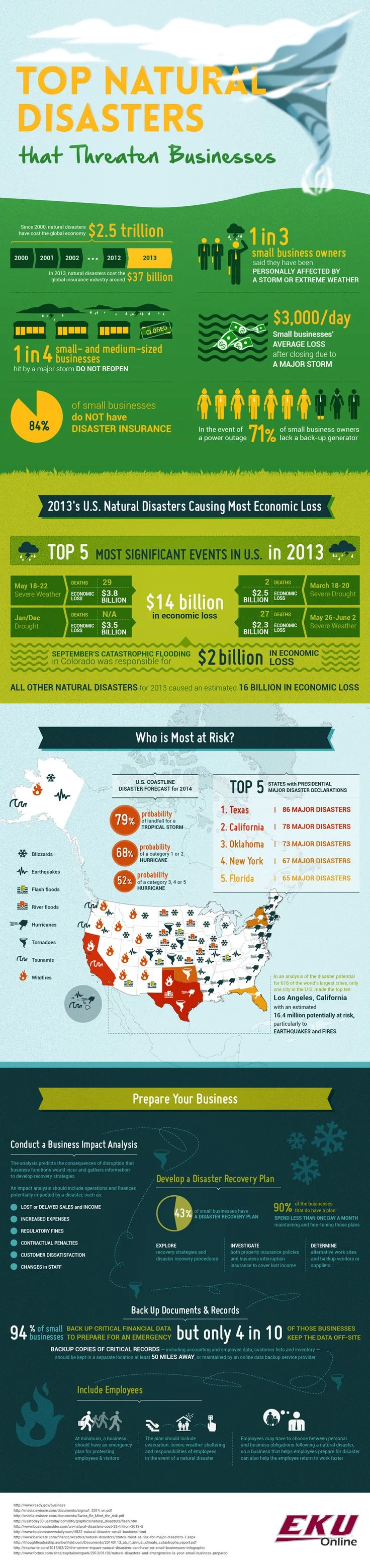
Are Disaster Infographics Still Cool? Useful?
It seems like every week or month, I get "the latest" disaster infographic in my inbox. Inforgraphics have become popular in recent years to communicate complicated topics and data. There are infographics on social media, types of hazards, impact to businesses, emergency management careers, etc. I keep a Pinterest board for these types of graphics (see below).
Because I am largely a curator of this information, not a consumer, I am not clear how infographics have helped the industry. Are disaster infographics useful? How have they helped? Are they effective? Have you used any in your work? If so, how?
Check out of a few of the infographics below and let me know what you think.
It seems like every week or month, I get "the latest" disaster infographic in my inbox. Inforgraphics have become popular in recent years to communicate complicated topics and data. There are infographics on social media, types of hazards, impact to businesses, emergency management careers, etc. I keep a Pinterest board for these types of graphics.
Many that I have seen, though, are actually marketing and recruiting tools for bachelors and masters emergency management programs. I am not opposed to this approach, but I am left wondering about the value of infographics these days.
Because I am largely a curator of this information, not a consumer, I am not clear how infographics have helped the industry. Are disaster infographics useful? How have they helped? Are they effective? Have you used any in your work? If so, how?
Check out of a few of the ones below.


Exercising Social Media - Review of and Q&A with EMSocialSimulation
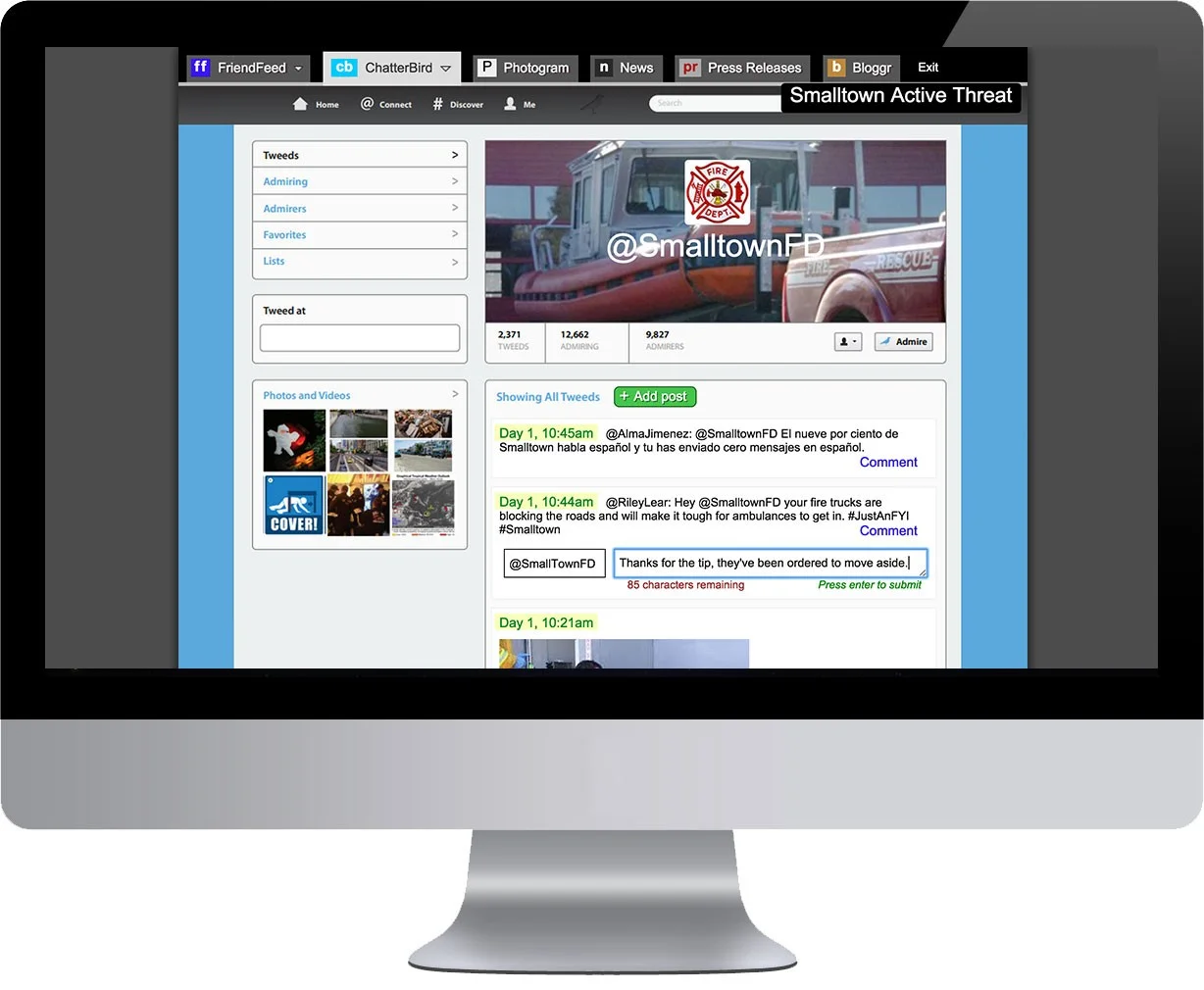
I was recently able to talk with both Corey Mulryan and Kyle McPhee from Hagerty Consulting, a well-known and fast growing emergency management consulting firm. Corey and Kyle have been leading an effort at Hagerty to develop a new social media exercise tool called EMSocialSimulation. This blog post contains a review of the tool as well as Hagerty's Q&A responses that provide additional information.
EMSocialSimulation is a great social media simulation tool geared toward organizations and jurisdictions looking to train and exercise on beginner to intermediate social media capabilities at an affordable price. I was impressed...
I was recently able to talk with both Corey Mulryan and Kyle McPhee from Hagerty Consulting, a well-known and fast growing emergency management consulting firm. Corey and Kyle have been leading an effort at Hagerty to develop a new social media exercise tool called EMSocialSimulation. This blog post contains a review of the tool as well as Hagerty's Q&A responses that provide additional information.
EMSocialSimulation is a great social media simulation tool geared toward organizations and jurisdictions looking to train and exercise on beginner to intermediate social media capabilities at an affordable price. I was impressed by how well the whittled down the feature set to not overwhelm users as well as exercise planners. This is perhaps a significant advantage over incumbents such SocialSimulator, Conductrr, Polpeo and SimulationDeck that offer more advanced features and controls, but can easily become overwhelming to a novice social media organization.
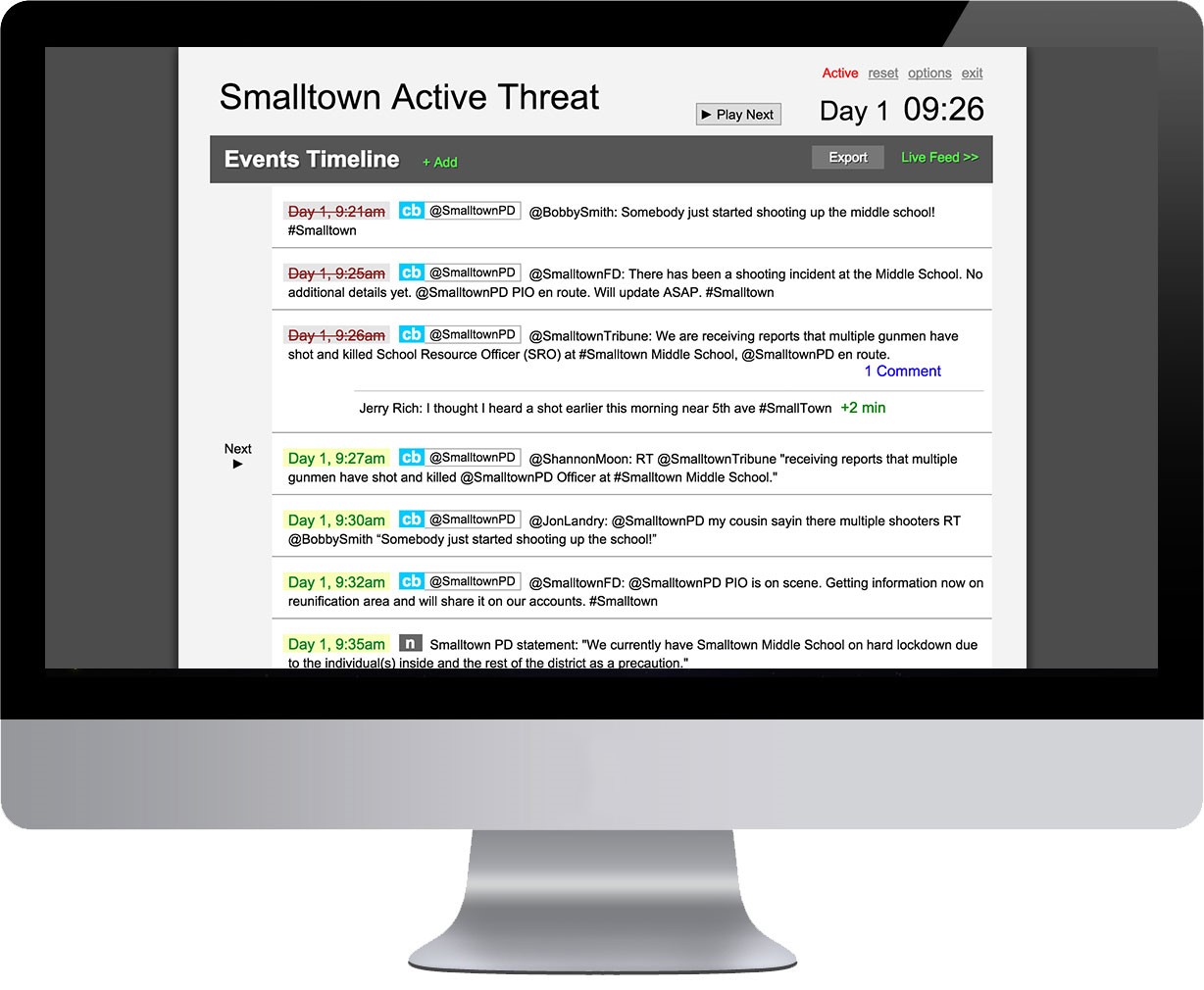
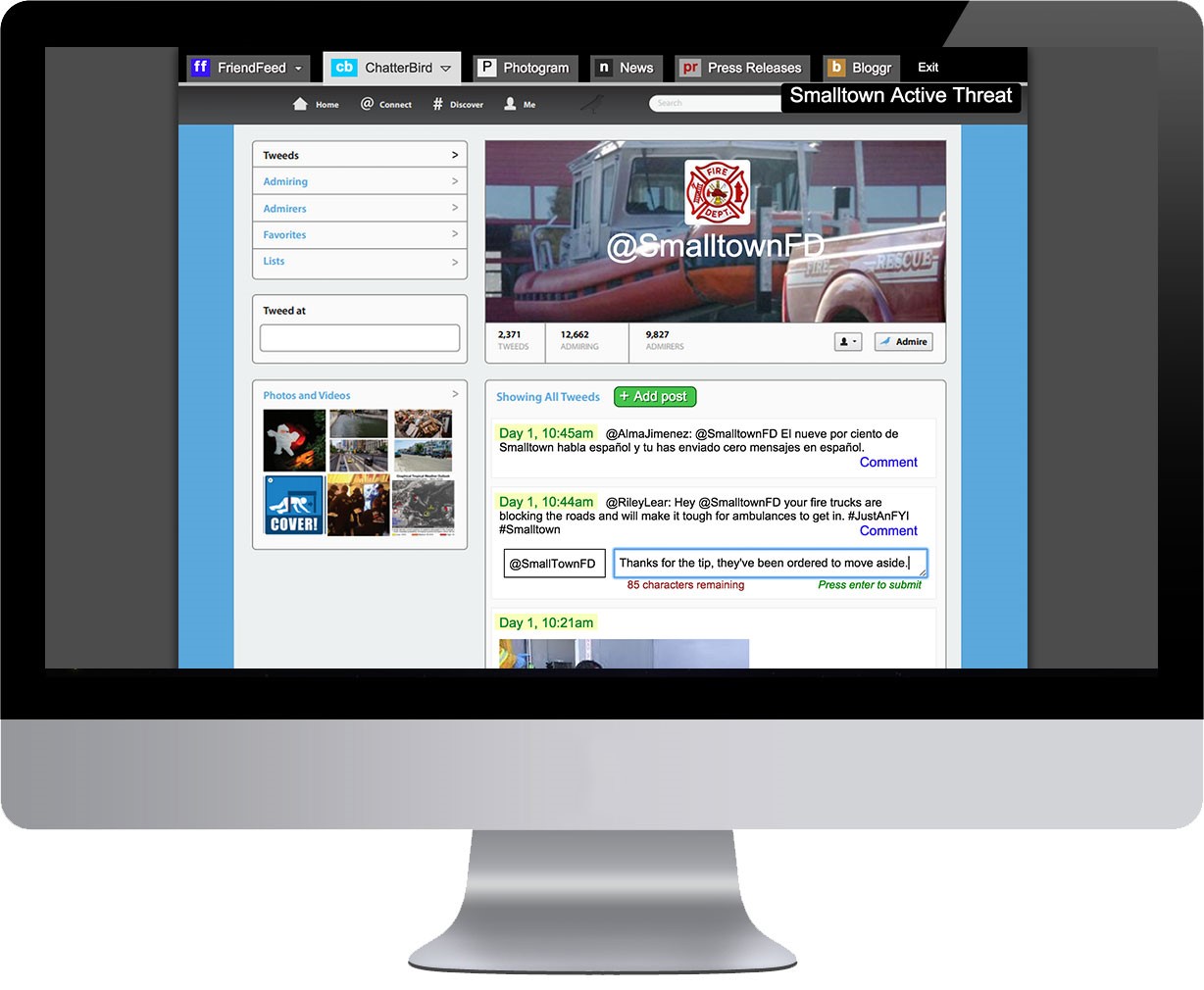
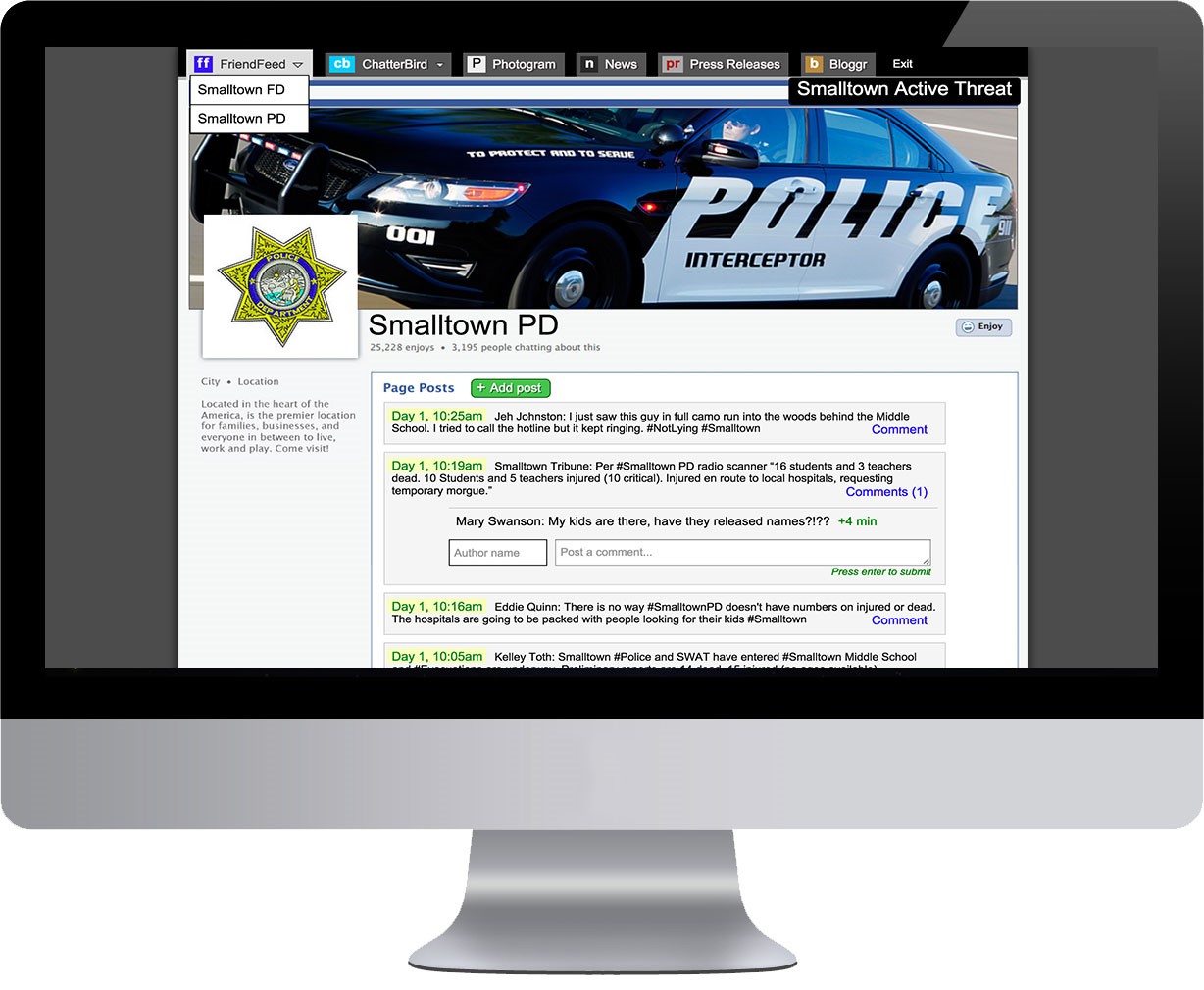
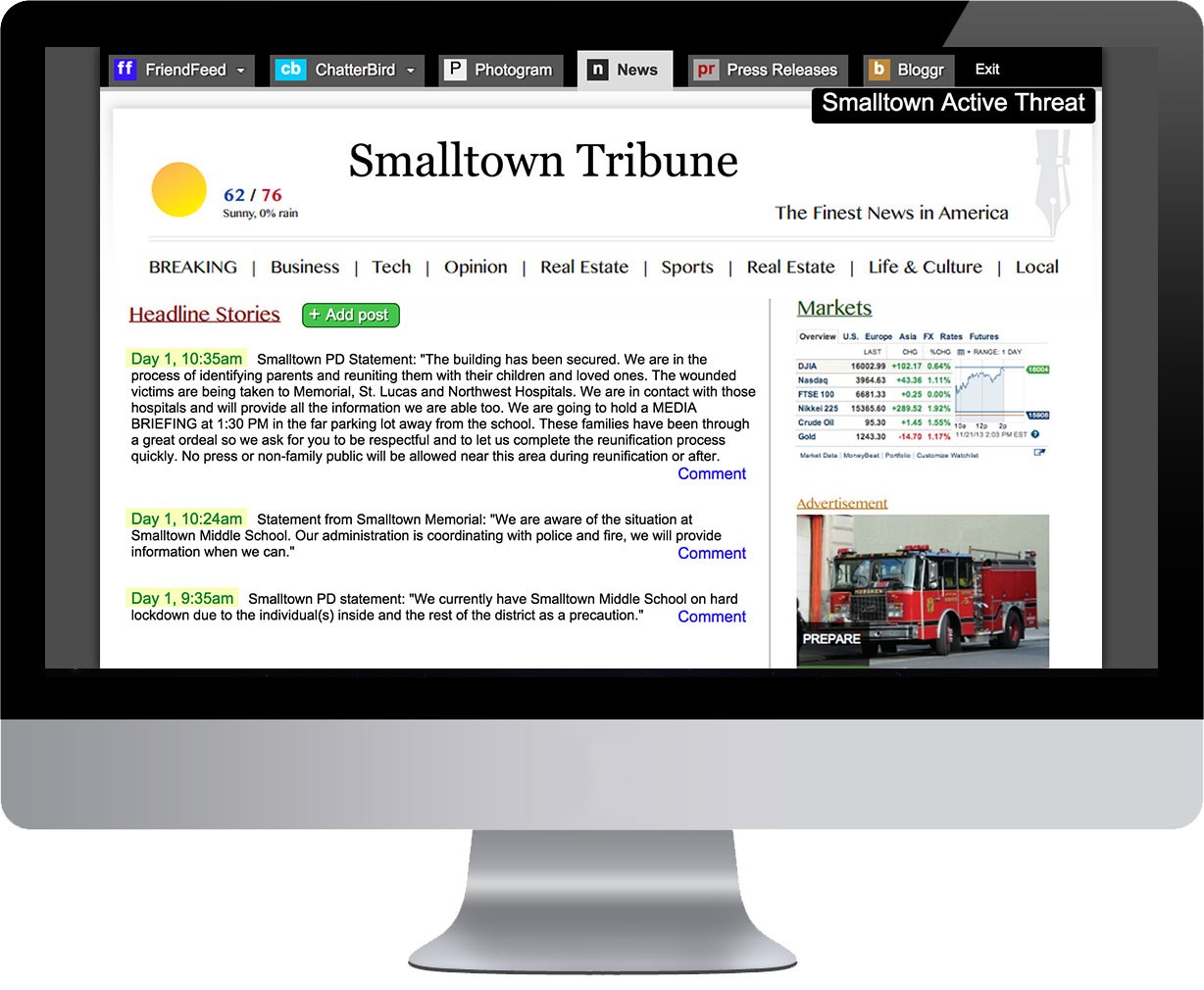
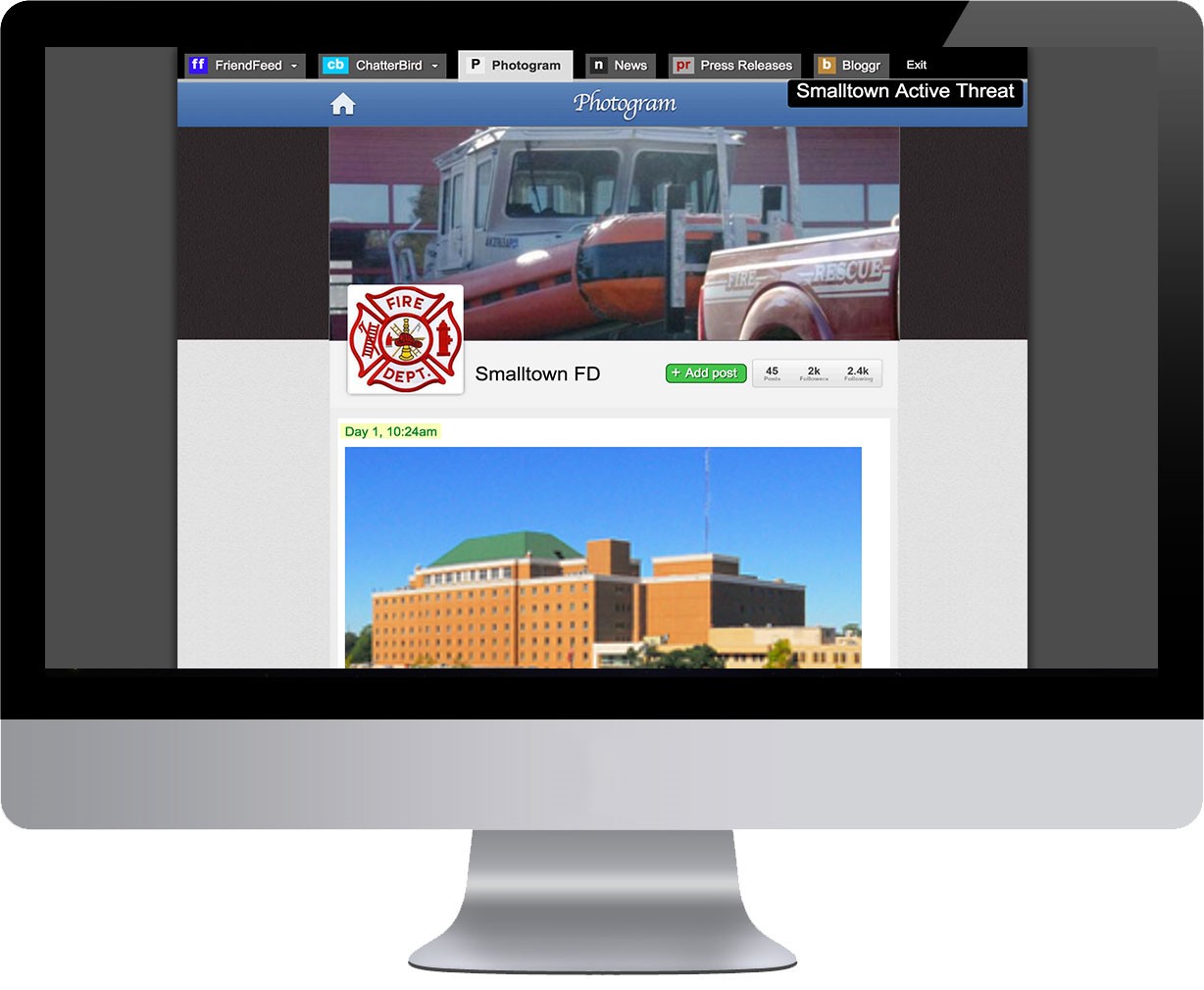
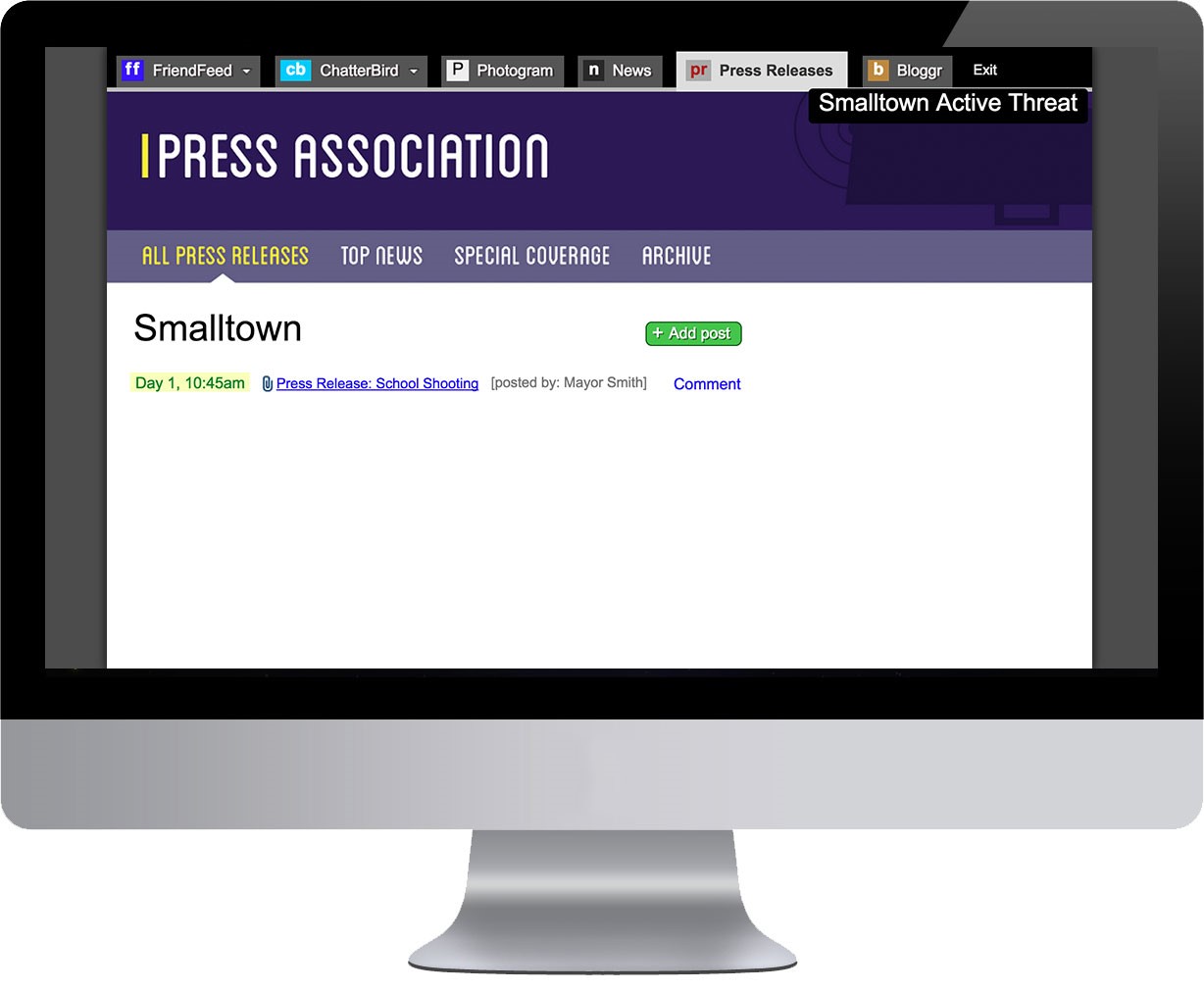
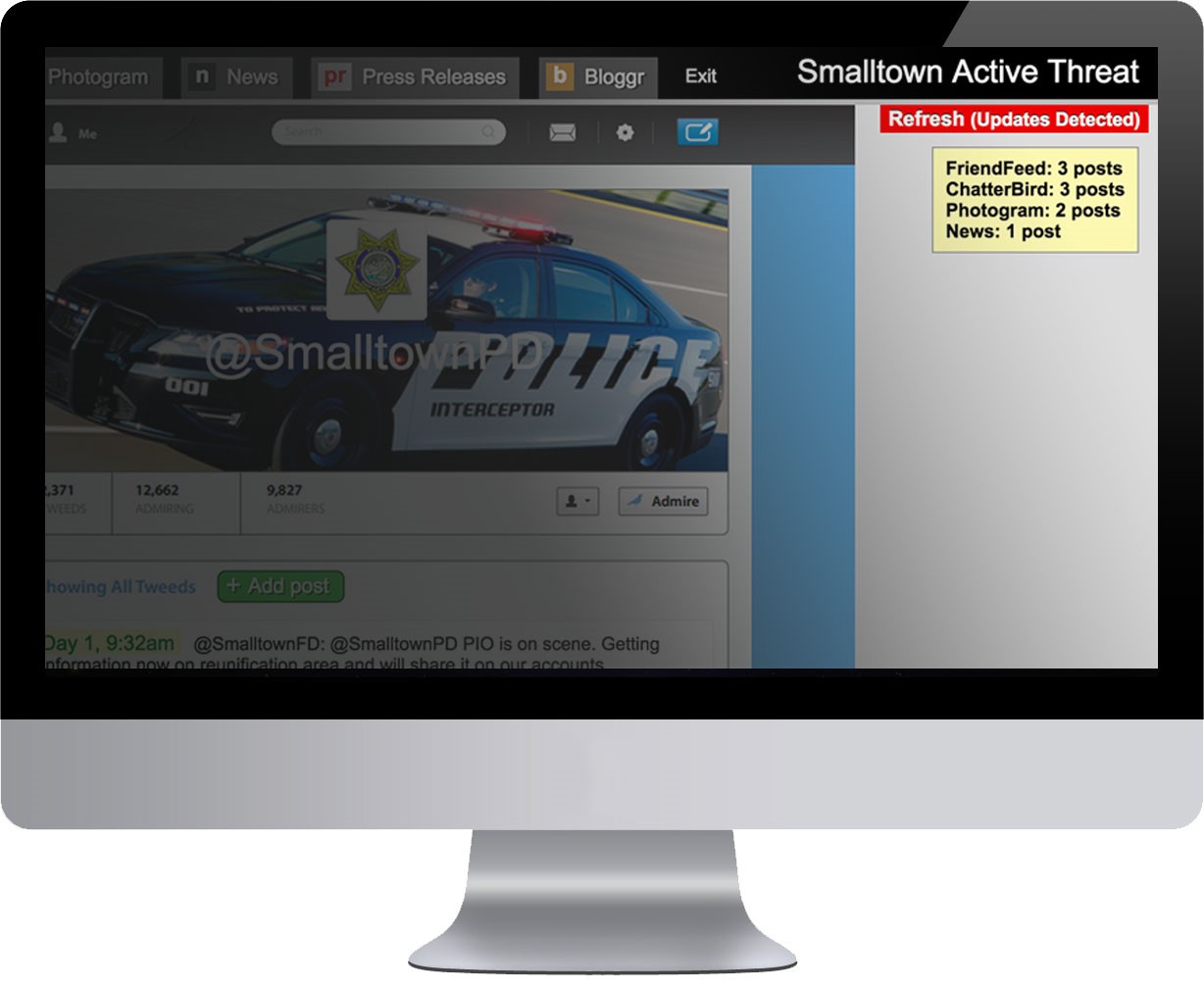
If you want to test different types of social media accounts such as all the Twitter accounts in your jurisdiction, EMSocialSimulation makes it easy to create multiple accounts on each simulated social media platform. It has accounts for FriendFeed (Facebook), ChatterBird (Twitter), Photogram (Instagram), News (Simulated Media Posts), and Press Releases.
Many of you in the public sector may be asking if the tool is aligned with HSEEP as you may be required to follow this methodology. Because EMSocialSimulation is just a simulation platform (not a methodology), this is the wrong question to be asking. EMSocialSimulation merely helps you execute HSEEP designed and developed exercises or other types of exercises related to social media. As such, it is aligned with HSEEP, but is certainly not an HSEEP methodology tool. You would plan an exercise just like you would normally and then use EMSocialSimulation to simulate the social media capabilities under the Public Information / Public Affairs emergency support function.
Hagerty has mostly been using EMSocialSimulation to support their existing clients and as a result is not as self-service oriented I would have liked to see it, especially as it has been in use for over twelve months. For example, you still have to go through a sales process with them and have them bulk upload injects, unless you want to do each one by hand. They also have inject templates available and are creating more for different hazards and scenarios; but again, you must still go through your Simulation Coordinator in order for these templates to be accessed and uploaded.
The video below walks you through EMSocialSimulation as well as Hagerty's social media exercise design and development process.
I am excited to see, though, that they allow the export of all simulation data for analysis. Most of the data can be analyzed by someone with some basic Excel data and analytic skills. However, Hagerty will also provide this type of analysis as a service. One data point they capture that might be useful is the response time between when a message was posted vs. responded to. This can help you identify if response times are within your guidelines or help you determine if there was a problem with the social media response timing as a whole.
Overall, I would recommend this tool to organizations and jurisdictions just beginning their foray into social media messaging and response. I would not say this is your Cadillac platform for social media simulation and it won't scale to thousands of tweets easily. But it should suffice and be all that is needed for many in the emergency management community. Just don't be scared off by the design of the tool looking like it was built in 2005. It still has the power you need it to have.
In the comments below, I would interested in knowing your social media training and exercise challenges? What has been your experience with other tools?
I also asked Corey to answer some additional background questions you might finding interesting:
What is your name and role in the Organization?
My name is Corey Mulryan and I am the Simulation Coordinator and simulation content developer for EMSocialSimulation (EMSS). I work with clients to develop the simulation, and if needed, help run the application on the day of the exercise.
What does your tool do?
EMSS helps users practice the use of social media in a realistic, safe, and secure environment. EMSS helps identify gaps in plans and operational structures where internal policies and procedures. Finally, EMSS is scalable, which results in cost effectiveness and customization.
What/who inspired you to create this?
Social media is here to stay and its role in emergency management has become a matter of expectation, not the exception. As an example, a client of ours asked if there was a way that we could incorporate social media into their exercise. We questioned our typical response and that sparked the innovation. We researched current solutions and found that they were not meeting the need. Some examples observed included low tech options like sending a fax or email with simulated social media messages or creating private accounts on live systems, but that is not realistic and is risky, not to mention a lot of work for our clients. Other high tech solutions seemed overdone, expensive, and outside of clients reach.
The Hagerty team started discussing social media and that its inclusion should be the standard, the same way we don’t think twice about following or including Homeland Security Exercise Evaluation Program (HSEEP) in every exercise. We wanted to provide our clients with an opportunity to practice social media, familiarize themselves with process and approach, and see how social media could be incorporated into what they do during normal operations and response.
What challenge does your tool help customers overcome?
Emergency Managers and first responders know they should be using social media. The University of San Francisco’s 2013 study on using social media identified that “80% of Americans expect emergency response agencies to monitor and respond on social media platforms, additionally, 33% expect help to show up within just 60 minutes of a post.”
Those numbers are a wake-up call. A public expectation has been established and EMSS helps meet this challenge by training staff and demonstrating to management the benefits of using social media in disaster response. During Hurricane Sandy, “the American Red Cross had 23 staffers monitor over 2.5M Sandy-related social media posts.” Agencies cannot hope that one person will be able to handle social media alone, EMSS allows them to cross train multiple staff members to build knowledge and trust within an agency. EMSS allows players to remain engaged during a longer exercise with a steady flow of information that we try to keep interesting.
How does it do this?
EMSS hosts replicas of common social media platforms that can be customized based on the objectives of the engagement. Players are able to make posts and comment in a way that looks and feels real. Of course, all of this is controlled in a secure environment by the Simulation Controller. EMSS does not link to any social media platforms so there is zero chance that any messages sent or posted during a simulation will end up on an agency’s actual accounts. The Simulation Controller will develop injects to test various responses from the players. This can be issuing information, responding to requests, monitoring traffic, or anything else. The Simulation Controller will then upload injects in accordance with the exercise timeline and be able to respond to players in real time. After the simulation is complete, the Simulation Controller can export the data to an After-Action Report/Improvement Plan.
What is next for the tool?
This tool can really help people, we have seen it firsthand. We want to continue to help users experience social media in their training and exercise endeavors, and to bring the whole concept to life. We want this to foster the development of internal procedures and integration of social media into communications standards. We want to continue this process and work to better identify how social media is used to monitor situations, communicate with residents and stakeholders, share information, and reach the whole community. EMSS has been used geographically across the country, with events ranging from a tabletop to a full-scale exercise. This tool is available for an affordable price and can include multiple stakeholders or formats, such as training, exercise, or simulation.
How can people get in touch, learn more or test the tool?
If anyone is interested in EMSS they can go to our website for more information www.emsocialsimulation.com. On the website they can fill out the contact us form at the bottom or send an email directly to emsocialsim@hagertyconsulting.com. We will quickly respond and schedule a demo and discuss the application.

The Different Types of Technology for Disaster
A couple weeks ago I presented yet again on technology trends for disaster management. There seems to be a great demand to understand the technology landscape, namely what is out there. I am glad to see this interest and want to share the work I have done.
This week, I decided to create a dedicated webpage that will highlight the different technologies available. I will continue to add new technologies as I come across them! Feel free to send any leads you may have!
Also, check out the webinar I gave a couple weeks ago on Technology Trends in Disaster Management. Due to a technical glitch, the recording started a few minutes in...
A couple weeks ago I presented yet again on technology trends for disaster management. There seems to be a great demand to understand the technology landscape, namely what is out there. I am glad to see this interest and want to share the work I have done.
This week, I decided to create a dedicated webpage that will highlight the different technologies available. I will continue to add new technologies as I come across them! Feel free to send any leads you may have!
Also, check out the webinar I gave a couple weeks ago on Technology Trends in Disaster Management. Due to a technical glitch, the recording started a few minutes in...

Disaster Technology is Built All Wrong
Technology is a great asset for organizations. It facilitates communications and helps simplify complex tasks. This is great when you have complete or majority control of your operating environment, which is common in business and day-to-day operations.
The problem in disaster response, though, is that unique and temporary organizational structures (e.g., ICS, JFO, ESF, etc.) form during a disaster that differ significantly from day-to-day operational structures. And roles within these temporary structures are filled by various people at different times, some professional and some volunteer.
For example,
Technology is a great asset for organizations. It facilitates communications and helps simplify complex tasks. This is great when you have complete or majority control of your operating environment, which is common in business and day-to-day operations.
The problem in disaster response, though, is that unique and temporary organizational structures (e.g., ICS, JFO, ESF, etc.) form during a disaster that differ significantly from day-to-day operational structures. And roles within these temporary structures are filled by various people at different times, some professional and some volunteer.
For example, a Public Health Analyst at the Public Health Department may move to ESF-8 Lead in the County EOC for Shift A, which has a different operational structure from the Analyst's day-to-day job. And another Analyst from the Hospital Association will likely support ESF-8 during Shift B. Now the analyst is part of two different organizational structures (employment and response) with separate technologies for communicating and fulfilling functional responsibilities.
But many technologies on the market today are developed for and sold directly to single organizations for their given missions and responsibilities. Little attention is paid to when the Public Health Department needs to collaborate with and share data with Law Enforcement or vice versa. Significant time and effort ends up being spent on reconciling information inconsistencies between systems as well as ensuring one has the most up-to-date information...by hand.
Or, these technical systems end up being back-hacked for a fee to the vendors or consultants. However, "back-hack" connections are mere patches to larger information sharing problems. They may solve your immediate information sharing problem, but not the systemic problems. This is critical in disasters where many different organizations need to work together as one or in coordination with each other.
My main argument is that technology products in the disaster response industry are geared toward a single enterprise deployment. This is not representative of the way disaster responses are managed or coordinated. The next generation of technology needs to recognize that it needs to serve both organizational AND inter-organizational information needs with relative ease and reliability.
In addition, in looking to the immediate future, technology needs to incorporate citizen participation in disaster response in practical and process-reducing ways. The public are key assets to response that are underutilized in part because technologies don't address the additional process burdens that naturally occur with managing and coordinating volunteers and using information from the public. I see way too many analytic and visualization tools that give little thought to how the information can be collected and leveraged in a compressed time frame in a way that adds value to the response.
Technology of the future needs to give more thought to how it captures organizational affiliations while still enabling inter-organizational and citizen collaboration in less process-intensive ways (e.g., not having to administrate five different systems with different sets of users).
What do you think? What are you gripes with buying and administrating new technology?

Talking Tech, #SMEM & Nepal with the Dukes of Hazards
On Tuesday, May 5th, I had the pleasure of being interviewed by Mitch and Andrew on their Dukes of Hazards Podcast. We talked about technology, social media, and the recent Nepal earthquake. You can listen to the full Podcast here:
The Dukes of Hazards Podcast is put on by two very funny guys, Mitch Stripling and Andrew McMahan. Mitch is the Assistant Commissioner for Agency Preparedness & Response at the New York City Department of Mental Health and Hygiene. Andrew is the Deputy Director of Emergency Operations Support for the NYC MTA (Metropolitan Transportation Authority).
On Tuesday, May 5th, I had the pleasure of joining Mitch and Andrew on their Dukes of Hazards Podcast. We talked about technology, social media, and the recent Nepal earthquake. You can listen to the full Podcast here:
The Dukes of Hazards Podcast is put on by two very fun guys, Mitch Stripling and Andrew McMahan. Mitch is the Assistant Commissioner for Agency Preparedness & Response at the New York City Department of Mental Health and Hygiene. Andrew is the Deputy Director of Emergency Operations Support for the NYC MTA (Metropolitan Transportation Authority).
Mitch + Andrew drink Shandies and break down all things tech+disaster w/ Brandon Greenberg of @disasternet. Avocado? http://t.co/QfYb8ZXpah
— Dukes of Hazards (@hazardspodcast) May 6, 2015![How Disaster "Mesh" Networks Provide Critical Value in Disasters [A Primer]](https://images.squarespace-cdn.com/content/v1/53a9cfb7e4b0ac3522f6060f/1430856341703-0VM0M4Y450TF0C11NOTY/image-asset.jpeg)
How Disaster "Mesh" Networks Provide Critical Value in Disasters [A Primer]
Mesh networks have been around since the Department of Defense starting playing around with the idea of exchanging data and information in remote and infrastructure-compromised locations. In recent years, mesh networks have been applied to disaster operations to enable the exchange of data and information regardless of Internet access.
However, mesh networks are quite technical to setup and use. A non-profit and open source technology called LDLN makes this a lot less technical so nearly anyone with some basic tech skills can set up and use a mesh network. Before I dive into how LDLN does this, I want to provide a primer on mesh networks, how they work, and the problems they solve.
A couple weeks ago, I published a post extolling the virtues of a nonprofit and open source technology called LDLN. I wanted to highlight the importance of such an endeavor, which is more than most people realize.
After publishing the post, a colleague and long-time emergency manager I greatly respect replied to me, "Whereas I love the fact that you bring new technology to the forefront of disaster management, I often find myself not really understanding what exactly is being discussed. The average non techy emergency manager like myself, who may want to further explore options like LDLN, needs to have an example of its use in the hospital or other environment that is concrete and that can put the technology in prospective."
In reflecting on this, I could have done a better job explaining the problem and how mesh networks such as LDLN play a critical role. This is a complicated but important subject that I want to make sure people understand. So I decided to write another post explaining mesh networks and the value of LDLN.
Mesh networks have been around since the Department of Defense starting playing around with the idea of exchanging data and information in remote and infrastructure-compromised locations. In recent years, mesh networks have been applied to disaster operations to enable the exchange of data and information regardless of Internet access.
However, mesh networks are quite technical to setup and use. A nonprofit and open source technology called LDLN makes this a lot less technical so nearly anyone with some basic tech skills can set up and use a mesh network. Before I dive into how LDLN does this, I want to provide a primer on mesh networks, how they work, and the problems they solve.
The Relationships Betwen Networks, Servers, Routers and the Internet
Let's talk networks, servers, routers and the Internet in a very over-simplified way. Servers are basically supped up computers that can manage the storage of and access to data and information. In some ways, your personal computers access as a server, but when I say server I am talking of machines whose sole purpose is to store and manage access to its data and information. You know that share drive you have access to at work? It is hosted on a server. You know that application that you have access to on the web or only when you are at work? It is hosted on a server. Servers host and store applications with their associated data and information.
In order to access the applications as well as data and information, servers are connected to networks, both wired and wireless. Think of your home network where you can connect your computer, mobile phone, tablet, etc. (also called a "client" in tech terms) via an Ethernet cable or via WiFi. Corporate networks are principally the same, but a bit more complicated in practice. What you need to know is that networks connect you to servers. You rely on this access almost 90% of the time, though you may not realize it. Connecting to your employers wireless network creates an unspoken relationship between your personal computing device and the servers. Outlook is a classic example where the application and the data and information can live on your computer, but all that information is backed up and synced to servers operated by your organization or a third-party vendor.
Now what happens when multiple networks exist or you have to keep an network up across a wide geographic area? It is not so simple for the application with its data and information on your computer to find the relevant server that it needs to sync with. To help direct this digital traffic are routers. The professionals who typically manage this traffic for organizations are called "network engineers." You are an amateur network engineer when you set up your home wireless router, which helps you print to your printer wireless and connect to the Internet. Routers operate in the background to help manage the digital relationship between your computer and servers, printers, the Internet, etc. Routers are especially important when you have many computers and devices on a network that need to exchange data and information. Otherwise, the network would be overloaded and no one would be able to access the servers.
The Internet is like a meta-network that gives you access to the outside world. Many web-based applications live on servers hosted by vendors (or third-party data centers), but are accessible via the Internet because they allow such access. When it comes to Internet access, though, you may have access to your servers via your network, but unless the network is connected to the Internet, you will not be able to access anything external such as web-based applications. For example, you can input patient records into your computer, but you won't be able to access TMZ.com to get the latest dish on Kardashians. So you need to remember that network access and Internet access are related, but separate. You can have network access without Internet access, but not the other way around.
If you don't understand what networks, servers, and routers are and how they work together, the following may be a little harder, but not impossible to follow.
Options for Accessing and Syncing Data and Information
In disasters (and in most of the world), their are generally two ways to exchange data and information no matter what applications you use: 1) a private network, and 2) or the Internet.
Private Network. Before the Internet was a thing, this is where organizations focused their efforts. Organizations set up their own servers, networks and routers at their employment locations to ensure employees have access to and could exchange data and information. All applications along with their data and information remained in complete control of the company and separate from the Internet.
In modern times, a private network plays an important role in data security and control by being able to create a digital wall around data and information (does "firewall" ring a bell?). As you can image, when such an ecoystem is set up with the goal of keeping information in, trying to share data and information across networks becomes extremely challenging. Virtualization and VPNs help mitigate these challenges, but are not perfect and can create some critical and complicated interdependencies. Disaster recovery managers (the IT-focused kind) help plan for and manage these interdependencies so they do not impact operations.
The Internet. The Internet acts much like the networks mentioned above, but in a more public way. Servers are still there and routers help manage the digital traffic in the meta-network called the Internet. The exchange of data and information across the meta-network becomes significantly easier as their are less geographic restrictions. However, using the Internet to exchange data and information creates an extremely critical interdependency. For example, many applications that we have come to love and enjoy on our phones or through our web browser are dependent on Internet access and consume a lot of bandwidth. No Internet means no exchange. Period.
The Problem. These are basically two terrible options for exchanging data and information in a disaster! You can either build applications that work on your private network or build them to work via the Internet. The former limits how far away you can exchange information or across networks, such as hospital-to-hospital or hospital to EOC, and requires the application live on a physical server in your network (e.g., bring a server to the disaster location). The latter creates a critical interdependency on Internet access, which can be a luxury in a disasters.
Mesh Networks in Disaster
Mesh networks allow for the sharing of data and information across wireless networks when no Internet is present. The "mesh" part comes because of the way these networks are typically deployed. A typical deployment model is to "daisy-chain" networks together in such a way that each network shares the data and information with the network it is next to, which then shares it to the next one, and the next one, etc. (think overlapping WiFi signals that link up to each other). And sometimes, if another network has Internet access, you may be able to get Internet access in your network. But the quality of wireless signal drops dramatically the further away you go. Setting up this type of environment is also very technical and difficult in practice!
LDLN and Mesh Networking
LDLN's software and hardware acts as a combined network, router and server. Instead of having to have data and information sync from your computer or mobile device to "the cloud" (servers accessed via the Internet) or internal servers (servers accessed only through your private network), LDLN becomes the best of both worlds. LDLN provides the technology that lets you physically move your phone or computer from one private network to another private network and seamlessly exchange data and information regardless of Internet access.
For example, you have information on your computer that was created while you were in your hospital's network. Now you moved to the municipal EOC that is on a different network, but neither network has Internet access to sync up data and information. With LDLN, as you move to the other network, your computer or mobile devices automatically uploads the data and information on your device to the hardware in that network.
That part is not exactly innovative. What happens next is more innovative:
- If other devices are on the new network, your data and information will automatically be synced to their devices and their data and information will automatically be synced to your devices (regardless of the Internet situation)
- If the new network is connected to the Internet, your data and information will also automatically be synced to the "cloud" for people in other networks to access and their data and information will automatically be synced to your devices.
- If your network is connected to other networks (called daisy-chaining), your data and information will also automatically be synced to those networks and all the devices in those connected networks.
In essence, LDLN has mastered issues that arise when syncing occur asynchronously and distributed across different networks and servers. It will not produce errors when all devices become synchronized with their own as well as each others data. This is huge. Many software solutions don't know what do with conflicting or asynchronous data and information, which causes lots of problems. The software can't reconcile what is the latest information or that it is the same information from different locations such as two receiving hospitals tracking patients.
Gmail handles data conflicts well, but still relies on the Internet for syncing. For example, I might run through my email on my mobile phone while on a plane with no WiFi. I archive some emails, star others, etc. Then I forget and compose an email in my tablet and archive some of the same emails. When I get to the ground, Gmail reconciles what I did on my phone as well as my tablet and doesn't produce any errors. But what if I was in the air with no Internet access and wanted my Gmail on my phone to sync with my Gmail on my tablet? LDLN solves this problem in a disaster environment.
LDLN's Value Proposition
The biggest value for LDLN is to be embedded in various applications, servers and routers. For example, during Hurricane Sandy, this technology could have been integrated with NYU's electronic health records system to share critical patient information stored on their servers with the other receiving hospitals. A person could have physically moved to one of the receiving hospital locations with his or her laptop that had the latest data and information automatically downloaded and synced. That person could have then have electronically shared health records with the receiving hospital. Simultaneously, that person could have kept track of who is at what hospital and have that information be automatically shared back to NYU emergency management personnel.
This is of course a hypothetical example that is over simplified. It merely demonstrates the power of LDLN. Issues such as technical integration, HIPAA and data security would still have to be navigated when setting up this technology. However, I think that can be worked out in the future.
Questions, comments, concerns? I would love any feedback you have on this topic and article.
![Public Health Emergency Canvassing Operations Planner [Job]](https://images.squarespace-cdn.com/content/v1/53a9cfb7e4b0ac3522f6060f/1430857574144-6GDE9ZB105I3FPRBM7DI/image-asset.jpeg)
Public Health Emergency Canvassing Operations Planner [Job]
A friend just forwarded me a great job opportunity in emergency health planning with the NYC Department of Health and Mental Hygiene. They are looking for Post-Emergency Canvassing Operation (PECO) Planner that has both health planning, management and data/tech skills.
This job is at the forefront public health emergency preparedness and I would encourage anyone who wants to be at the cutting edge of data in public health to apply for this position.
A friend just forwarded me a great job opportunity in emergency health planning with the NYC Department of Health and Mental Hygiene. They are looking for Post-Emergency Canvassing Operation (PECO) Planner that has both health planning, management and data/tech skills.
This job is at the forefront public health emergency preparedness and I would encourage anyone who wants to be at the cutting edge of data in public health to apply for this position.
Job Description
The New York City Department of Health and Mental Hygiene (DOHMH), an agency recognized worldwide for being a leader in public health and at the forefront of cutting-edge public health emergency planning initiatives, seeks a dynamic professional with excellent writing, project management, and facilitation skills, to serve as a PECO Planner within the Agency’s Office of Emergency Preparedness and Response (OEPR), Post Emergency Canvassing Operations project. The selected candidate will develop and maintain the operational plans relevant to the Post Emergency Canvassing Operations (PECO).
The Post-Emergency Canvassing Operation (PECO) project will be a process initiated after the impact from an event, depleting electric power, and/or heat, and/or water to over 5,000 households, lasting at least, or anticipated to occur for more than 48 hours. Such events can be the result from, but not limited to, heat waves, coastal storms, localized earthquakes, and water main breaks. The canvassing is an operation meant to rapidly survey newly vulnerable populations to determine critical needs such as water, food, power, and medical care. These needs will be referred to appropriate partners and the services the City provides post-emergency to individuals who are unable or who have difficulty, because of their disability, to access services that the City will coordinate. This canvassing operation is targeted at those who did not evacuate and may need assistance to maintain their independence in a post-disaster scenario.
This candidate should be able to:
- Coordinate with city agencies’ leadership to resolve policy issues regarding the canvassing of NYC residents, such as privacy, security, and language issues.
- Collect large quantities of data from disparate sources and perspectives and develop written reports, protocols, and process documents.
- Coordinate and request information from subject matter experts and city agencies.
- Serve as a liaison with city agencies on the development of planning materials related to PECO program.
- Coordinate with DOHMH’s Community Resilience Unit to create plan components that leverage capabilities of non-profit and community-based organizations to determine how they can best integrate with PECO .
- Conduct data analysis and research on best practices utilized in NYC canvassing efforts.
- Develop several operations tools, including operational checklists and job action sheets.
- Maintain testing/evaluation plans and associated corrective actions to ensure that plans continue to be viable, effective, and fulfill the needs of NYC
- Coordinate and oversee PECO Program plan contract deliverables with consultants and vendors.
Minimum Qual Requirements
1. A baccalaureate degree from an accredited college and five years of full-time professional satisfactory experience acquired within the last fifteen years, in a health services setting such as a laboratory, hospital, or other patient care facility, or in a public health, environmental health, or mental hygiene program, at least 18 months of which must have been in a managerial capacity, consisting of managerial experience clearly demonstrating the ability to perform difficult and responsible managerial work, requiring independent decision-making concerning program management, planning, allocation of resources, and the scheduling and assignment of work
2. Education and/or experience equivalent to "1" above. Education may be substituted for experience on the basis that each 30 graduate semester credits from an accredited college in hospital administration, public health, public administration, business administration, management or administration can be substituted for one year of non-managerial experience up to a maximum of 60 semester credits for two years. However, all candidates must have a minimum of a baccalaureate degree and 18 months of managerial experience as described in "1" above.
Preferred Skills
- Proven experience conducting emergency preparedness planning and implementation within an Incident Command System environment
- Exceptional communications and interpersonal skills
- Be able to coordinate a large number of projects simultaneously under pressure with very tight deadlines
- Strong writing skills and presentation skills
- Experience working with New York City Agencies is preferred.

Developing Accurate, Complete and Current Information is a BAD Idea
This quote comes from a seasoned emergency manager in a recent Emergency Management Magazine article. Simply said, I don't agree with this key point. This kind of thinking leads us down a very dangerous path as it builds up false expectations and breads unrealistic thinking.
"Accurate, complete, and current" information is a nice goal, but entirely impractical and unrealistic in reality. In a recent email listserv conversation, a number of very experienced information managers discussed the difficulty in simply keeping up with the flow of information during a disaster. Perhaps this can be better achieved
“Every single decision EOC responders make depends on accurate, complete and current situational awareness.”
This quote comes from a seasoned emergency manager in a recent Emergency Management Magazine article. Simply said, I don't agree with this key point. This kind of unilateral thinking leads us down a very dangerous path as it builds up false expectations and breads unrealistic thinking. To quote a colleague, "the mythical quest for perfect authoritative data can be paralyzing."
"Accurate, complete, and current" information is a nice goal, but is entirely impractical and unrealistic in reality. In a recent email listserv conversation regarding the Nepal earthquake, a number of very experienced information managers discussed the difficulty in simply keeping up with the flow of information during a disaster. Perhaps this can be better achieved in the future, but in current practice it is near impossible to manage and achieve, even before a disaster.
The more important aspect of this is to understand HOW accurate, complete and current the information is. For example, if you know information is two hours old, you can assess the value of it for your own decision making. When you receive information, you should know who it is from, how old it is, and what is addresses. This "meta-information" is critical for good SA/COP and is actually quite informative for a decision maker. Granted the information is not ideal, but one can make a more educated decision based on his or her own assessment of the data or information.
Plus, you can spend an inordinate amount of time trying to gather accurate, complete and current information. This can produce a effort-to-outcome imbalance where you spend more time gathering and organizing less valuable information. Time can be better spent on working with the information you have, regardless of its condition, which can be more valuable for decision making and action taking during a disaster.
Also, while I agree with the author's points about thinking through the process for gathering and disseminating SA, the existing processes for developing information requirements are equivalent to throwing a dart at a dartboard blindfolded. While you were pointed in the right direction to begin with, you still have no idea where you are aiming. The result is a set of information put into SA/COP, but not understanding of its relative value across responders and different disasters.
In fact, the decision approach to identifying information requirements gives a false sense of security as you only define information requires you may face and can identify ahead of time. There are usually a host of unanticipated critical decisions the need to be made during a disaster. Developing information requirements is arguably more important for the unanticipated decisions.
![Academic Research on Disaster Communications Technology [Survey]](https://images.squarespace-cdn.com/content/v1/53a9cfb7e4b0ac3522f6060f/1430240319094-98QFFBMEWAJQ0DR0Z22K/image-asset.jpeg)
Academic Research on Disaster Communications Technology [Survey]
Two great universities, the MIT Lincoln Laboratory and the Pennsylvania State University’s College of Engineering, are coming together to do some much needed research on disaster communications technology. I am very pleased to see this type of research taking place and hope you can participate by completing this survey.
The researchers are looking for all levels of practitioners involved in emergencies or disasters (e.g., DoD, DHS, Public Safety, private industry, etc.). The survey has 25 questions and should take about 15 minutes.
Two great universities, the MIT Lincoln Laboratory and the Pennsylvania State University’s College of Engineering, are coming together to do some much needed research on disaster communications technology. I am very pleased to see this type of research taking place and hope you can participate by completing this survey.
The researchers are looking for all levels of practitioners involved in emergencies or disasters (e.g., DoD, DHS, Public Safety, private industry, etc.). The survey has 25 questions and should take about 15 minutes.
“The purpose of this research study is to explore emergency response tasks, equipment and incident management operations. The responses collected will be vital to improving communication technologies and addressing future incident challenges more effectively.”
They are also exploring the relationship between traditional Public Safety (i.e. Fire, Law, EMS) communication and information usage / needs in the Utilities sector (i.e. Refineries, etc.).
Here is the full link to the survey: https://pennstate.qualtrics.com/jfe/form/SV_a2CczrRQPpObbrD