
Data and Info Sharing with No Power or Internet? - Meet LDLN
There is an organization that I have wanted to introduce people to for a while. It is a game changer, provided it can be applied more and baked into operations and various technologies.
In disaster operations, the Internet is the predominate way to share data and information across people, organizations, and geographies--when it is available. It is a critical failure point to inter-organizational and region-wide operations that need to share across wireless networks. When access to the Internet is compromised, cascading effects occur such as having to reconcile what the latest data and information is. In fact, data and information sharing is often reduced to files on USB sticks that are physically traded. Version control becomes essential, but hard to maintain.
There is an organization that I have wanted to introduce people to for a while. It is a game changer, provided it can be applied more and baked into operations and various technologies.
In disaster operations, the Internet is the predominate way to share data and information across people, organizations, and geographies--when it is available. It is a critical failure point to inter-organizational and region-wide operations that need to share across wireless networks. When access to the Internet is compromised, cascading effects occur such as having to reconcile what the latest data and information is. In fact, data and information sharing is often reduced to files on USB sticks that are physically traded. Version control becomes essential, but hard to maintain.
LDLN
LDLN (pronounced "landline") is a robust open source mesh network that goes beyond network reliability issues for connecting to the Internet. LDLN combines the best of sync technology to enable data and information sharing with or without Internet across networks, organizations and geographic areas. Most importantly, this is all done without duplicating content or complicating reconciliation efforts. Simply said, it is designed to just work without the need for constant management and oversight. Pretty cool, huh?
Normally, I would limit conversation of this type of technology to the techies among us who work to maintain network operations. But I believe everyone should be aware of its existence and capabilities to inform strategic and operational thinking before and during disasters. There are two key components to LDLN's potential success, it's software and it's hardware. These two aspects are are discussed below in the Q&A with LDLN's founders.
This technology is not a far cry from Ushahidi's BRCK, which is a small all-in-one portable router (wired and wireless), server, and multi-modal Internet connection device with a long-lasting battery back-up. However, BRCK's focus is on single-point data and information exchange while LDLN allows the carrying of data and information on any device to another access point, which then automatically shares the most current data and information with all devices connected to the new access point.

BRCK and LDLN are complementary technologies that enhance each other's value proposition. LDLN could potentially be implemented on BRCK as well as any other hardware such as existing servers and routers. The hardware, though, does not need to be limited to the RaspberryPi devices mentioned below. While these possibilities are not yet in LDLN's current product, they could be a next step for them.
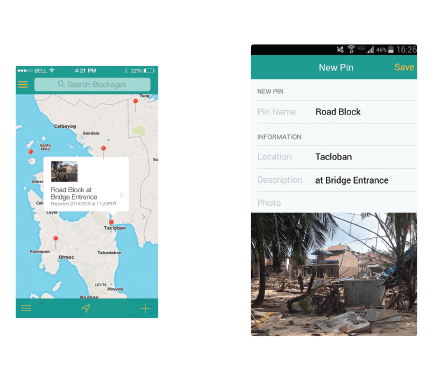
I am glad LDLN was able to respond to my Q&A request. Check out the entire Q&A below, which includes pictures of LDLN's software.
LDLN Question & Answer
What is your name and role in the product/solution/company?
- Matt Grasser - CEO
- Emily Duong - CCO
- Sam Krueckeberg - Engineering Lead
- Arthur Chen - Chief Legal Counsel
- Joyce De Vera - Head of Marketing
- Nick Ihm - CTO
- Christopher Guess - COO
- Kristine Austria Sanchez - Designer
What does LDLN do?
LDLN is a communications system for disaster relief organizations when there is no power, internet or wireless connectivity. LDLN allows organizations currently reliant on notebooks and pencils to have a fully synced, fully backed up, reliable communications system over any size of operation theater.
What/who inspired you to create LDLN?
We were inspired by our team members’ experiences across the world. Chris first conceived of the idea while working with Occupy Sandy during the Hurricane Sandy response, and suggested it up as an idea at a Philippines resilience hackathon. From there the team pooled ideas and skills to create a system responders would want to, and easily be able to use in the field with minimal training.
What challenge does LDLN help users overcome?
When a disaster relief organization deploys to the field in 2015, they are for the most part still equipped with the same tools that were available in 1991. Every major tool and recovery method used today currently relies on two things that are, to put it mildly, in short supply: electricity and internet connectivity. In absence of connectivity, relief workers fall back to the stalwarts of pads of paper and pencils.
In short, we provide the software and hardware necessary to form a modern backbone for communications and document synchronization. This resilient, decentralized, "designed-for-disasters" network does not depend on cellular technology, Internet connectivity, satellite up-links, or even an external power grid where others would.
How does it do this?
The LDLN Base Station, a tiny computer about the size of a deck of cards, combines the networking features of a traditional decentralized mesh network node with the reliability and storage capabilities of a traditional web server. Standing in stark contrast to expensive, bulky, custom-built satellite trucks and enterprise solutions, the Base Station is inexpensive, extremely portable, and consists of open hardware.
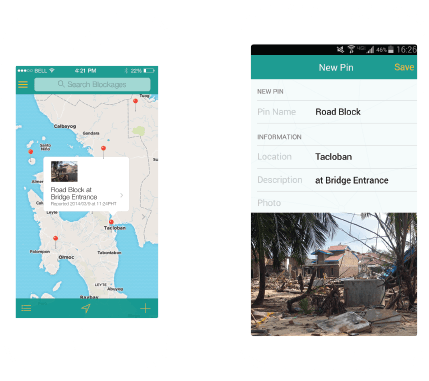
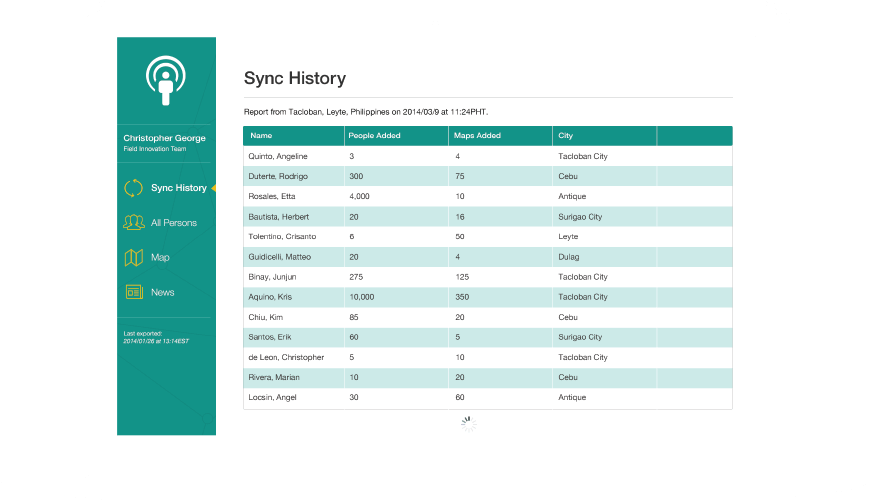
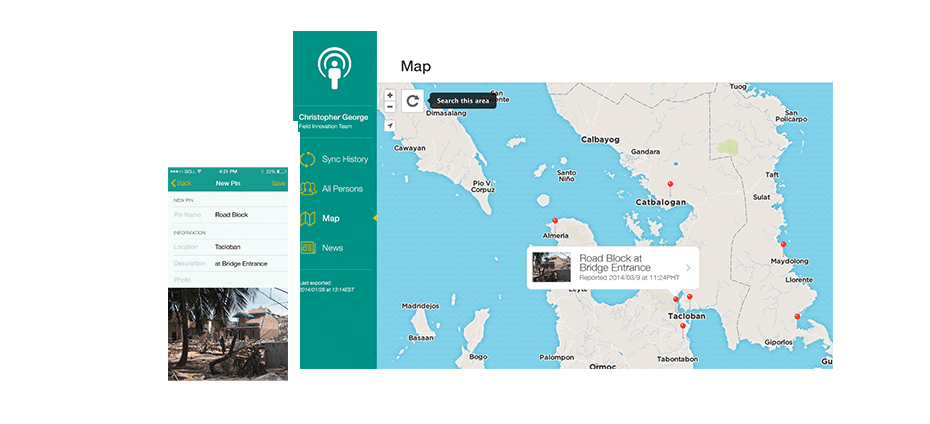
Building on this network of Base Stations, mobile apps powered by LDLN's SDK afford the familiar interfaces of a modern mobile experience, using of peer-to-peer protocols to skirt the need for a centralized network. Apps and Base Stations work in harmony to push and pull pieces of encrypted data across the network, ultimately displaying information in a natural and easy-to-read format.
What is next for LDLN?
LDLN is very proud to be have accepted into The GovLab Academy Coaching Program at New York University for the spring of 2015. We are looking forward to engaging with thought leaders and experts in the fields of disaster relief and government action.
In parallel, LDLN is currently developing our second generation of base station and mobile technology. This will allow in-the-field customization of the data collected and reported along with massive speed improvements on the base station side.
How can people get in touch, learn more or test LDLN?
Anyone interested can get in touch with our team through our website or social media, or via email.
- Website: http://www.ldln.co
- Facebook: https://www.facebook.com/ldln.co
- Twitter: https://twitter.com/landlineph
- Email: info@ldln.co
Since our software is open source you can also take a look at the code at our Github site: https://github.com/LDLN/

LaunchPAD - A New Exercise Delivery Tool + Q&A with the Founder
I was recently able to sit down with Robert Burton, Founder and Managing Director of Preparedex, LLC. The company recently launched a virtual exercise delivery platform called LaunchPAD. There are very limited technology options to support preparedness exercises, so I was very excited to learn more about LaunchPAD, especially given my background putting together large-scale exercises for almost four years.
LaunchPAD hones in on a very important issue, geographically...
I was recently able to sit down with Robert Burton, Founder and Managing Director of Preparedex, LLC. The company recently launched a virtual exercise delivery platform called LaunchPAD. There are very limited technology options to support preparedness exercises, so I was very excited to learn more about LaunchPAD, especially given my background putting together large-scale exercises for almost four years.
LaunchPAD hones in on a very important issue, geographically distributed exercises that are hard to coordinate and execute. With this in mind, they have developed LaunchPAD with a "virtual" focus in mind. The platform will deliver a pre-developed scenario (along with appropriate injects and events) to a virtual audience anywhere in the world. In this way, various distributed teams can work together toward the common goal(s) of the preparedness exercise. This can be more cost-effective for each exercise and be more realistic when teams are not all operating out of the same location. If you are interested in the platform, you will probably find a solution that isn't very robust, but does solve this very important problem.

Also, because HSEEP is a flexible exercise design and development approach, I think this platform would likely fit within the policy doctrine for different types of drills, tabletop and functional exercises. LaunchPAD is designed to help you with both exercise delivery and running an exercise program with many exercises each year. Right now, Preparedex is focusing on building a good system rather meeting doctrinal requirements, though. This may be a plus in the long run and enhance learning and evaluation.
The platform is fairly user friendly and they have some new features they want to release in the next year, including self-service for scenario and inject import and product registration/sign-up. However, because the platform just launched, it is light on native features. In the mean time, they provide a variety of exercise consulting and support services to enhance the platform. They are also planning to create an affiliate program for consultants and others that want to help market the platform and use it in their own consulting practices.

In the comments below, I would interested in knowing your exercise pain points and how technology can help with exercises. Also, do you use an existing product? If so, what are its strengths and weaknesses.
I also asked Robert to answer some additional background questions you might finding interesting.
What does LaunchPAD do?
LaunchPAD helps organizations and governments manage their crisis, emergency, security and business continuity exercise programs. It streamlines the exercise design process and delivers highly realistic crisis scenarios to geographically dispersed teams.
What/who inspired you to create LaunchPAD?
We originally came up with this idea based on a client that had to complete several emergency and security exercises over a six-week period in order to receive their operating license. In 2009, Canaport LNG, a large liquefied natural gas terminal, had various regulators and public safety officials that required them to conduct a tabletop, functional and full-scale exercise prior to officially unloading the first LNG tanker. Pressure also came from the public as well as from many internal and external stakeholders. The major issue was scheduling all the different stakeholders to be at the various exercises over a short period of time. We decided to put all three exercises online and allow approved stakeholders access so they could be a part of the validation process. This is when LaunchPAD was born. Several regulators and public safety officials commented on how easy and effective it was to access LaunchPAD and see the progression of the exercises. It was at that point in time that we realized that we were onto something and decided to develop the product further.
What challenges do you help your customers overcome?
LaunchPAD helps in a number of areas. Scenario planning should be customized to meet a set of specific objectives during each exercise. Many organizations will use the same power point deck over and over. This might be a storm or other scenario with bulleted text and limited visuals which never engages continuants. With the LaunchPAD enhancement services (videos, audio, simulated social media and other customized visuals) participants get involved in the exercise as it’s more realistic – and challenging, as an actual crisis would be. Another benefit is that LaunchPAD stores all the scenario so it can be repurposed to get new team members up to speed or used as a reminder for current teams or individuals. Logging team or individual responses is another feature we added to the application to allow users the ability to record their responses to the various injects that move the scenario forward and print out a PDF at the end of the session. There are many other benefits.
What is next for Preparedex/LaunchPAD?
We recently launched a number of eLearning courses through our online learning platform. These courses provide our clients as well as individuals the opportunity to educate their employees on an ongoing basis from anywhere in the world. This cost-effective training option provides anyone the opportunity to educate on a variety of specialist crisis, emergency, security and business continuity subjects without having to travel. We believe, and data shows, that online training and educational platforms like LaunchPAD are increasing due to the ongoing growth of the internet. We are already becoming known as the “exercise specialists” and want to continue that trend.
How can people get in touch and learn more?
We have two main websites: www.preparedex.net is where you will find our digital solutions and www.preparedex.com is our main corporate site.
My contact information is: rob.burton@preparedex.com Office: +1.401.236.1363 x714
We provide regular crisis simulation exercise and related articles via our newsletter – The Crisis Preparedness Resource Newsletter

![Emergency Response Planner [Job]](https://images.squarespace-cdn.com/content/v1/53a9cfb7e4b0ac3522f6060f/1428443290679-RG4BU3PDD1OCX7XVF3UH/image-asset.png)
Emergency Response Planner [Job]
A friend just forwarded me a great job opportunity in emergency planning with Booz Allen. The job is housed in a Business Continuity environment, but the planning is emergency management focused. They are looking for somewhat junior person...
A friend just forwarded me a great job opportunity in emergency planning with Booz Allen. The job is housed in a Business Continuity environment, but the planning is emergency management focused. They are looking for somewhat junior person.
Job Description
Emergency Response Planner-01187357
Key Role: Work as a part of a dynamic, highly functioning team that manages Booz Allen's internal corporate business continuity, crisis, and emergency management program. Work with internal offices and teams globally to develop detailed plans and procedures to manage disruptive incidents affecting Booz Allen staff, offices, or operations. Develop training and exercises to measure program performance and enhance readiness. Lead or support training and exercises in the team and with other key corporate stakeholders. Monitor risks to Booz Allen and its employees on a continuous basis, provide situational awareness to firm leadership, and work with offices and teams to mitigate and manage risks. Contribute to the design or selection, implementation, and maintenance of decision support, planning, risk monitoring, and communications tools. Support the firm's response to crises and other disruptions, including the stand-up and operation of an incident operations center to centrally manage the firm's response.
Basic Qualifications: Experience with operational planning. Experience with writing emergency response plans, contingency plans, evacuation plans, or emergency and tactical standard operating procedures (SOP). Experience with participating in the response to complex emergencies, including work in operations centers or fusion centers. Experience with risk and threat monitoring, analysis, and reporting. Experience with conducting training or briefings for senior personnel. Knowledge of private sector emergency and risk management principles and practices, including preparedness, mitigation, response, training, and exercises. Ability to pay strict attention to detail.
Additional Qualifications: Experience with private sector business continuity management principles and practices. Experience with commercial vendor tools for mass notification, business continuity, and risk monitoring and situational awareness. Experience with designing, implementing, and managing technology-based tools to compile, visualize, and present risk and operational dashboards. Possession of excellent oral and written communication skills. Possession of excellent presentation skills. BA or BS degree.

Curate Dashboards NOT Documents in Disasters
The goal of any information or intelligence unit in a disaster is to produce information useful for decision makers. Information managers, though, curate and analyze information into static and overly-standardized reports that are hard to interact with and update with new and different data and information.
Instead, information managers should focus on publishing information into dynamic dashboards that can be further manipulated by disaster decision makers at their convenience. This is because decision makers may want to quickly...
The goal of any information or intelligence unit in a disaster is to produce information useful for decision makers. Information managers, though, curate and analyze information into static and overly-standardized reports that are hard to interact with and update with new and different data and information.
Instead, information managers should focus on publishing information into dynamic dashboards that can be further manipulated by disaster decision makers at their convenience. This is because decision makers may want to quickly probe information directly if they find something potentially alarming. If it requires more analysis, sure, it can be sent back to the situation or intelligence unit. But a 1 minute prob may have just satisfied all of the disaster decision makers concerns, especially when time is a luxury.
On the plus side, your customer base likely won't change as you much as you think. In fact, most of what should change is your mindset on how to convey data and information. For example, instead of creating five reports for five groups of people, you are now working to curate five dashboards for the same five groups. The tools may differ, but the process of creating useful information outputs will be similar. Information managers may still need to collect, organize and analyze data and information, but now there are new and better ways to present it.

Tableau Dashboard
There are plenty of software solutions that support dynamic dashboards, both online and offline. Tableau, Splunk, and Palantir are some of the leading providers. The danger, though, comes when you develop a dashboard before a disaster and have no plans to optimize and update it during a disaster. This optimizing and updating must be incorporated into your response operations in order to provide more useful dashboards based on real-time feedback.
This real-time curation and updating mindset is a shift from the report publication cycles that are often aligned with operational periods. It enables information managers to provide the most up-to-date information to disaster decision makers. This is especially needed when operational periods differ across the many organizations involved in a response.

In many cases as well, you are able to develop automated processes that streamline the collection, organization and analysis of data an information. This allows information managers to focus on presenting available information that is most useful to disaster decision makers rather than spending significant amounts of time processing data and information.
Anyone who has dealt with data understands that data and information processing (e.g., obtaining, scrubbing, exploring, modeling and interpreting) is very time-consuming, but necessary. Any chance to automate processing allows you to focus more on presenting available information in more useful ways to the people who need it.
If dashboards are not yet an option or on your radar (for whatever reason), consider getting into this mindset in your next exercise or response. How would you become more "dynamic"? How would present information in more useful ways? What tools would you use?
![[APPLY NOW] Free Incubator for Disaster and Humanitarian Innovation!](https://images.squarespace-cdn.com/content/v1/53a9cfb7e4b0ac3522f6060f/1426791029598-AMKYXV4HKFNIO9XYLJ2P/image-asset.jpeg)
[APPLY NOW] Free Incubator for Disaster and Humanitarian Innovation!
I just got word of a great FREE coaching program at my master's alma matter. If you have been considering an idea and want to work on it more with great mentors and support, this is a great program for you. While the focus of the program is on developing a solution, you do not have to be technically oriented. In fact, this program works for anyone motivated to solve a real problem in the disaster or humanitarian space. Also, if your idea is disaster related, I might be one of the mentors you have access to as well. Here are the specifics...
The Governance Lab at NYU's Wagner School of Public Service is searching for highly motivated and passionate individuals with good ideas but who may not know how to develop them without help!
I just got word of a great FREE coaching program at my master's alma matter. If you have been considering an idea and want to work on it more with great mentors and support, this is a great program for you. While the focus of the program is on developing a solution, you do not have to be technically oriented. In fact, this program works for anyone motivated to solve a real problem in the disaster or humanitarian space. Also, if your idea is disaster related, I might be one of the mentors you have access to as well. Here are the specifics...
The Governance Lab at NYU's Wagner School of Public Service is searching for highly motivated and passionate individuals with good ideas but who may not know how to develop them without help! The aim of the Humanitarian Innovation Project Collaborative is to help individuals or teams worldwide to develop innovative humanitarian projects from idea to implementation. I highly recommend checking out the link above for additional details. The application process is also relatively short.

NYU GovLab will provide tailor-made resources to anyone with a good idea to implement in a conflict/emergency setting after 8 weeks. The classes will be held in the evenings every two weeks for 2-3 hours and be scheduled around the participants' availability. For those participants still not able to make a class, GovLab will record the session or be available for one-on-one sessions.
“Convened by a former White House Senior Advisor responsible for leveraging emerging technologies to address national challenges such as Hurricane Sandy and an Australian Prosecutor working for the UN Advocacy Division International Crisis Group, this eight week collaborative convenes those working on projects that have the potential to tackle the pressing needs of people in conflict, post-conflict, or disaster-affected communities through the use of civic innovation tools. Projects might aim to tackle diverse issues from the protection of vulnerable populations to strengthening health initiatives to providing shelter, education, and livelihood opportunities. But they will share in common the application of open, bottom-up and collaborative approaches. Through peer-to-peer support and coaching, expert mentoring and hands-on advising, the goal of this program is to help humanitarian innovators implement, scale, and assess projects. Ideal teams or individuals are those who have a project already or close to underway and clear insight into the problem they are trying to ameliorate.”

Tech Trends for Digital Volunteerism - An Introduction
Recently, there has been a surge of groups and tools supporting digital volunteerism. Digital volunteers are "a new breed of people willing and able to respond is emerging — ones with technical skills. These are digital humanitarians who, whether they can code or simply use a computer or mobile device, are saying "I want to help, so help me help!" They generally fall into two categories: 1) I have a technical skill [novice to advanced] that could help, or 2) I am not near the disaster and can't be there in person, but I want to help. They are not mutually exclusive."
In the spirit of pushing this concept forward, I was recently asked to present on this topic to a number of non-profits that support disaster relief efforts. Below is the presentation that outlines existing digital volunteer groups as well as some common tools. There are of course many more tools, but this should provide a brief introduction.
Recently, there has been a surge of groups and tools supporting digital volunteerism. Digital volunteers are "a new breed of people willing and able to respond is emergencies — ones with technical skills. These are digital volunteers who, whether they can code or simply use a computer or mobile device, are saying 'I want to help, so help me help!' They generally fall into two categories: 1) I have a technical skill [novice to advanced] that could help, or 2) I am not near the disaster and can't be there in person, but I want to help. They are not mutually exclusive."
In the spirit of pushing this concept forward, I was recently asked to present on this topic to a number of non-profits that support disaster relief efforts. Below is the presentation that outlines existing digital volunteer groups as well as some common tools. There are of course many more tools, but this should provide a brief introduction.

Information Management & Sharing...the Right Way
If you have ever responded to a disaster, you have likely made an infinite number of decisions and taken an infinite number of actions. Information has informed these decisions and actions in some way. However, had the information been delivered in the right way at the right time, you probably would have been more efficient and effective with your time. Having the information in the right way allows you to spend more time mastering your objectives rather than mastering the art of data and information management.
Situation Reports (SitReps) are a great example of information delivered in a more usable way. However, SitReps were created in an era when paper documents reigned supreme and when that was the best way to convey information to a large group of people. As technology becomes better and more data is available, though...
If you have ever responded to a disaster, you have likely made an infinite number of decisions and taken an infinite number of actions. Information has informed these decisions and actions in some way. However, had the information been delivered in the right way at the right time, you probably would have been more efficient and effective with your time. Having the information in the right way allows you to spend more time mastering your objectives rather than mastering the art of data and information management.
Situation Reports (SitReps) are a great example of information delivered in a more usable way. However, SitReps were created in an era when paper documents reigned supreme and when that was the best way to convey information to a large group of people. As technology becomes better and more data is available, though, the mass approach to information sharing is no longer sufficient to support the infinite and diverse number of decisions being made and actions being taken.
There are so many stakeholders involved in disaster response that it is natural to think that their information needs vary greatly. While a SitRep may convey useful information to a decent sized audience, stakeholders' information needs are much greater than a summary report of activities and intentions. They want to use your information to strategize, coordinate, and identify gaps so they can help too. This requires detailed information that is not always easy to come by unless there is a pre-established process already in place. (Sometimes this can get unweildy and expensive to manage)
This lack of access to detailed information severely in real-time also limits emergent groups who have the capacity and capabilities to support disaster response efforts. What if Occupy Sandy had more information from NYC OEM? Could they have focused their efforts better? Could Team Rubicon's skills be better utilized if they know the local emergency management agency has designated a particular neighborhood as a priority?
Some people might say this information is available. But I would contend that it is either buried in a person's head, an email, or a PDF report. This is NOT effective information sharing because it places additional burden on others to find, sort and track all this incoming information. Imagine the last time you received hundreds, if not thousands, of emails during a disaster response. Was it overwhelming to just keep up with your inbox?
This is where technology can help. First, technology can help you publish data and information in more usable formats for others. If everyone does this, there is a net benefit to everyone involved in a disaster response. Second, technology can help you find and manage relevant data and information so you can spend more time on your objectives rather than mastering the art of data and information management.
Imagine you log into your disaster management application in real-time and select a few pre-populated check boxes of internal and external information that may be relevant to you given the situation you currently face. Then you shift over to your dashboard to find this information is now neatly displayed in an easy-to-use interactive format. You ultimate decide to deploy resources to that area and with the click of one more button, others who may be affected by this decision are immediately notified of your actions within their own dashboards.
From a technical standpoint, this is entirely possible. The real challenge is who will take the lead to update information policies that allow more practical information sharing? Who will demand that their software vendors all have good data management schemes (based on existing standards) with open APIs? Who will build the marketplace for the easy integration of systems?
How to Become a Digital Humanitarian?
With the rise of Digital Humanitarianism, people are no longer restricted to donating money or showing up in person in order to support response and relief efforts. They can support in new digital ways. From wherever they have internet access, people help filter important tweets and imagery, help identify individuals in need and connect them with appropriate resources, or develop new technologies to support response operations.
With the rise of Digital Humanitarianism, people are no longer restricted to donating money or showing up in person in order to support response and relief efforts. They can support in new digital ways. From wherever they have internet access, people help filter important tweets and imagery, help identify individuals in need and connect them with appropriate resources, or develop new technologies to support response operations. During Typhoon Haiyan, MicroMappers called on the public and help filter out the thousands of irrelevant tweets and images. Check out this great video by Paul Conneally on Digital Humanitarianism:
What I like about these new digital opportunities are that they range in skill from novice to expert and in many cases training is provided. But I wonder how many people outside of industry really know about ways they can contribute from the comfort of their own home? Or that they only need limited technology skills to support a crisis half way around the world?
If you have a chance check out Patrick Meier's new book that chronicals the power of digital humanitarians.

![Is ICS Organic or Mechanistic? [RESEARCH]](https://images.squarespace-cdn.com/content/v1/53a9cfb7e4b0ac3522f6060f/1423172664689-B9AHIE6XRZCW9174PF1Y/image-asset.gif)
Is ICS Organic or Mechanistic? [RESEARCH]
The incident command system is a staple in emergency operations. If you are in emergency services or emergency management, you know ICS because it plays such a role in your operation. It is the way in which we organize ourselves to manage the complexity and craziness with emergencies and disasters.
In recent years, there has been some focused research discussing the relative merits and downsides of the system. In fact, much of our ICS best practices have been based around our intuitive understanding of the system. But more research is still needed to understand the many nuanced strengths and weaknesses of the system.
The incident command system is a staple in emergency operations. If you are in emergency services or emergency management, you know ICS because it plays such a role in your operation. It is the way in which we organize ourselves to manage the complexity and craziness with emergencies and disasters.
In recent years, there has been some focused research discussing the relative merits and downsides of the system. In fact, much of our ICS best practices have been based around our intuitive understanding of the system. But more research is still needed to understand the many nuanced strengths and weaknesses of the system.
A fellow PhD colleague of mine, Ray Chang at the University of Delaware Disaster Research Center, is seeking to understand how the organizational structure of ICS is built out during a disaster. He is trying to identify how and why decisions are made to expand and contract the ICS structure.
If you are available, Ray would like to interview you. You are a great candidate if you fulfilled a Supervisor or above role in a Type II or Type III (complex emergency with IAPs) emergency/disaster AND others within your department and outside of your department who also served in the same emergency/disaster are also willing to be interviewed.
The best would be if he could get two people from each of five different organizations that worked together under an ICS structure in the same disaster and were supervisors or above.
If you would be a great fit or you have a great referral, contact Ray Chang at ray.h.h.chang@gmail.com.
Whether you participate in the research or not, I look forward to your comments!

Disaster Information is Like Duct Tape
You may be wondering what these two things have in common. Believe it or not, they have a lot more in common than you think.
There is a lot of discussion these days regarding how information can help in disasters. But is hard to pinpoint exactly how it can help. This is a lot like duct tape.
You carry duct tape around, maybe in your car or in your basement. It is there because one day you might need it. It is such a versatile product that you must have it available just in case something happens.
Information is similar in that ...
You may be wondering what these two things have in common. Believe it or not, they have a lot more in common than you think.
There is a lot of discussion these days regarding how information can help in disasters. But is hard to pinpoint exactly why or how it can help. This is a lot like duct tape.
You carry duct tape around, maybe in your car or in your basement. It is there because one day you might need it. It is such a versatile product that you must have it available just in case something happens.
Information is similar in that you want to keep as much of it as around just in case you need it. You may not know why or how you will use it, but you know you will one day. You want to be prepared when that day comes.
But what if you could have a little better idea of why or how that information (or duct tape) is needed? This would help so much with optimizing what you collect in the first place so you are not spinning your wheels collecting and managing useless information. You could also have more relevant information available to you when the time comes rather having to dig through a digital information haystack to find a needle.
To draw an analogy, what if you knew that one of the reasons you would need duct tape is to cover electrical cord for an impromptu emergency operations center? Could a light duty grey duct tape do the job? Sure, but having a heavy duty duct tape that is red or yellow would be more helpful and practical. The added color and reliability of heavy duty tape helps improve your safety precautions. Now you know you should have at least a few roles of heavy duty colored tape.
What is the lesson here? Try to figure out in as much detail the most useful information you might need for a disaster and focus on developing processes and systems that help collect, manage, and share this particular information. Start small and grow from there. Don't try to capture every possible piece of information, it is a daunting and unrealistic task. It is better to have 20% of the right information than 100% of the wrong information.

2 EM Jobs and 1 EM Internship For You!
In the last two days I have received several entry-ish level job opportunities to list. They are great opportunities in NYC with two great organizations: 1) Mount Sinai Hospital and 2) JetBlue. Here they are:
1) Administrative Manager for Emergency Management, Mount Sinai Hospital
If selected for this opportunity you will be responsible for:
- Assisting in the development, implementation and oversight of new preparedness initiatives and programs for Mount Sinai Health System
- Conducting research and analysis of guidance and policies to assist in preparedness efforts
- Assuring regional responsibilities are fulfilled with regard to coordination of preparedness initiatives and / or event responses
In the last two days I have received several entry-ish level job opportunities to list. They are great opportunities in NYC with two great organizations: 1) Mount Sinai Hospital and 2) JetBlue. Here they are:
1) Administrative Manager for Emergency Management, Mount Sinai Hospital
If selected for this opportunity you will be responsible for:
- Assisting in the development, implementation and oversight of new preparedness initiatives and programs for Mount Sinai Health System
- Conducting research and analysis of guidance and policies to assist in preparedness efforts
- Assuring regional responsibilities are fulfilled with regard to coordination of preparedness initiatives and / or event responses
- Collaborating with multiple service lines and departments within Hospital Operations including, but not limited to, clinical leadership, Hospital Administration, Safety, Security, Finance, Information Technology, Legal, Marketing and Purchasing
- Serving as the Senior Project Officer to oversee the development of deliverables, policies, and guidelines for NIMS/HEICS compliance and NYDOHHMH deliverables
- Developing and providing training, and conducting drills and exercises consistent with HSEEP methodologies to ensure readiness and improve response
To qualify you must have the following:
- Master’s degree in Emergency Management, Hospital Administration or related topic preferred
- Three years Hospital-based Emergency Management experience
To apply and for full details, visit Mt. Sinai Careers (Job #: 54803)
2) Analyst - Emergency Response, JetBlue (Closes 2/4)
The Analyst manages, revises and tests the validity and integrity of JetBlue Airways Corporate and Local Emergency Response Plans, and builds and maintains relationships with key internal and external Emergency Response (ER) teams and partners. The Analyst revises and audits JetBlue’s Emergency Operations Manual and Deployment Kits and creates and maintains Emergency Response (ER) deployment tools, resources, and software programs.
Essential Responsibilities
- Emergency Operations Manual (EOM) Maintenance - Reviews EOM for necessary corrections and updates, reviews checklists for accuracy and suggests enhancements to current documents
- Emergency Response Member Team Management – Manages member information database; maintenance, training and regular testing of emergency notification tool; develops, trains, and manages Initial and Recurrent Emergency Response training programs
- Emergency Exercise Manager - Creates, activates and reviews effectiveness of companywide and station exercises, tests and drills, which may include full scale exercises, functional exercises, tabletop exercises, manifest drills and/or notification drills
- Emergency Command Center (ECC) Management - Facilitates quarterly ECC maintenance checks, communicates problem areas with the appropriate departments, ensures that operational integrity of the room and acts as the point person for ECC operational concerns
- Go Team Supplies Management - Perform maintenance checks of the emergency supplies and equipment in the Go Team Kits to ensure status-ready condition
- Emergency Response Liaison (ERL) Program Management - Communicates with ERLs in each city regarding station activities and trainings; creates and maintains training program for station preparedness and response; acts as Emergency Response point person for station leadership and ER Liaisons
- Webpage Management - Maintains Emergency Response and ERL intranet sites by adding current information and maintaining information on exercises, deployments, ER programs, training materials and other resources
- Station Audit/Opening Support - Researches demographics and challenges that may impact JetBlue’s response in the event of an emergency in that area (i.e. language barrier, cultural differences, legal restrictions, and unfamiliar government agencies) and proposes proactive solutions to the challenges; audit local Emergency Response Plans and participate in station emergency exercises, as needed; visit with airport authorities and review plans
- Relationship Building - Formulates strong working relationships with JetBlue Leadership, ER Team Members, and ER Liaisons and other Emergency Response professionals, including other airlines, governments, airports, state emergency management groups other methods of transportation etc
- Supports Crewmembers in Crisis - Participates in rotating on-call coverage to link Crewmembers and Crewleaders to appropriate support resources i.e. Employee Assistance Program, JetBlue Crewmember Crisis Fund, People Resources, BlueBenefits, Anti-Drug and Alcohol, etc. after hours; provide logistical support for major events that impact a large number of Crewmembers
- Creates, implements, and manages ad-hoc projects as needed
- All other duties as assigned
Minimum Experience and Qualifications
- High School Diploma or General Education Diploma (GED)
- Excellent verbal and written communication skills
- Outstanding interpersonal skills
- Strong organizational skills
- Ability to pay attention to detail
- Ability to multi-task and prioritize projects
- Ability to work independently and plan work schedule accordingly to upcoming events
- Available for occasional travel (20%)
- Must be in possession of valid travel documents with the ability to travel in and out of the United States
- Must pass a ten (10) year background check and pre-employment drug test
- Must be legally eligible to work in the country in which the position is located
Preferred Experience and Qualifications
- Bachelors Degree in Aviation or Emergency Management preferred, or One (1) to three (3) years of experience in the Emergency Response field
- Computer literate in Word, Excel, Outlook, PowerPoint, SharePoint
- Emergency Program Management experience
- Ability to remain calm and professional during crisis/emergencies
- Positive attitude, self-motivated and ability to adapt to a demanding environment
To apply and for full details, visit JetBlue Careers (Job #: 27694). Applications should be submitted by February 4, 2015.
3) Intern, Business Continuity & Emergency Response, JetBlue (Closes 2/6)
JetBlue Airways’ Business Continuity & Emergency Response Department will have one vacant position for a full-time, paid internship this summer (2015) in New York City. The College Crew Internship position is posted online. This position is listed under Operations, and it explains that each candidate may apply to one of several operational departments.
Responsibilities for Business Continuity & Emergency Response Intern
Responsible for planning for and responding to any major business disruption event, including aircraft accidents, weather events, and other corporate crises. Our department manages, trains, and drills corporate Emergency Response teams, including the Emergency Command Center, Go Team, and Crisis Management Team.
In addition to pay, this internship includes JetBlue flight benefits. We are seeking a qualified undergraduate upperclassman, recent graduate, or graduate student to help support our team’s mission.
To apply and for full details, visit JetBlue Careers (Job #: 27523). Candidates should express interest in our specific department in their resume and/or cover letter. Applications should be submitted by February 6, 2015.
Technology Trends for Situational Awareness
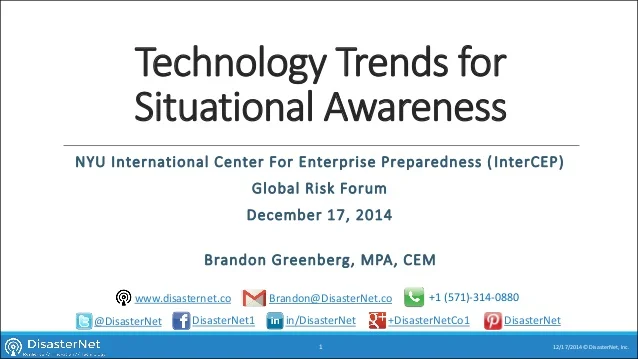
I just had the great pleasure of giving a webinar on Technology Trends for Situational Awareness. The webinar had some great discussion on macro technology trends as well as new and emerging technologies and concepts that can be applied to disaster work.
I wanted to share this you all as well as I think it may be quite useful to a wider audience!
I would also love your comments and feedback!
I just had the great pleasure of giving a webinar on Technology Trends for Situational Awareness. The webinar had some great discussion on macro technology trends as well as new and emerging technologies and concepts that can be applied to disaster work.
I wanted to share the presentation with you all. I think it may be quite useful to a wider audience!
I would also love your comments and feedback!

Data.gov Launches Disaster-Specific Open Data Portal
On Monday, Data.gov launched a disaster-specific open data portal. This was an initiative first announced in at the White House Innovation for Disaster Response and Recovery Demo Day this past July. Many other innovative apps, tools and initiatives were also demoed that day.
The portal features a number apps, tools, and data relevant to disaster and is conceptually similar to what NYC did a couple years ago with its public safety data. In total, 114 Federal data sets are already indexed in the portal
On Monday, Data.gov launched a disaster-specific open data portal. This was an initiative first announced in at the White House Innovation for Disaster Response and Recovery Demo Day this past July. Many other innovative apps, tools and initiatives were also demoed that day.
The portal features a number apps, tools, and data relevant to disaster and is conceptually similar to what NYC did a couple years ago with its public safety data. In total, 114 Federal data sets are already indexed in the portal and I am hoping many more are on their way. A portion of the data seems quite useful to integrate with your own data. Another portion of the data seems to be relevant for only a select subset of people.

The reason this open data portal is such an achievement, though, is because the future of innovation for disaster is in how we collect, organize and share data and information. Technological innovation will continue to plateau if we can not figure out better ways to access our most valuable commodities, data and information.
As it stands now, the 114 data sets is an extremely small portion of data. Much more data and information is needed by many different organizations and communities to effectively mitigate, prepare for, respond to, and recovery from disasters.
In addition, not all data that is needed is disaster-specific. For example, you may want to know population estimates for the jurisdiction you are supporting. This is relevant and useful data for disasters, but is certainly not disaster-specific.
Regardless, this is a huge step toward more open data for disaster. There is still a long road ahead and I hope this movement toward more open and accessible data keeps pushing forward.

UN OCHA Job and Internships
In the past few days, I have received information on a great job opportunity as well as several internships at the UN Office for the Coordination of Humanitarian Affairs (OCHA). OCHA is the primary UN agency responsible for coordinating humanitarian relief efforts in a disaster.
In recent years, there has been on a huge push to transform operations, so these positions have the potential to be very impactful. I have also seen the work of the interns and they get a lot of visibility within the humanitarian community.
Humanitarian Affairs Officer (P-3)
In the past few days, I have received information on a great job opportunity as well as several internships at the UN Office for the Coordination of Humanitarian Affairs (OCHA). OCHA is the primary UN agency responsible for coordinating humanitarian relief efforts in a disaster.
In recent years, there has been on a huge push to transform operations, so these positions have the potential to be very impactful. I have also seen the work of the interns and they get a lot of visibility within the humanitarian community.
Humanitarian Affairs Officer (P-3) (NYC)
“Within delegated authority, the Humanitarian Affairs Officer - Policy Innovation and Analysis (PAIS) will be responsible for the following duties: Supports the development of policy related to humanitarian action, with a focus on innovation and emerging trends, and prepares or contributes to the preparation of policy positions for OCHA on these issues. Organizes and prepares studies on humanitarian, emergency relief and related issues with a focus on innovation and emerging trends in humanitarian response. Organizes preparatory and follow-up work, including interagency technical review meetings to support analysis, policy development work and decision-making on important issues. Assists in the development, preparation and implementation of humanitarian policy events. Establishes and maintains contacts with other UN agencies, non-governmental organizations, diplomatic missions, think-tanks and academic institutions, and private sector companies, and build networks of subject matter experts around emerging issues. Prepares or contributes to the preparation of various written reports, documents and communications, including editing and publication management e.g. drafts sections of studies, background papers, policy guidelines, parliamentary documents, briefings, case studies, presentations, correspondence, etc. Serves as the primary focal point on specific topics or policy-related issues; keeps abreast of latest developments, liaises with other humanitarian organizations, donors, private sector actors, etc., ensures appropriate monitoring and reporting mechanisms; provides information and advice on a range of related issues. Reviews and provides advice on policy issues related to ensuring the effective delivery of humanitarian assistance. Organizes and participates in work groups, meetings, conferences, consultations with other agencies and partners on humanitarian and emergency relief-related matters. Provides guidance to, and may supervise, new/junior staff. Performs other duties as required.”
UN OCHA Internships (Geneva)
“If you are in the last year of your Bachelors, enrolled in your Masters/PhD, or within one year of having completed a Masters/PhD, and are interested, do apply. Otherwise, if you know someone who does qualify, kindly encourage them to apply.
Do not be discouraged by the job titles, the fine details of the job description or the burdensome online application process. The job descriptions are relatively general so we have a lot of room to modify the actual work.....and hopefully have more fun than the bland narrative may imply.
My past interns have had a lot of fun and do some interesting projects. A couple recent examples include an animation for the Humanitarian.ID project (https://www.youtube.com/watch?v=W1jvwaLl8ds) and some in production lego-based stop-motion movies! Of course, we also do some more serious, research-based work and arrange for it to be shared publicly - like the Hashtag Standards for Emergencies.”
1) Volunteer & Technical Community and Digital Humanitarian Network (Opening 38842)
2) Internship-Innovative Info-graphics Creation (Opening 38844)
3) Technology and Humanitarian Affairs (Opening 38845)
4) Mobile Developer and Mobile Strategy Design (Opening 38823)
5) Information Management (Humanitarian Data Scientist) (Opening 38838)

To Make Better Decisions, Combine Datasets
The Harvard Business Review just published this excellent article about decision making and data. The key point it makes is that value and insights come from the ability to combine datasets. Two thoughts emerge:
First, when purchasing and using technology, ensure that data can be shared in real-time (if not, at least exportable in a non-proprietary format!). Otherwise, all you have is a fancy application that is good only for
The Harvard Business Review just published this excellent article about decision making and data. The key point it makes is that value and insights come from the ability to combine datasets. Two thoughts emerge:
First, when purchasing and using technology, ensure that data can be shared in real-time (if not, at least exportable in a non-proprietary format!). Otherwise, all you have is a fancy application that is good only for its intended purpose. The value is when you purchase technology that serves many more purposes. Today, that value is the ability to connect in real-time to other systems for better insights and information that is valid and current.
Second, we need more education on data science for every day disaster managers. Information is being used in increasingly complex ways to support disaster decision making and strategy. It is important that the workforce of today AND tomorrow can effectively harness this information to improve operations as well as their resilience and preparedness postures. Information will become an Achilles heel unless proper thought and consideration is given to this topic.
I am curious how you see these two topics. How do they affect you? Do you have more questions than answers about these topics?