![[APPLY NOW] Coaching for Tech-Enabled Disaster Management Projects](https://images.squarespace-cdn.com/content/v1/53a9cfb7e4b0ac3522f6060f/1462307316457-N9ZM2TH3LHKFOYKLQNP6/2dd6f5943b745302.png)
[APPLY NOW] Coaching for Tech-Enabled Disaster Management Projects
Last year, I wrote about a similar coaching opportunity with The Governance Lab at NYU. The lab has since moved to the Tandon School of Engineering from the Wagner School of Public Service (my master's alma matter), however, that does not mean they are any less focused on doing good.
This year's coaching program focuses on tech-enabled disaster management. This program is ideal for you if you have specific project in mind or are actively working on a project. You will have access to great mentors and support. While the focus of the program is on developing a solution, you do not have to be technically oriented. In fact, this program works for anyone motivated to solve a real problem in the disaster or humanitarian space. Also, they have instituted...
Last year, I wrote about a similar coaching opportunity with The Governance Lab at NYU. The lab has since moved to the Tandon School of Engineering from the Wagner School of Public Service (my master's alma matter), however, that does not mean they are any less focused on doing good.
This year's coaching program focuses on tech-enabled disaster management. This program is ideal for you if you have specific project in mind or are actively working on a project. You will have access to great mentors and support. While the focus of the program is on developing a solution, you do not have to be technically oriented. In fact, this program works for anyone motivated to solve a real problem in the disaster or humanitarian space. Also, they have instituted a $250 fee, but I think this is more than worth it.
You can apply by clicking the button below. The application deadline is May 27th if you want to be considered for the summer session (June to August).
Here at the details:
Innovations in Disaster Management is a ten week online coaching program designed to convene government, social and civic entrepreneurs (both individuals and teams) who are developing projects that have the potential to tackle the pressing needs of people in disaster-affected communities. Whether your project is nonprofit or for-profit and whether you are focusing on disaster preparedness, disaster management or disaster relief, this program aims, through peer-to-peer support and expert coaching and mentoring, to help humanitarian innovators implement, scale, and assess effective projects.
Ideal participants are those who have already identified a project and/or have a project underway and have clear insight into the problem they are trying to ameliorate. Projects might aim to tackle diverse issues from the protection of vulnerable populations, to strengthening health initiatives, to providing shelter, education, and livelihood opportunities. They will have in common the application of open, data-driven, bottom-up and collaborative approaches. A public interest and public engagement focus should ultimately be the driving force behind the projects.
The GovLab Academy coaching programs have helped 450 government, social and civic entrepreneurs take 250 projects from idea to implementation. We aim to help you “cross the chasm” from idea to implementation and help you scale.

Building Better Disaster Response and Resilience with Information and Technology
For nearly five years I have been in higher education exploring how information and technology can improve disaster response and resilience. I have explored complex issues in great detail and I have learned a lot about the challenges and opportunities being faced by communities, organizations and people trying to leverage information and technology to better respond to disasters and build resilience.
But as I begin my transition back to the working world in the near future, I am forced to reflect on how I can apply this new knowledge to help address current problems while also preparing for an innovative future beyond what we can imagine today. I find myself writing about my philosophy on leveraging information and technology to improve disaster response and resilience...
For nearly five years I have been in higher education exploring how information and technology can improve disaster response and resilience. I have explored complex issues in great detail and I have learned a lot about the challenges and opportunities being faced by communities, organizations and people trying to leverage information and technology to better respond to disasters and build resilience.
But as I begin my transition back to the working world in the near future, I am forced to reflect on how I can apply this new knowledge to help address current problems while also preparing for an innovative future beyond what we can imagine today. I find myself writing about my philosophy on leveraging information and technology to improve disaster response and resilience. This philosophy will guide me in my career and allow me to apply and transform my knowledge into pragmatic and sustainable change that pushes disaster response and resilience to achieve better outcomes with information and technology.
My Philosophy
I subscribe to the notion that a specific approach helps focus change and improvement. The approach of having good people, processes and products is essential to guide small businesses through significant growth and change toward profitability. For disaster response and resilience, focusing on the following five initiatives will help communities, organizations and people achieve better outcomes with information and technology:
- Understanding the value that information and technology provides to different people in different situations.
- Improving policies that better enable data and information sharing while preserving privacy and security.
- Developing better programs that incentivize sustainable disaster information and technology innovation, research and education.
- Designing scalable and consistent ways to process (e.g., collect, manage, analyze and share) data and information across a variety of information and technology systems.
- Creating new products (technical and non-technical) that deliver significant value to communities, organizations and people responding to and affected by disasters
Beginning to address these complex initiatives starts with a paradigm shift in thinking that focuses on the value of information and how information systems, separate from technology systems, can improve disaster response and resilience. In addition, it requires concurrently aligning policies, programs, processes and products to overcome the unique nuances and complexities of disaster response and resilience.
Origins of My Philosophy
My philosophy on improving disaster response and resilience with information and technology is based on five years of intense study and reflection that culminate in new paradigms and theories. It represents my foundational beliefs that are influenced by two primary issues:
1) Information systems are different from technology systems
An information system is a conceptual understanding of who needs what information and when, and how it needs to be delivered to them. It helps describe the larger organizational systems that are being supported and understand the unique nuances and complexities of disaster response and resilience. An information system is also technology agnostic as it is about understanding why, how, when and for whom information is needed. Unfortunately, disaster information systems have received little attention over the years in both research and practice.
A technology system is a specific tool that helps manage information as it moves from its raw form (or original location) to its relevant and actionable form for the consumer. The value of technology systems is that they primarily help with time and effort intensive processes such as collecting, managing, analyzing, and sharing data and information as well as perform functions that humans can’t do (e.g., analyze big data).
However, if an information system is not well defined or understood, the supporting technology systems will only provide marginal benefits. This is, in part, why we have seen limited adoption and diffusion of new and innovative technologies despite there being a plethora of ideas and innovations. New and innovative technology systems need to reflect the real-world complexities of disaster response and resilience information systems; otherwise their adoption and diffusion will be slow with marginal benefits. Someone needs to be looking out for how technology systems integrate with information systems.
2) Disaster information and technology policies, programs, and processes are misaligned
Disaster response and resilience is a complex industry and profession that has not done a thorough job looking strategically and comprehensively at the impediments to effective information and technology systems. This has resulted in misaligned policies, programs, processes and products that stall innovation and hamper sector-wide progress and achievement. For example, attempts to develop and track meaningful response and resilience metrics are hampered by the inability to get reliable data and information about those metrics quickly and easily. The impediments though, are not due to a failure of ideas or technology. Rather the impediments are due to a complex working environment/profession that:
- Lacks understanding about the discrete value of information for different situations as well as different communities, organizations, and people.
- Has policies that primarily focus on how to protect and secure rather than share data and information.
- Lacks grants and programs that specifically and adequately focus on information system projects, research, and curricula.
- Develops custom and ad hoc processes to collect, manage, analyze and share data and information that result in missed opportunities for leveraging economies of scale and in high sunk costs that disincentive change.
- Seeks out technological solutions that conform more to existing policies, programs, processes and products rather than fundamental need.
The Importance of Sharing My Philosophy
It is important to share my philosophy because it helps inform employers, clients, partners, readers, etc. of my approach to leveraging information and technology. This approach, combined with my expertise and strengths, is why I am attracted to positions that help challenge the status quo and lead to innovation and systemic change. These include disaster information and technology positions related to:
- Strategy and policy
- Program/project management
- Public-private partnerships
- Product management
- Education and training
- Applied research and evaluation

NYU's GovLab is Crowdsourcing Innovation for the Cotopaxi Volcano Eruption
NYU's Governance Lab (GovLab) is looking for some experts to participate in a series of virtual roundtable problem-solving discussions to help the Ecuador government and its local cities prepare for an increasingly likely eruption of the Cotopaxi Volcano. The volcano has recently become very active. If it erupts, some communities will have less than 30 minutes to evacuate.
For some background, GovLab is an NYU Wagner School of Public Service lab that helps institutions work more openly and collaboratively by harnessing the power of the crowd in problem solving. GovLab also harnesses the latest practices and innovations in data and technology to support its mission.
If you believe you can offer expertise or support for one of the sessions below...
NYU's Governance Lab (GovLab) is looking for some experts to participate in a series of virtual roundtable problem-solving discussions to help the Ecuador government and its local cities prepare for an increasingly likely eruption of the Cotopaxi Volcano. The volcano has recently become very active. If it erupts, some communities will have less than 30 minutes to evacuate.
For some background, GovLab is an NYU Wagner School of Public Service lab that helps institutions work more openly and collaboratively by harnessing the power of the crowd in problem solving. GovLab also harnesses the latest practices and innovations in data and technology to support its mission.
If you believe you can offer expertise or support for one of the sessions below, sign up here. The first session starts October 1. If you know of anyone who would like to participate, forward this on.
Here are the details that were sent to me:
The City of Quito, Ecuador needs your help and that of your classmates and colleagues in your program and your newsletter readers to prepare for the likely eruption of the Cotopaxi Volcano situated 30 miles from Quito.
Cotopaxi is currently spewing ash (latest images here). The last large-scale eruption was in 1877, and it is believed that another one is now inevitable. If it erupts, some communities will have less than half an hour to evacuate.
The scale of the challenge is overwhelming. Yet there are those of you out there with good ideas for how to mitigate the risks, especially using technology and innovation, or those of you who know others who have relevant experience, skills, and know how.
We will convene a dozen online sessions to help the city address the major pressing challenges in disaster management.
The goal of these online sessions is to:
- Better define and understand the nature of the problem
- Help connect those people with relevant experience and know how to city officials to help Quito better manage the impending disaster
- Identify innovative and practical ways, especially using new technology, to tackle the challenge at hand
- Result in at least 2-3 implementable ways per topic of doing things differently that could potentially save lives, save resources, and allow for money to be spent on what matters most.
Logistics:
- Each session will run online from 11 am EST for 1.5 hours on a Monday or Thursday (see calendar below)
- Each session will be attended by those city officials with responsibility for that topic, who will share background information about the current state of readiness.
- Each session will be moderated by an expert in the field.
- Each session will be staffed by volunteers who will take notes and follow up the session to develop good ideas into more concrete and actionable proposals backed up by research.
What We Need From You?
Sign up (https://the-govlab.forms.fm/cotopaxi) for the sessions of greatest relevance where you have the most to contribute.
- Coordination of Communication - Thursday, October 1, 11am - 12.30pm EST
- Evacuation Planning - Monday, October 5, 11am - 12.30pm EST
- Cost Effective Human and Animal Shelters - Thursday, October 8, 11am - 12.30pm EST
- Citizen Sensing and Citizen Science - Monday, October 12, 11am - 12.30pm EST
- Protection of Vulnerable Populations - Thursday, October 15, 11am - 12.30pm EST
- Construction of a Skills-Based Expert Network - Monday, October 19, 11am - 12.30pm EST
- Continuity of Communications Systems - Thursday, October 22, 11am - 12.30pm EST
- Air and Water Quality and Sanitation - Monday, October 26, 11am - 12.30pm EST
- Food Safety and Cold-Chain Supply Management - Thursday, October 29, 11am - 12.30pm EST
- Access to Health Services - Monday, November 2, 11am - 12.30pm EST
- School Alternatives During a Disaster - Thursday, November 5, 11am - 12.30pm EST
- Innovative Financing for Redevelopment - Monday, November 9, 11am - 12.30pm EST
The magnitude of the crisis is grave and the timing is urgent. Please take the time to share this invitation with the right people.
You can also suggest another session or tell us how we can do this better.
Many thanks for your assistance and for volunteering your time and expertise to help the people of Ecuador.
- Carolina Pozo, Secretary General, Planning and Open Government, City of Quito
- Beth Simone Noveck, Founder, The GovLab
- Dinorah Cantu, Director, The GovLab Academy
![[APPLY NOW] Free Incubator for Disaster and Humanitarian Innovation!](https://images.squarespace-cdn.com/content/v1/53a9cfb7e4b0ac3522f6060f/1426791029598-AMKYXV4HKFNIO9XYLJ2P/image-asset.jpeg)
[APPLY NOW] Free Incubator for Disaster and Humanitarian Innovation!
I just got word of a great FREE coaching program at my master's alma matter. If you have been considering an idea and want to work on it more with great mentors and support, this is a great program for you. While the focus of the program is on developing a solution, you do not have to be technically oriented. In fact, this program works for anyone motivated to solve a real problem in the disaster or humanitarian space. Also, if your idea is disaster related, I might be one of the mentors you have access to as well. Here are the specifics...
The Governance Lab at NYU's Wagner School of Public Service is searching for highly motivated and passionate individuals with good ideas but who may not know how to develop them without help!
I just got word of a great FREE coaching program at my master's alma matter. If you have been considering an idea and want to work on it more with great mentors and support, this is a great program for you. While the focus of the program is on developing a solution, you do not have to be technically oriented. In fact, this program works for anyone motivated to solve a real problem in the disaster or humanitarian space. Also, if your idea is disaster related, I might be one of the mentors you have access to as well. Here are the specifics...
The Governance Lab at NYU's Wagner School of Public Service is searching for highly motivated and passionate individuals with good ideas but who may not know how to develop them without help! The aim of the Humanitarian Innovation Project Collaborative is to help individuals or teams worldwide to develop innovative humanitarian projects from idea to implementation. I highly recommend checking out the link above for additional details. The application process is also relatively short.

NYU GovLab will provide tailor-made resources to anyone with a good idea to implement in a conflict/emergency setting after 8 weeks. The classes will be held in the evenings every two weeks for 2-3 hours and be scheduled around the participants' availability. For those participants still not able to make a class, GovLab will record the session or be available for one-on-one sessions.
“Convened by a former White House Senior Advisor responsible for leveraging emerging technologies to address national challenges such as Hurricane Sandy and an Australian Prosecutor working for the UN Advocacy Division International Crisis Group, this eight week collaborative convenes those working on projects that have the potential to tackle the pressing needs of people in conflict, post-conflict, or disaster-affected communities through the use of civic innovation tools. Projects might aim to tackle diverse issues from the protection of vulnerable populations to strengthening health initiatives to providing shelter, education, and livelihood opportunities. But they will share in common the application of open, bottom-up and collaborative approaches. Through peer-to-peer support and coaching, expert mentoring and hands-on advising, the goal of this program is to help humanitarian innovators implement, scale, and assess projects. Ideal teams or individuals are those who have a project already or close to underway and clear insight into the problem they are trying to ameliorate.”
Can Evernote be a Planning Tool? Training? Evaluation?
I am usually very excited when new tools disaster tools come out on the market. But I am equally excited when everyday tools can be applied to the disaster context to better meet our needs and more often than not achieve significant cost savings.
In the past year, I have used Evernote religiously to capture my thoughts, research and any other type of information I can think of. I can then search Evernote with its powerful search features to inform my blog posts, support my PhD research and consulting clients, manage class assignments, and take notes...for everything.
Evernote has an easy capture tool for clipping things from the web (including PDFs) and an easy to use architecture that can easily link and/or publish notes within the program. Additionally, I can use it on ANY of my devices with online and offline capabilities and integrate it with MANY other applications. Needless to say, I am a big fan of the tool.

But I really wonder if Evernote can be used as an emergency response or continuity planning tool. According to Wikipedia:
Evernote is a suite of software and services designed for notetaking and archiving. A "note" can be a piece of formatted text, a full webpage or webpage excerpt, a photograph, a voice memo, or a handwritten "ink" note. Notes can also have file attachments. Notes can be sorted into folders, then tagged, annotated, edited, given comments, searched and exported as part of a notebook.
To put this a bit into perspective, Evernote 's motto is:
Remember everything. Capture anything. Access anywhere. Find things fast.
Hmmm....sounds a lot like a lot of our fundamental planning needs for disasters? We need to collaborate well and then access our information easily and fast. Evernote Business provides many of the collaboration features missing in the consumer product.
The incorrect approach, though, would be to ask Evernote to do everything our word processor does. Conceptually, it is an entirely different tool that must be approached in a new way.
For example, what if we could have each note represent a chapter and all linked back to a Table of Contents note? What if we could create a notebook solely for our base plans and then have other notebooks dedicated to our functional annexes? Add supplementary or supporting PDF, Word, PowerPoint, Excel Documents with ease?
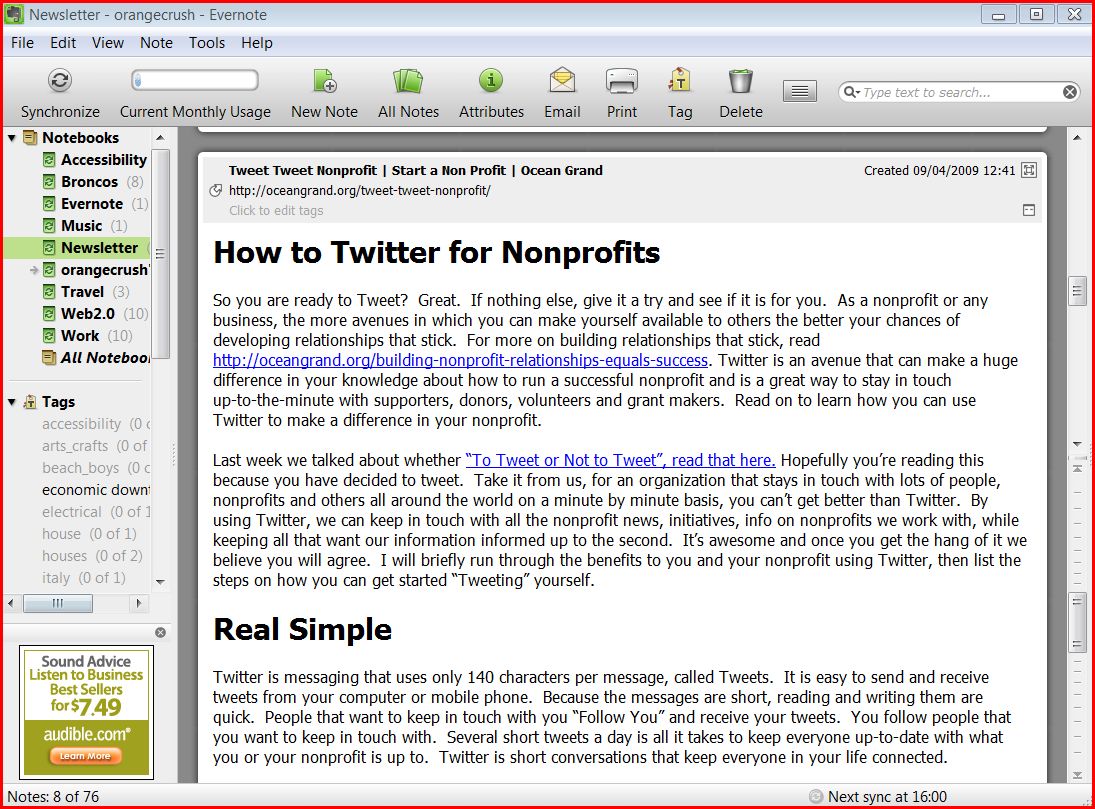
In another case, what if your incident commander could easily look up and reference relevant procedures and protocols directly on his or her phone or tablet? Better yet, can it provide a checklist for action within seconds?

Or what if you could get real time information back from the field by having them taking pictures, record audio or mark up a screen shot of a map directly from their phones and tablets?

Evernote is such a powerful repository of information that it can do all the things mentioned above. I am just wondering what the workflow is for organizations with emergency response and business continuity planning needs. Does it end up being more expensive than other tools or are there any work arounds?
What are your thoughts? Would you consider Evernote for your organization? Why or why not?
Related articles
- The All New Evernote Web Clipper 6 for Chrome (evernote.com)
- 5 Tips for Making the Most of Evernote (everything-pr.com)
- 7 IFTTT recipes to supercharge your use of Evernote (agbeat.com)
- Take note: Smart classroom tools for tech-savvy students (pcworld.com)
White House Poised for Further Innovation with "Design Jam"
I had the distinct pleasure attending a White House design jam (think "design-a-thon") on Disaster Response and Recovery with over 90 colleagues from all over the tech and innovation space last Tuesday. Honorable mentions include Microsoft, Google, NYC Digital, Twitter, Airbnb, Twilio, Topix, LiquidSpace, Reddit, Rackspace, Palantir, DirectRelief, Recovers.org, APCO International, and Singularity University to name a few. And yes, FEMA was there along with a couple White House Presidential Innovation Fellows!
Here is a quick description of the event:
The event, to be led by Todd Park, US Chief Technology Officer, and Richard Serino, Deputy Administrator of FEMA, will convene leaders in technology, design, academia, entrepreneurship, and philanthropy, as well as local and state officials to develop ideas for innovative solutions to emergency management challenges.Participants will brainstorm creative new solutions and ways to support the development of prototypes for some of the best emerging ideas. Solutions will focus on: empowering disaster survivors; enhancing the ability of first responders as well as Federal, state and local officials to conduct critical recovery and restoration activities; and supporting integrated, whole-community efforts to better prevent, protect, mitigate, respond to, and recover from disasters.
We spent most of the day "jamming" to not just discuss, but actually create designs. We worked through a cycle that included problem definition, design & build, test & evaluate, and iterate. At the end of the day, we chose team captains to spearhead ongoing development efforts.
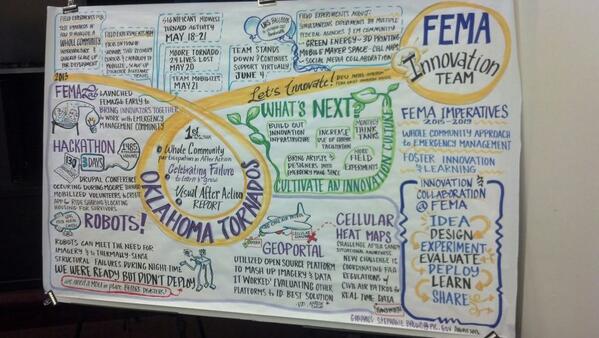
There were a number of fabulous projects that, if continued, could really help us leap frog forward. Here are a few:
- DisasterRSS - Creation of a "disaster.txt" publishing standard & ontology for websites (like RSS for blogs). This simple idea is for any organization that has data or information useful in disasters. The organization would create a .txt file on its website that would have all relevant information for data geeks and others to access its data. Here is a very basic example.
- SMS Survivor Survey - Designed to get specific information from specific population groups, the simple prototype simulated sending a short text message survey to a list of durable equipment owners with a tree of questions asking for their current location and the battery needs for their life-saving medical devices. That information is then saved for disaster responders to deliver aid for the folks that need it. This model can be adapted to a variety of use cases . Check it out by texting (415) 236-3575.
- Disaster Response Data Interchange - Geographically aware data interchange that will intelligently aggregate disaster recovery information from social media and other sites. The system will include Customer Relationship Management (CRM) functionality to autonomously engage “customers” to connect the “haves” with the “wants” across multiple sites. Additionally, it will have an Application Programming Interface (API) that will allow third parties to push/pull information automatically into and out of the data interchange.
Check out the full Storify here.
So what is your opinion on what we need to go from innovative ideas to action and sustainability?