
Help Research and Support the Response to Hurricane Irma
We need your help! If you have a few minutes, please read below.
As Hurricane Irma bears down on Florida, hundreds, maybe thousands of organizations are preparing to descend upon the state to support the survivors. It is an effort that takes many different types of people from many different organizations. But who are these groups? How do they find each other?
These questions are the impetus for the Response Roster Project. We want to understand response efforts from the perspective of both the official and unofficial response. Who are the unsung heroes and responders taking time to help in any way they can?
We need your help! If you have a few minutes, please read below.
As Hurricane Irma bears down on Florida, hundreds, maybe thousands of organizations are preparing to descend upon the state to support the survivors. It is an effort that takes many different types of people from many different organizations. But who are these groups? How do they find each other?
These questions are the impetus for the Response Roster Project, an effort I am supporting with G&H International Services, Inc. We want to understand response efforts from the perspective of both the official and unofficial response. Who are the unsung heroes and responders taking time to help in any way they can?
This project provides some critical understanding about how these various groups, projects and initiatives can be better supported and integrated in the future. It is impossible to support the survivors of disasters such as Hurricanes Harvey and Irma without the support of neighbors, non-profits (e.g., Humanity Road), and other groups that form as needs arise (e.g., Cajun Navy).
The Project
Today, we officially launch the Response Roster Project. It as an operational research tool designed to understand who is responding and how they are finding each other. This project is unique in that it has a real-time operational component that allows the public as well as responders to:
- Submit any type of organization that is helping survivors of Hurricanes Harvey and Irma in any way; and
- Search and find each other during response and recovery efforts.
This catalogue will be actively curated throughout the response and recovery to Hurricanes Harvey and Irma. When the dust settles, this information will be used to understand how self-organized groups can be better supported in future disasters.
How You Can Help
Helping will take just a few minutes of your time. Specifically, we need help finding the various groups, projects and initiatives that are supporting response and recovery efforts. You can submit your findings using a simple form found at:
No time to submit? Please help spread the word! If you have any questions about the project, please contact us

NYU's GovLab is Crowdsourcing Innovation for the Cotopaxi Volcano Eruption
NYU's Governance Lab (GovLab) is looking for some experts to participate in a series of virtual roundtable problem-solving discussions to help the Ecuador government and its local cities prepare for an increasingly likely eruption of the Cotopaxi Volcano. The volcano has recently become very active. If it erupts, some communities will have less than 30 minutes to evacuate.
For some background, GovLab is an NYU Wagner School of Public Service lab that helps institutions work more openly and collaboratively by harnessing the power of the crowd in problem solving. GovLab also harnesses the latest practices and innovations in data and technology to support its mission.
If you believe you can offer expertise or support for one of the sessions below...
NYU's Governance Lab (GovLab) is looking for some experts to participate in a series of virtual roundtable problem-solving discussions to help the Ecuador government and its local cities prepare for an increasingly likely eruption of the Cotopaxi Volcano. The volcano has recently become very active. If it erupts, some communities will have less than 30 minutes to evacuate.
For some background, GovLab is an NYU Wagner School of Public Service lab that helps institutions work more openly and collaboratively by harnessing the power of the crowd in problem solving. GovLab also harnesses the latest practices and innovations in data and technology to support its mission.
If you believe you can offer expertise or support for one of the sessions below, sign up here. The first session starts October 1. If you know of anyone who would like to participate, forward this on.
Here are the details that were sent to me:
The City of Quito, Ecuador needs your help and that of your classmates and colleagues in your program and your newsletter readers to prepare for the likely eruption of the Cotopaxi Volcano situated 30 miles from Quito.
Cotopaxi is currently spewing ash (latest images here). The last large-scale eruption was in 1877, and it is believed that another one is now inevitable. If it erupts, some communities will have less than half an hour to evacuate.
The scale of the challenge is overwhelming. Yet there are those of you out there with good ideas for how to mitigate the risks, especially using technology and innovation, or those of you who know others who have relevant experience, skills, and know how.
We will convene a dozen online sessions to help the city address the major pressing challenges in disaster management.
The goal of these online sessions is to:
- Better define and understand the nature of the problem
- Help connect those people with relevant experience and know how to city officials to help Quito better manage the impending disaster
- Identify innovative and practical ways, especially using new technology, to tackle the challenge at hand
- Result in at least 2-3 implementable ways per topic of doing things differently that could potentially save lives, save resources, and allow for money to be spent on what matters most.
Logistics:
- Each session will run online from 11 am EST for 1.5 hours on a Monday or Thursday (see calendar below)
- Each session will be attended by those city officials with responsibility for that topic, who will share background information about the current state of readiness.
- Each session will be moderated by an expert in the field.
- Each session will be staffed by volunteers who will take notes and follow up the session to develop good ideas into more concrete and actionable proposals backed up by research.
What We Need From You?
Sign up (https://the-govlab.forms.fm/cotopaxi) for the sessions of greatest relevance where you have the most to contribute.
- Coordination of Communication - Thursday, October 1, 11am - 12.30pm EST
- Evacuation Planning - Monday, October 5, 11am - 12.30pm EST
- Cost Effective Human and Animal Shelters - Thursday, October 8, 11am - 12.30pm EST
- Citizen Sensing and Citizen Science - Monday, October 12, 11am - 12.30pm EST
- Protection of Vulnerable Populations - Thursday, October 15, 11am - 12.30pm EST
- Construction of a Skills-Based Expert Network - Monday, October 19, 11am - 12.30pm EST
- Continuity of Communications Systems - Thursday, October 22, 11am - 12.30pm EST
- Air and Water Quality and Sanitation - Monday, October 26, 11am - 12.30pm EST
- Food Safety and Cold-Chain Supply Management - Thursday, October 29, 11am - 12.30pm EST
- Access to Health Services - Monday, November 2, 11am - 12.30pm EST
- School Alternatives During a Disaster - Thursday, November 5, 11am - 12.30pm EST
- Innovative Financing for Redevelopment - Monday, November 9, 11am - 12.30pm EST
The magnitude of the crisis is grave and the timing is urgent. Please take the time to share this invitation with the right people.
You can also suggest another session or tell us how we can do this better.
Many thanks for your assistance and for volunteering your time and expertise to help the people of Ecuador.
- Carolina Pozo, Secretary General, Planning and Open Government, City of Quito
- Beth Simone Noveck, Founder, The GovLab
- Dinorah Cantu, Director, The GovLab Academy
How You Can Help 'Crowdsource' Typhoon Yolanda Response (UPDATED)
Update. This blog post has been updated since its original posting to provide additional background on MicroMappers' two primary initiatives (TweetClicker and ImageClicker) and provide additional explanation.
Update 2. As of 9am Eastern on 11/13, no more Tweets and images are being added to the applications. However, you can still view results on the crisis map.
Typhoon Yolanda hit the Philippines this past Friday as one of the largest and most powerful storms ever recorded on earth. Many initiatives are underway to support response efforts. However, if you would like to support response efforts with your time and energy rather than donating, MicroMappers, at the request of the United Nations Office of Humanitarian Assistance (UN OCHA), has stood up two applications to help quickly identify ("tag") information from tweets and images relevant to disaster responders.
TweetClicker and ImageClicker are both simple to use "microtasking" applications to verify Tweets and images gathered from social media. The goal is to leverage the "crowd" to help sift through the massive amounts of data collected. Each application requires no technical expertise and can even be used on your computer or mobile device. The application runs you through a simple tutorial before beginning. Each message takes about 3 seconds to review and will get reviewed by two other people, so your selections will be validated by others as well.
NOTE: If you encounter a "100% complete" notice when navigating to the pages, keep checking back every hour. The applications are adding new messages and images to verify continuously.

The results of this effort are being displayed on a live crisis map supported by the StandbyTaskForce and GISCorps, which are both members of the Digital Humanitarian Network. Each of these groups are network of people and organizations with missions to support the formal and informal response.
In the response to Hurricane Yolanda/Haiyan, they are digitally skilled volunteers acting as force multipliers. Conceptually, they are similar to Red Cross's Digital Operations Center that leverages digital volunteers to support response efforts. However, describing these organizations and how they operate is a separate post.
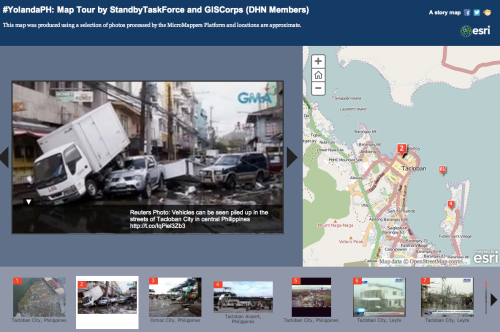
Leading this effort, though, is MicroMappers. The initiative (loosely defined) is a partnership between QRCI, CrowdCrafting, and UN OCHA and is led by a number of industry technologists including Patrick Meier, Ji Lucas, Luis, Daniel, Ariba Jahan, Christine Jackson, and Daniel Lombrana Gonzalez.
For more background and continuous updates on Typhoon Yolanda/Haiyan response efforts using TweetClicker and ImageClicker, check out this blog post.
Related articles
- Typhoon Yolanda: UN Needs Your Help Tagging Crisis Tweets for Disaster Response (irevolution.net)
- After Yolanda, int'l community offers sympathy, aid (rappler.com)
- UN, gov't send communications teams to Tacloban (rappler.com)
- Super-Typhoon Haiyan (Yolanda): How Can We Help? (jacksaunsea.wordpress.com)
Getting Started on a Emergency Management/Business Continuity Program
The disaster domain is huge. The level of detail and specificity to which you can get is almost infinite. As such, it can be an overwhelming experience for businesses and nonprofits to get started with preparing their organizations for disasters.
In response to an email I just got from a former MPA classmate, I wanted to share some helpful thoughts on how to get started.
The Actions to Take
When discussing this topic, there are four main actions that organizations can take:
- Prepare for a Disaster (through planning, training, exercise and equipment)
- Plan for Response/Continuity of Operations (responding in the moment/maintaining operations, if possible)
- Plan for Recovery (getting back to normal)
- Mitigate Impact (stop things from happening in the first place)

Implementing into the Organization
There are many approaches and models to implement these actions (think program management vs. project management). However, the process typically starts with leadership forming a disaster committee of some sort to begin addressing the organization's disaster needs and corrective actions. The committee then establishes a path forward.
Typical agendas are a variation of the following:
- Identify Risks and Gaps
- Develop Plan(s) to Address Risks and Gaps (keeping in mind the four actions mentioned above)
- Train and Exercise on Those Plans and Purchase Required Tools/Equipment
- Redo Steps 1-3 annually (or at designated intervals).
Given the typical resource constrained environment of organizations, there is a lot of potential to address "low hanging fruit" once risk and gaps are identified. This is not perfect as the approach should be as comprehensive as possible, but it is helpful nonetheless.
The important thing is to not fall into a false sense of security because you have only addressed some of the risk and gaps. The coordination of effort and understanding your strengths and weakness is vital to a successful disaster management program.
High Value Resources
Here are a few high value resources on what nonprofits can begin to do. Grant making institutions should consider baking some of these principles into their grant requirements.
Domain Headings
If you are looking to do more research in this area, especially as your disaster management program matures, you should look for resources in the following domains:
- Emergency Management
- Business Continuity/Continuity of Operations
- Operational Risk Management
- Disaster Recovery
Getting Started
As a starting point, I highly recommend the following priorities:
- Develop a disaster committee led by someone willing and able to champion the effort
- Decide if it is best to shut down, continue operations at full or reduced scale, and/or respond to the disaster (i.e., support the community)? This will help clarify how detailed the planning should be for all scenarios.
- Identify 3 targets for the next year (i.e., establish committee, develop a program plan, develop a plan)
It is easy to get overwhelmed. Focus on establishing realistic goals and moving forward. Any forward movement is better than no movement at all.
Related articles
- Emergency Preparedness Guide | Business Disaster Planning (thehartford.com)
- When It Comes to Disasters, We Don't Plan to Fail We Fail to Plan (habnet1.wordpress.com)
- Natural disasters, rising costs are Canada's biggest public safety risk: documents (globalnews.ca)
- Emergency preparedness checklist for perfect storm Hurricane Sandy - Here's what you need to get NOW (danielleqdlopez.wordpress.com)
What Should Researchers Know About First Responders?
I have been invited to speak next Thursday on a panel at the National Geospatial Intelligence Agency Academic Research Symposium. The title of the panel is "Social Media Research for First Responders and Analysts" and it's goal is "...to help researchers understand what operational capability gaps need to be filled."
In hopes of informing my panel talk, I want to ask you what should researchers know about the operational needs of first responders? Especially as it relates to social media!
I am excited about this workshop because it starts to put practitioners with academics in hopes of aligning the priorities of both worlds. In fact, a new term is emerging called the "pracademic." The pracademic has experience as both a practitioner and an academic and chooses to work to align the worlds so that academic research can be as applicable as possible. Patrick Meier captures this well as "scholar-practioner" in Advice to Future PhDs from 2 Unusual Graduating PhDs.
Some prior practioner-based gap analysis work has already been done on this by DHS's Virtual Social Media Working Group (of which I am a member). In June of this year, the VSMWG released Lessons Learned: Social Media and Hurricane Sandy. The report highlighted many of the success and learning points regarding social media. On page 29, it highlights a number of technology, process, and policy gaps requiring further attention. The major themes included:
- Big Data
- Compliance and Requirements
- Funding
- Standards, Training, and Guidance
- Policy and Process
- Partnerships
- Technology, Tools, and Features
I will undoubtedly speak to these gaps, but other feedback and thoughts would be helpful and greatly appreciated!