
WEBINAR: Practical Tools for Better Decision Making
There are many different decision making tools available in the marketplace. These tools serve many purposes including information sharing, multi-criteria decision making and mapping.
On Wednesday, February 21, 2018, the National Information Sharing Consortium (NISC) is hosting a webinar that will provide an overview of several solutions G&H International (the company I work for) has developed to address specific client problems, which include:
- Managing large-scale events;
- Integrating data silos to enhance local decision-making; and
- Developing a virtual exercise facilitation capability.
Here is the official blurb:
There are many different decision making tools available in the marketplace. These tools serve many purposes including information sharing, multi-criteria decision making and mapping.
On Wednesday, February 21, 2018, the National Information Sharing Consortium (NISC) is hosting a webinar that will provide an overview of several solutions G&H International (the company I work for) has developed to address specific client problems, which include:
- Managing large-scale events;
- Integrating data silos to enhance local decision-making; and
- Developing a virtual exercise facilitation capability.
Here is the official blurb:
"The G&H International Services webinar is the sixth webinar in the NISC's Mission-Focused Job Aids Webinar Series that reviews tools, techniques, and standard operating procedures that NISC partners in the homeland security, emergency management, public safety, first responder, and healthcare preparedness communities use to facilitate and manage information sharing. For more information about the webinar series and the NISC, visit the NISC website at www.nisconsortium.org. To become a member of the NISC, click here to join, membership is free for all users!"

Looking for My Virtual EM Conference Presentation?
A couple weeks ago I informed you that I was participating in my first virtual conference. I am happy to report the conference was a resounding success and I had many people attend my session on data, technology and social media for disaster management.
Unfortunately, I know many of you could not make it. Don't fret! Check out the recorded video below...
A couple weeks ago I informed you that I was participating in my first virtual conference. I am happy to report the conference was a resounding success and I had many people attend my session on data, technology and social media for disaster management.
Unfortunately, I know many of you could not make it. Don't fret! Check out the recorded video below.
If you are still interested in accessing all videos from the conference, you can purchase the VIP All Access Pass until October 10 via this link. Be sure to use the code DISASTERNET10 for 10% off!

Information Requirements for Crisis Response – A Radio Perspective
I take the position that differing and contradictory viewpoints or perspectives help shed light on the many gaps and issues the industry faces. As such, I invited Terry Canning to provide a guest post in response to my recent post on redefining information requirements for disaster response. The views he expresses are his own. We welcome your thoughts in the comments below!
A couple of weeks ago Brandon wrote a thoughtful and thought-provoking blog describing how the information requirements for successful crisis response is being redefined. He opened with “Developing information requirements for crisis response is a tedious and flawed process filled with many uncertainties…” In a reply, I agreed with his postulation that it can be a tedious process (although I proposed fastidious rather than tedious) but disagreed that it is flawed. Brandon then challenged me to write a response to fully explain my position on this issue – and I have accepted.
I take the position that differing and contradictory viewpoints or perspectives help shed light on the many gaps and issues the industry faces. As such, I invited Terry Canning to provide a guest post in response to my recent post on redefining information requirements for disaster response. The views expressed are his own. We welcome your thoughts in the comments below!
A couple of weeks ago Brandon wrote a thoughtful and thought-provoking blog describing how the information requirements for successful crisis response is being redefined. He opened with “Developing information requirements for crisis response is a tedious and flawed process filled with many uncertainties…” In a reply, I agreed with his postulation that it can be a tedious process (although I proposed fastidious rather than tedious) but disagreed that it is flawed. Brandon then challenged me to write a response to fully explain my position on this issue – and I have accepted.
To put my comments in perspective I have been a volunteer fire fighter for over 35 years and a chief officer for 15 of those years, having retired in December of 2013. For the past 16 years I have been engaged as a radio communications consultant with the Province of Nova Scotia, Canada, where I was responsible for coordinating emergency communications. My role also included ensuring radio interoperability for twelve provincial government departments, two regional municipalities, four federal government departments, several NGO’s with public safety roles, the provincial police service (RCMP) and 285 volunteer fire departments. The volunteer fire service encompasses over 9000 volunteer fire fighters. All of these users share a common, single 700 MHz, province-wide trunked radio system, operating at 86 sites. My focus on the radio ‘tool’ is intentional, as that is my background and strength; there are certainly other tools that contribute to success.
In order to achieve full situational awareness (the ultimate objective of gathering, storing and sharing information) for crisis response, all engaged response parties must be able to communicate directly with all others in real time, as required, and as authorized. This is the foundation of the successes realized by the many agencies and orders of government utilizing the second generation trunked mobile radio system in Nova Scotia. Rather than competing for limited precious radio spectrum and even more elusive capital funding, an attitude of cooperation and system resource sharing has created a model for information sharing and universal situational awareness.
This may seem to be only moderately related to the topic of redefining information requirements for crisis response, however my point is that with real time interagency communications using the one-to-many capability of two-way radio, there is much less need to gather and store information. Instead my suggestion is that the parties with the information essential for an effective crisis response be brought directly into the picture utilizing the radio system – thus every stakeholder is aware of all pieces of the puzzle.
The Nova Scotia approach has resulted in much less time defining requirements and dramatically more accurate and timely information during a response. There are basically three components employed in the Nova Scotia model:
1) A process of post incident analysis
Engage all incident stakeholders to perform a thorough, frank and inclusive debriefing after every significant multi-agency incident, and, ensure the learnings from these analyses are incorporated into go-forward response plans. Of course each of the typical incident response agencies maintains their own standard procedures and protocols, but they are developed and refined in light of the information gathered from the analysis and debriefing process.
2) A stakeholder interoperability lessons learned forum
To emphasize the positive learnings, the province hosts an annual Interoperability Forum, attended by key agency representatives, where incidents of the previous year are reviewed and discussed from a communications perspective and the attendees are invited to interact and learn with and from their counterparts.
3) A formal interoperability advisory group
The Radio Interoperability Nova Scotia Advisory Council (RINSAC) is made up of designated municipal, provincial and federal agency representatives to consider, vet and advise on government initiatives to optimize the provincial radio system. RINSAC members may also present proposals from constituent users to the provincial radio authority for consideration. Through these three channels, a suite of best practices and most effective information sharing approaches are developed.
I fully endorse Brandon’s categorization of the three types of information surrounding crisis response and his assertion that they are types, not levels of information. It is impossible to accurately predict which party will require what piece(s) of information at any particular point in time during a response. Thus, a fully interoperable radio communications system encompassing all stakeholders, is key to ensuring those who hold required information can promptly and accurately communicate it to those who need it during a crisis response. As a result, the requirements for pre-incident information collection and storage is reduced, eliminating noncurrent information and minimizing inaccurate information.
A Radio Case Study
From my perspective, the responses to significant crises situations involving multiple agencies almost always have ineffective, underutilized, or non-existent interoperable voice communications paths or protocols amongst responders, resulting in much less efficacy in the crisis response. The penultimate objective of information management must be to overcome the information vacuum (or at least the gaps) that accompanies many crises situations. The advent of the Nova Scotia shared Trunked Mobile Radio system has resulted in less post-incident debriefings that that point to ‘communications’ as being the biggest failure in the response – a huge achievement.
Obviously there are other approaches to glean and share crisis response information, but I would argue that there are probably no better or more effective, or more timely methods, than the use of system wide, shared talkgroups. Every one of the almost 10,000 radios on the Nova Scotia provincial system is required to have the standard suite of interoperability talkgroups: eight provincial ‘mutual aid’ talkgroups and two interprovincial ‘mutual aid’ talkgroups shared with users in the neighbouring provinces of New Brunswick and Prince Edward Island.
The other key ingredient to effectively sharing timely and accurate information during a crisis response is regular and repeated user training. Radio user training in Nova Scotia is provided by a dedicated provincial trainer who provides training directly to the users, or disseminates knowledge through a ’Train the Trainer’ approach. All too frequently when shared radio systems are implemented, user training is provided to familiarize the users with their new ‘tools’ and technology, but post implementation, training programs are eliminated or dramatically down-sized. Experience would suggest that with the rate of turn-over of emergency response personnel (particularly in the volunteer sector) an ongoing training and refresher program, including table-top exercises, is of critical importance.
A very valuable educational ‘tool’ has been the development of a communications module attached to the ICS 200 program. This module takes about 25-30 minutes to deliver and helps the command level responder to focus on aspects of communications that is – or should be - of most concern to her/him. It emphasizes the shared nature of the trunking system, the range of agencies that use it, and the established methods of ensuring all potentially involved users are aware of the shared talkgroup assignment and its purpose.
To quote Brandon again, “We are doing ourselves a disservice if we focus on predictable information needs in an environment where the most valuable information is unpredictable!” I fully agree with this premise, and suggest that rather than struggling to gather, store, then quickly share information in response to the unknown, unexpected or unprecedented crisis, we do ourselves a much greater service by making the effort to develop cooperative, collaborative, shared radio communications systems and policies that enable real-time sharing of any information relevant to any response party engaged in the crisis.

Drone Feeds in Your Incident Management System?
Drones are increasingly utilized for disaster response to support situational awareness. While they are a great tool, you must also properly integrate them into your operations, including your common operating picture or situational awareness/intelligence platform(s). Integrating drone feeds can present both operational and technical challenges.
To address this, a NJ-based startup, Currant Inc., has developed a module that makes this integration easy with existing platforms. As an advisor to Currant, I am...
Drones are increasingly utilized for disaster response to support situational awareness. While they are a great tool, you must also properly integrate them into your operations, including your common operating picture or situational awareness/intelligence platform(s). Integrating drone feeds can present both operational and technical challenges.
To address this, a NJ-based startup, Currant Inc., has developed a module that makes this integration easy with existing platforms. As an advisor to Currant, I am impressed by what they have accomplished. This is just the beginning of what I see possible with drones and the information they produce.
Here are the details from Currant's blog post:
Currant Inc. has announced the launch of CurrantDRONE, a feature of their online incident management system that will incorporate live data feeds from drones directly into CurrantGRID, a web-based platform used by emergency managers and first responders.
“We are so excited about this launch of our drone feed integration and its potential to change how quickly we can respond to disasters,” says Denise Spell, CEO of Currant. “Drones can safely go where humans can’t, and our live video feed can help first responders know exactly what they’re up against,” Ms. Spell said from the OEM Conference on Drones being held in Cape May, NJ. “OEM coordinators can achieve real-time situational awareness, determine if there are people needing rescue, if power lines are down, or if hazardous materials are present, without traveling into harm’s way.”
Data from CurrantDRONE can feed directly into CurrantGRID, where it can be reviewed and workflowed from the safety of a mobile command center. OEM coodinators can use this real-time data to efficiently evaluate a situation and determine a specific response. Teams of responders can then be organized, prioritized, and assigned with the click of a mouse. Drones can also be used to drop supplies, medicine, and information to those awaiting rescue.

UPCOMING: National Information Sharing Exercise
Information sharing exercises are rare and hard to put on, but are important to learning about how to improve information sharing in disasters.
I am passing on this information about an upcoming information sharing exercise. Participation is open to many different organizations in the EM community and I encourage your to sign up and participate as soon as possible. The exercise will take place on May 11, 2016.
Below are the details that were provided to me:
Information sharing exercises are rare and hard to put on, but are important to learning about how to improve information sharing in disasters.
I am passing on this information about an upcoming information sharing exercise. Participation is open to many different organizations in the EM community and I encourage your to sign up and participate as soon as possible. The exercise will take place on May 11, 2016.
Below are the details that were provided to me:
"In May 2016, the National Information Sharing Consortium (NISC) will conduct CHECKPOINT 16, a virtual tabletop exercise that will allow participants to test, evaluate, and download for daily use various model web applications, tools, and data models for situational awareness and decision support. Dozens of organizations have signed up to participate in CHECKPOINT 16, with participants coming from state, local, and Federal government, non-profits, private sector companies, and academia. Participants can choose their level of participation, from being an observer, participating in a limited way using NISC-provided tools, to being a full-play participant integrating CHECKPOINT 16 tools into their own native operating environment throughout the exercise.
The exercise will take place from 11 am to 4 pm ET on May 11, 2016. For information on the exercise and to register, you can visit www.checkpoint16.org. So far the NISC has conducted two training events for the exercise, and these trainings can be viewed on the checkpoint 16 webpage; the next event will take place on April 21."

Building Better Disaster Response and Resilience with Information and Technology
For nearly five years I have been in higher education exploring how information and technology can improve disaster response and resilience. I have explored complex issues in great detail and I have learned a lot about the challenges and opportunities being faced by communities, organizations and people trying to leverage information and technology to better respond to disasters and build resilience.
But as I begin my transition back to the working world in the near future, I am forced to reflect on how I can apply this new knowledge to help address current problems while also preparing for an innovative future beyond what we can imagine today. I find myself writing about my philosophy on leveraging information and technology to improve disaster response and resilience...
For nearly five years I have been in higher education exploring how information and technology can improve disaster response and resilience. I have explored complex issues in great detail and I have learned a lot about the challenges and opportunities being faced by communities, organizations and people trying to leverage information and technology to better respond to disasters and build resilience.
But as I begin my transition back to the working world in the near future, I am forced to reflect on how I can apply this new knowledge to help address current problems while also preparing for an innovative future beyond what we can imagine today. I find myself writing about my philosophy on leveraging information and technology to improve disaster response and resilience. This philosophy will guide me in my career and allow me to apply and transform my knowledge into pragmatic and sustainable change that pushes disaster response and resilience to achieve better outcomes with information and technology.
My Philosophy
I subscribe to the notion that a specific approach helps focus change and improvement. The approach of having good people, processes and products is essential to guide small businesses through significant growth and change toward profitability. For disaster response and resilience, focusing on the following five initiatives will help communities, organizations and people achieve better outcomes with information and technology:
- Understanding the value that information and technology provides to different people in different situations.
- Improving policies that better enable data and information sharing while preserving privacy and security.
- Developing better programs that incentivize sustainable disaster information and technology innovation, research and education.
- Designing scalable and consistent ways to process (e.g., collect, manage, analyze and share) data and information across a variety of information and technology systems.
- Creating new products (technical and non-technical) that deliver significant value to communities, organizations and people responding to and affected by disasters
Beginning to address these complex initiatives starts with a paradigm shift in thinking that focuses on the value of information and how information systems, separate from technology systems, can improve disaster response and resilience. In addition, it requires concurrently aligning policies, programs, processes and products to overcome the unique nuances and complexities of disaster response and resilience.
Origins of My Philosophy
My philosophy on improving disaster response and resilience with information and technology is based on five years of intense study and reflection that culminate in new paradigms and theories. It represents my foundational beliefs that are influenced by two primary issues:
1) Information systems are different from technology systems
An information system is a conceptual understanding of who needs what information and when, and how it needs to be delivered to them. It helps describe the larger organizational systems that are being supported and understand the unique nuances and complexities of disaster response and resilience. An information system is also technology agnostic as it is about understanding why, how, when and for whom information is needed. Unfortunately, disaster information systems have received little attention over the years in both research and practice.
A technology system is a specific tool that helps manage information as it moves from its raw form (or original location) to its relevant and actionable form for the consumer. The value of technology systems is that they primarily help with time and effort intensive processes such as collecting, managing, analyzing, and sharing data and information as well as perform functions that humans can’t do (e.g., analyze big data).
However, if an information system is not well defined or understood, the supporting technology systems will only provide marginal benefits. This is, in part, why we have seen limited adoption and diffusion of new and innovative technologies despite there being a plethora of ideas and innovations. New and innovative technology systems need to reflect the real-world complexities of disaster response and resilience information systems; otherwise their adoption and diffusion will be slow with marginal benefits. Someone needs to be looking out for how technology systems integrate with information systems.
2) Disaster information and technology policies, programs, and processes are misaligned
Disaster response and resilience is a complex industry and profession that has not done a thorough job looking strategically and comprehensively at the impediments to effective information and technology systems. This has resulted in misaligned policies, programs, processes and products that stall innovation and hamper sector-wide progress and achievement. For example, attempts to develop and track meaningful response and resilience metrics are hampered by the inability to get reliable data and information about those metrics quickly and easily. The impediments though, are not due to a failure of ideas or technology. Rather the impediments are due to a complex working environment/profession that:
- Lacks understanding about the discrete value of information for different situations as well as different communities, organizations, and people.
- Has policies that primarily focus on how to protect and secure rather than share data and information.
- Lacks grants and programs that specifically and adequately focus on information system projects, research, and curricula.
- Develops custom and ad hoc processes to collect, manage, analyze and share data and information that result in missed opportunities for leveraging economies of scale and in high sunk costs that disincentive change.
- Seeks out technological solutions that conform more to existing policies, programs, processes and products rather than fundamental need.
The Importance of Sharing My Philosophy
It is important to share my philosophy because it helps inform employers, clients, partners, readers, etc. of my approach to leveraging information and technology. This approach, combined with my expertise and strengths, is why I am attracted to positions that help challenge the status quo and lead to innovation and systemic change. These include disaster information and technology positions related to:
- Strategy and policy
- Program/project management
- Public-private partnerships
- Product management
- Education and training
- Applied research and evaluation

Feedback Needed on House Bill Proposing Social Media Research Project with Red Cross
Representative Thompson from Mississippi introduced a bill to the House of Representatives for the American Red Cross (ARC) to conduct a pilot research project to better leverage social media in disasters. The language in the bill is fairly vague, but I gather they want the ARC to implement something tangible and then evaluate its usefulness and performance.
A study like this could be very useful to the wider social media in emergency management (SMEM) community. I particularly like how the bill incorporates the use of social media to help deliver response supplies to affected areas, a form of operational intelligence. And social media for operations and intelligence is the next frontier of social media research that will enable disaster decision makers to make better decisions faster and more accurately.
I will be providing feedback on this bill and am curious about others' thoughts. What other components of SMEM should be researched? Will this be useful to you? How so?
You can track the bill here. Here are the quick and dirty details of the bill:
Representative Thompson from Mississippi introduced a bill to the House of Representatives for the American Red Cross (ARC) to conduct a pilot research project to better leverage social media in disasters. The language in the bill is fairly vague, but I gather they want the ARC to implement something tangible and then evaluate its usefulness and performance.
A study like this could be very useful to the wider social media in emergency management (SMEM) community. I particularly like how the bill incorporates the use of social media to help deliver response supplies to affected areas, a form of operational intelligence. And social media for operations and intelligence is the next frontier of social media research that will enable disaster decision makers to make better decisions faster and more accurately.
I will be providing feedback on this bill and am curious about others' thoughts. What other components of SMEM should be researched? Will this be useful to you? How so?
You can track the bill here. Here are the quick and dirty details of the bill:
Department of Homeland Security pilot program
(a) In general. --
The Secretary of Homeland Security, acting through the Under Secretary for Science and Technology of the Department of Homeland Security, shall conduct a one-year pilot program with the American National Red Cross to research and develop mechanisms for the Department to better leverage social media to improve preparedness and response capabilities, including the following:
(1) The timely dissemination of public preparedness information for terrorist attacks and other disasters.
(2) The delivery of response supplies to affected areas.
(b) Report.--
Not later than 90 days after completion of the pilot program required under subsection (a), the Secretary of Homeland Security shall submit to the Committee on Homeland Security of the House of Representatives and the Committee on Homeland Security and Governmental Affairs of the Senate a report on the lessons learned from such pilot program and any plan to integrate such lessons into operations of the Department of Homeland Security.

ISCRAM is Conducting Survey for Masters Degree on EM Information Systems
ISCRAM, the international academic-practitioner group focused on Information Systems for Crisis Response and Management is conducting a survey that may be of interest to many people. The survey is looking for input on a Master's level degree in EM with a concentration in information systems.
I like ISCRAM's approach because it is not just about a particular type of technology such as GIS. Information systems for EM is sorely underrepresented in higher education and something I believe should be in included in every degree program. This topic is also near and dear to my heart as I have not only written about information and technology in EM, but is also the subject of my research and future work.
You need not be an expert in information systems, information, or technology to respond to this survey. In fact a non-technical EM expert may provide some great feedback!
ISCRAM, the international academic-practitioner group focused on Information Systems for Crisis Response and Management is conducting a survey that may be of interest to many people. The survey is looking for input on a Master's level degree in EM with a concentration in information systems.
I like ISCRAM's approach because it is not just about a particular type of technology such as GIS. Information systems for EM is sorely underrepresented in higher education and something I believe should be in included in every degree program. This topic is also near and dear to my heart as I have not only written about information and technology in EM, but is also the subject of my research and future work.
You need not be an expert in information systems, information, or technology to respond to this survey. In fact a non-technical EM expert may provide some great feedback!
Please respond by clicking this link or the button below:
Here are the details of the survey provided by ISCRAM:
The Education Committee of ISCRAM (Information Systems for Crisis Response and Management), under the leadership of Dr. Murray Turoff, is seeking to establish guidelines for a Master's level degree in Emergency Management with a concentration in Information Systems (IS) for Emergency Management (EM).
This survey is designed to solicit the opinions of EM professionals, practitioners and academics, as to what such a curriculum needs to have. Even if you are not an information systems practitioner or researcher, your opinion is valued. The results of this survey may be used for other scientific research by the ISCRAM Education Committee as well.
The survey is comprised of four sections. The first section addresses general emergency management courses for the program; the second section addresses information specific courses for the program; and the third section addresses which, if any, information systems for EM focused courses should be included in all Master's Degree programs in EM, regardless of the focus of the program. We recognize that specific content of certain courses might be influenced by the country in which they are taught such as what disaster types, risks and threats, response organizations are emphasized. The final section consists of a few general non-identifying demographic questions.
Participation in this survey is voluntary and anonymous. Identifying information will not be collected and individual responses will be kept confidential. If you choose to provide your email so that we can send to you results of the survey and/or invite you to participate in future work on this project it will be kept separate from the data used for analysis.
There are no known risks to participating in this survey. You must be at least 18 years of age. If you have any questions or concerns, you may contact Linda Plotnick at lplotnick@jsu.edu.

National Survey on R&D Priorities related to EOC Technology
I just came across this national survey on EOC technology. The goal of the researcher is to establish research and development priorities. I think this is a great idea and am glad to see it sponsored by some big names such as Harvard, AMTRAK, City of Los Angeles and the Department of Homeland Security. The survey takes about 10 minutes. Respond to the survey by clicking the button below or clicking this link.
This is a national survey on EOC technology. The goal of the researcher is to establish research and development priorities. I think this is a great idea and am glad to see it sponsored by some big names such as Harvard, AMTRAK, City of Los Angeles and the Department of Homeland Security. The survey takes about 10 minutes. Respond to the survey by clicking the button below or clicking this link.
Here are the introductory details of the survey!
Purpose: This research project will solicit prioritized Research and Development Emergency Operation Center (EOC) requirements from Local, Tribal, Territorial, Private Sector, State, and Federal Emergency Managers and select other professionals that will best advance the missions of Emergency Management.
Methodology: (1) Perform an online survey that allows Emergency Managers and/or Emergency Operation Center Managers, to identify their EOC Research and Development Priorities. (2) Publish the information in the Department of Homeland Security (DHS) Science and Technology online “National Conversation” forum and solicit feedback from the whole of community regarding the findings of the survey. (3) Synthesize the data and discussion to create significant findings in coordination with Harvard University’s National Public Leadership Initiative faculty.
Outcome: Present the findings of the survey to the White House Office of Science and Technology Policy (OSTP) Task Force for Homeland Security Research and Development and the DHS Undersecretary for Science and Technology (S&T) for consideration during the prioritization of research and development activities. The findings will also be distributed to the leadership of: Big City Emergency Managers, International Association of Emergency Managers, National Emergency Management Association, and the Federal Emergency Management Grants Programs.
Sponsorship and Research Staff/Support: This is a Harvard University - National Public Leadership Institute 2015 Cohort Capstone Research Project done in conjunction with the AMTRAK Office of Emergency Management, the City of Los Angeles Emergency Management Department, and the US Department of Homeland Security - Domestic Nuclear Detection Office and the Science and Technology Directorate.
Are We Really Better Off with NY Offering a Free Common Disaster Platform?
One of the glaring oversights in the pursuit of better interoperability and technology is the impact on market economics and innovation. NY just secured a contract with Buffalo Computer Graphics for its software to be freely available to NY counties in addition to it being used by NY State. But "free" isn't always best.
When this occurs, companies like Buffalo Computer Graphics lack market incentive to continuously innovate because NY essentially "owns" or "runs" the market. As such, they do what NY tells them to do because the NY is their largest customer in the State. Additionally, NY State is now in a position to dominate user feedback to serve their own interests rather than locals. Simply said, incentives...
One of the glaring oversights in the pursuit of better interoperability and technology is the impact on market economics and innovation. NY just secured a contract with Buffalo Computer Graphics for its software to be freely available to NY counties in addition to it being used by NY State. But "free" isn't always best.
When this occurs, companies like Buffalo Computer Graphics lack market incentive to continuously innovate because NY essentially "owns" or "runs" the market. As such, they do what NY tells them to do because NY is their largest customer in the State. Additionally, NY State is now in a position to dominate user feedback to serve their own interests rather than locals. Simply said, incentives to do better for everyone are lacking in a contract like this.
It also unduly influences others such as hospitals or universities to purchase Buffalo's technology due to its out of the box compatibility. However, its technology may not be right for everyone. Many of Buffalo's robust features/capabilities are simply not needed by all organizations and may direct attention away from the core capabilities needed.
While I do not know the contract specifics, I hope at the very least that NY's contract forces Buffalo to easily allow the complete and comprehensive exchange of data and information that can occur within the software to occur with external software systems.
Ultimately, I believe this is a terrible idea that NY will regret in 5 years when they don't have the budget to upgrade an ENTIRE system given new advances and innovations, leaving everyone worse off in the long run.
Exercising Social Media - Review of and Q&A with EMSocialSimulation
I was recently able to talk with both Corey Mulryan and Kyle McPhee from Hagerty Consulting, a well-known and fast growing emergency management consulting firm. Corey and Kyle have been leading an effort at Hagerty to develop a new social media exercise tool called EMSocialSimulation. This blog post contains a review of the tool as well as Hagerty's Q&A responses that provide additional information.
EMSocialSimulation is a great social media simulation tool geared toward organizations and jurisdictions looking to train and exercise on beginner to intermediate social media capabilities at an affordable price. I was impressed...
I was recently able to talk with both Corey Mulryan and Kyle McPhee from Hagerty Consulting, a well-known and fast growing emergency management consulting firm. Corey and Kyle have been leading an effort at Hagerty to develop a new social media exercise tool called EMSocialSimulation. This blog post contains a review of the tool as well as Hagerty's Q&A responses that provide additional information.
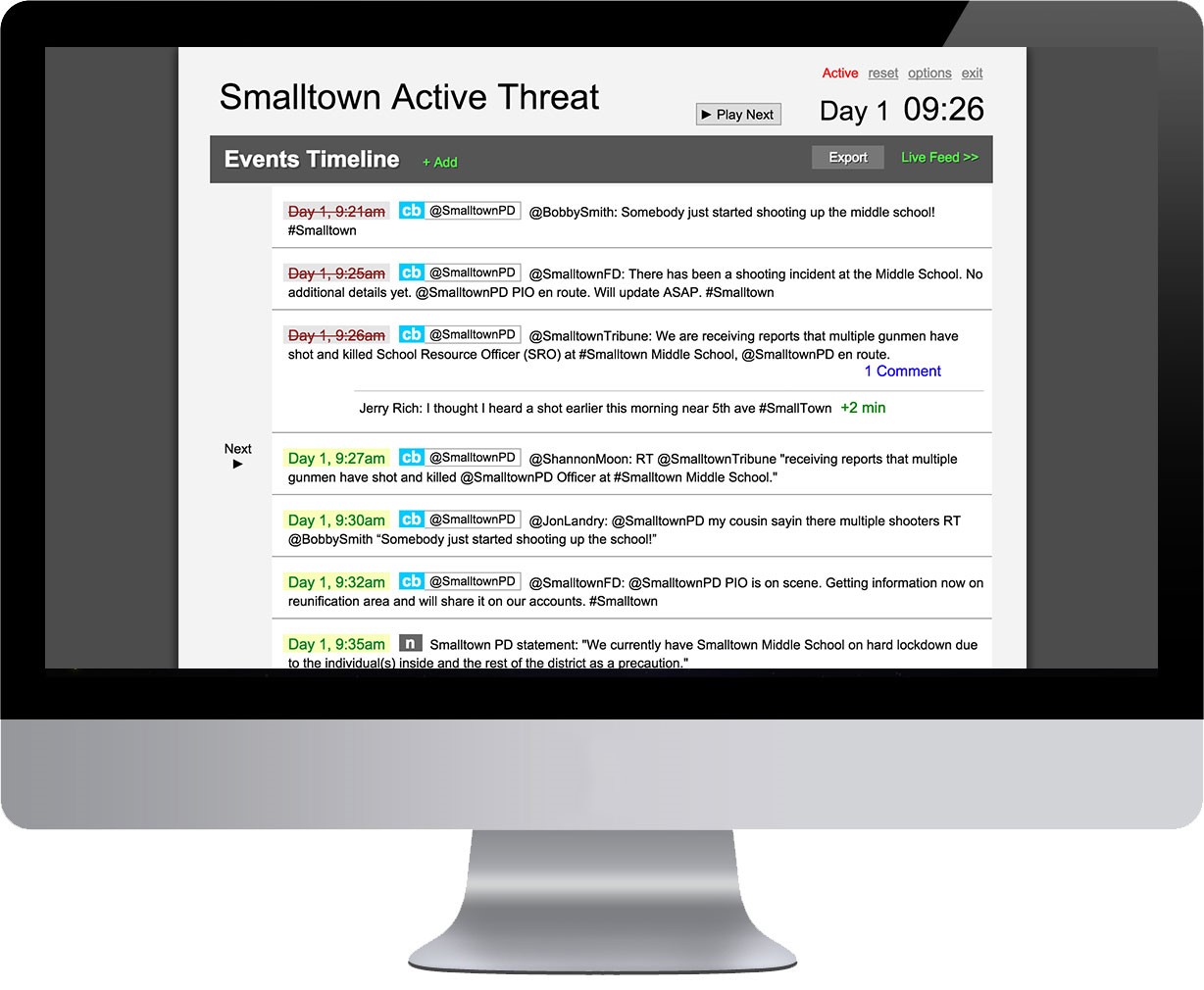
EMSocialSimulation is a great social media simulation tool geared toward organizations and jurisdictions looking to train and exercise on beginner to intermediate social media capabilities at an affordable price. I was impressed by how well the whittled down the feature set to not overwhelm users as well as exercise planners. This is perhaps a significant advantage over incumbents such SocialSimulator, Conductrr, Polpeo and SimulationDeck that offer more advanced features and controls, but can easily become overwhelming to a novice social media organization.
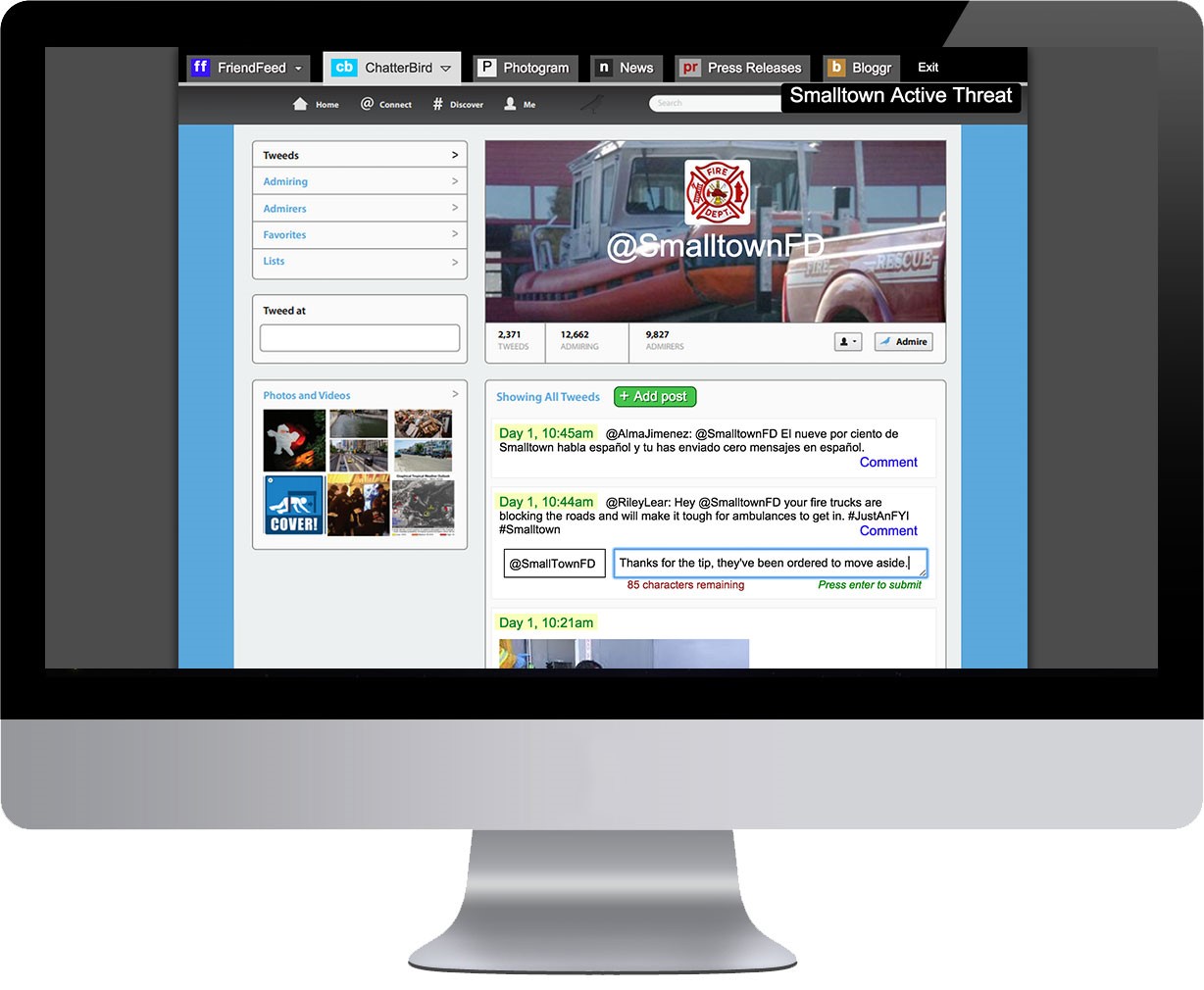
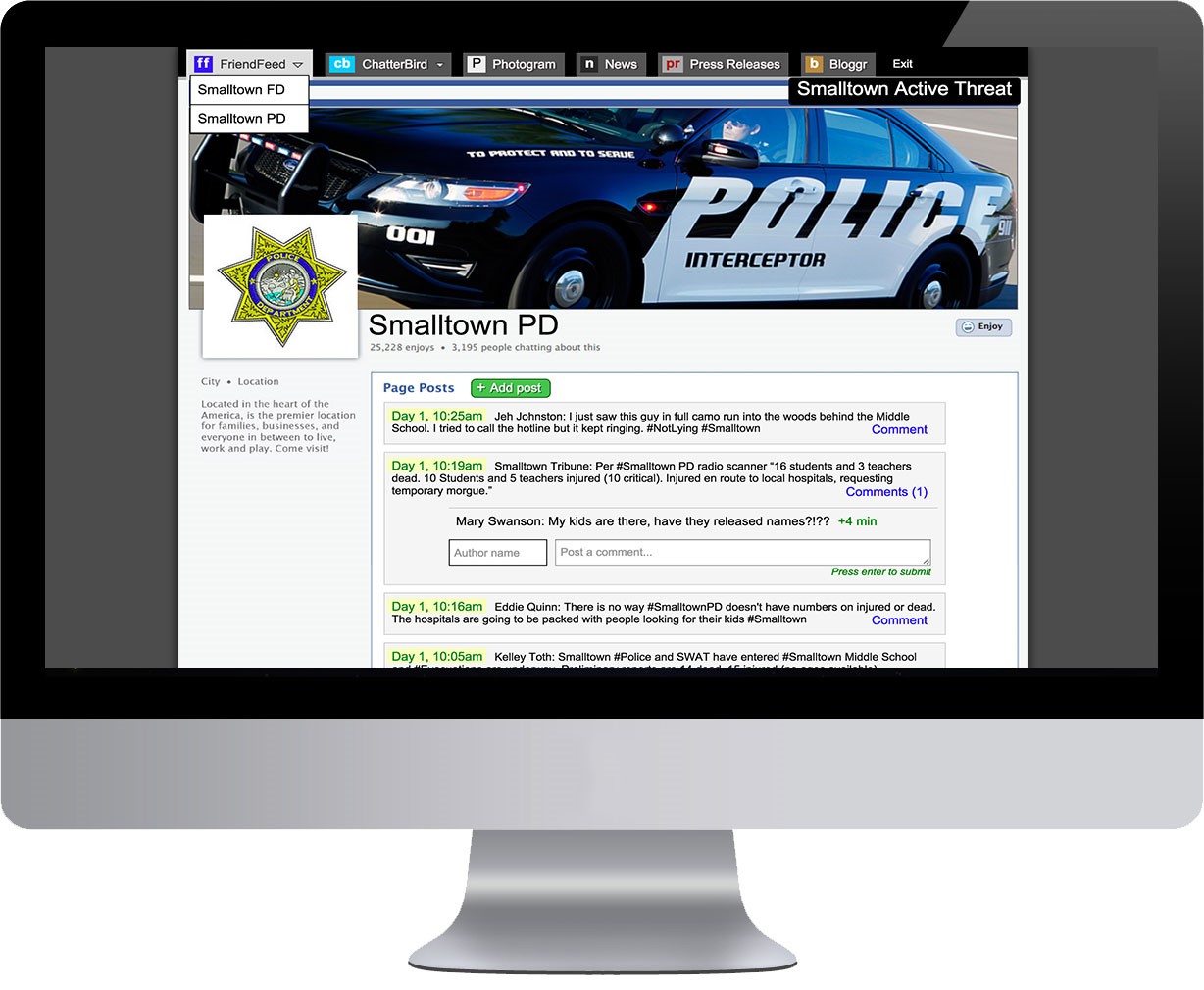
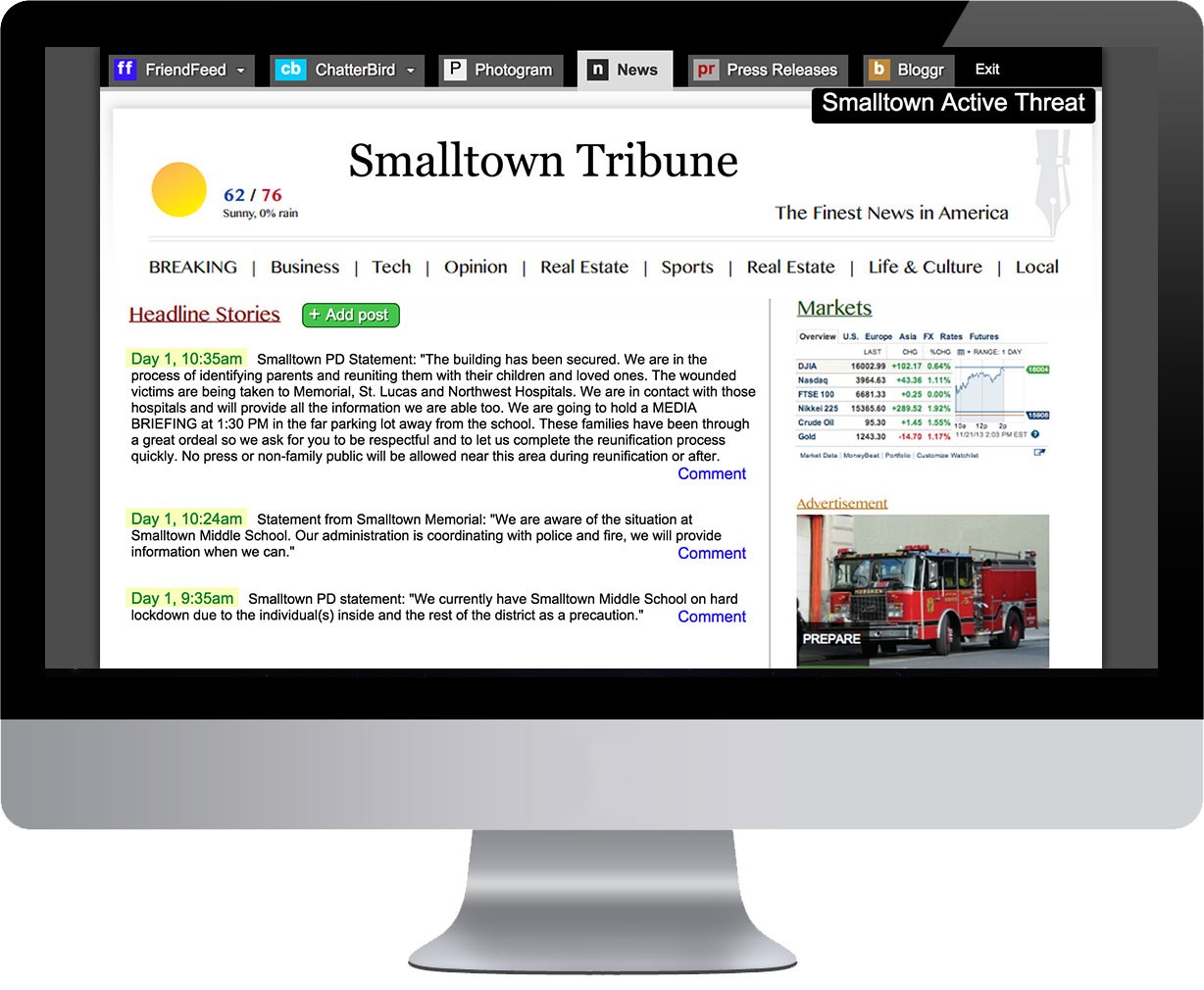
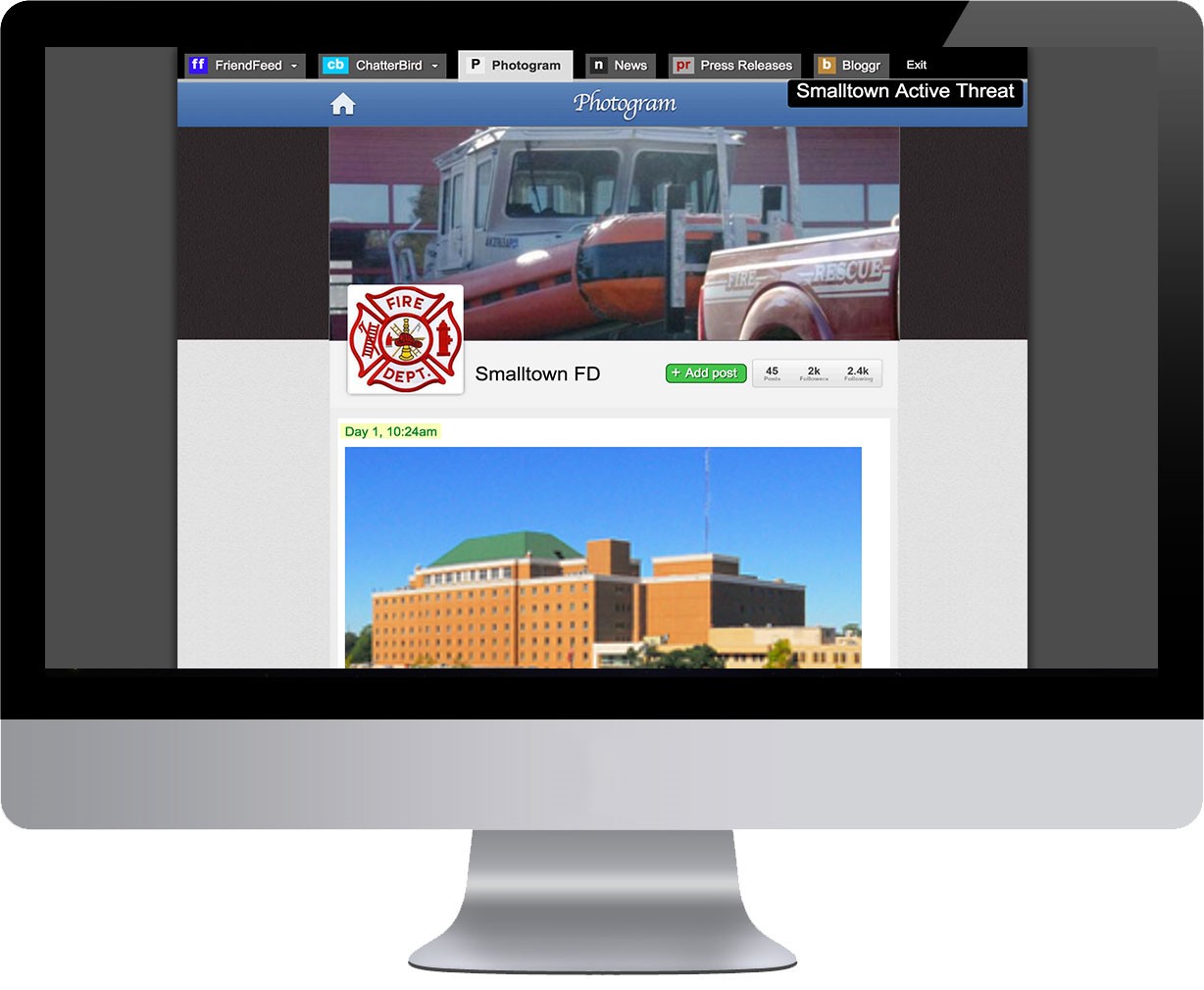
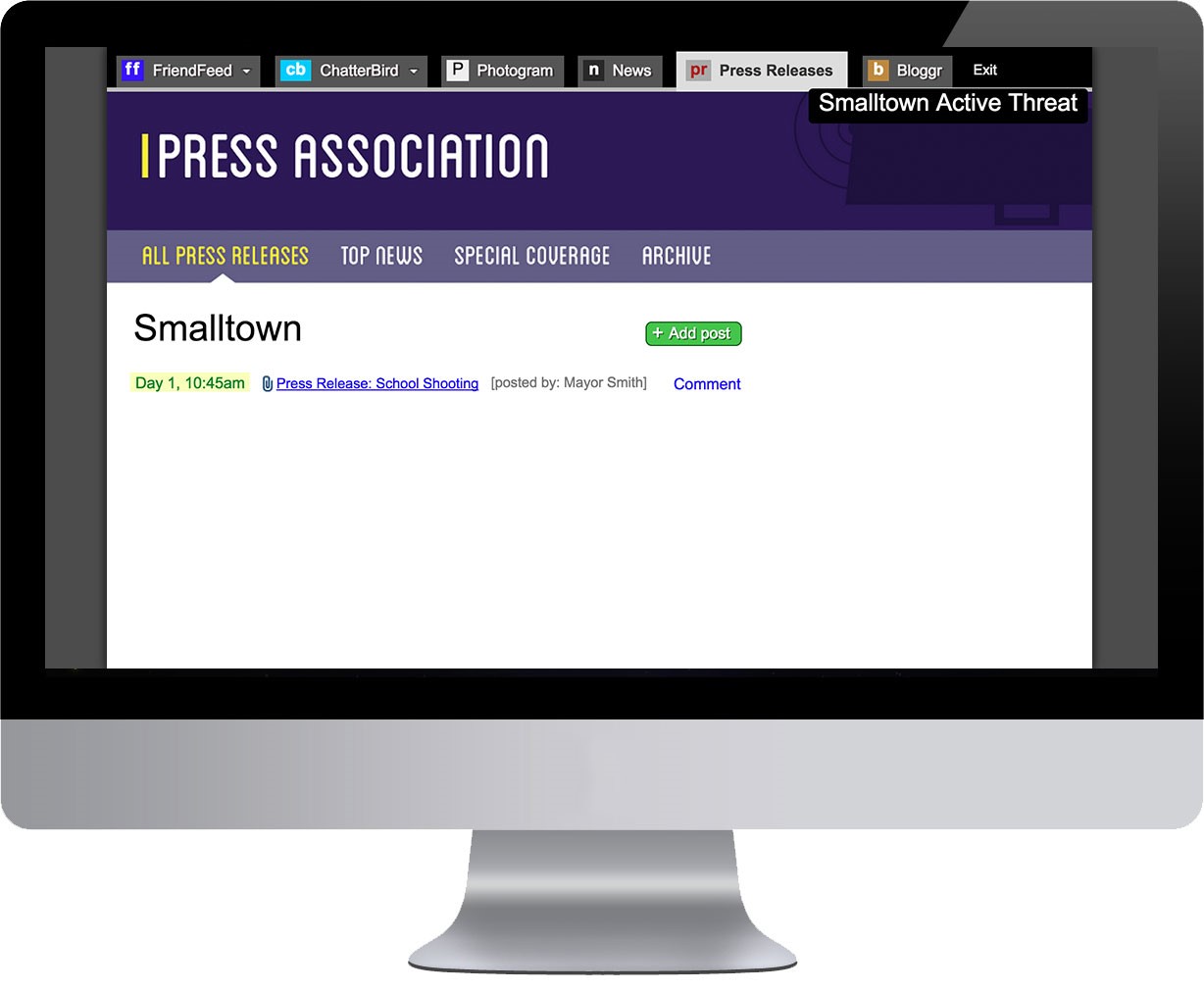
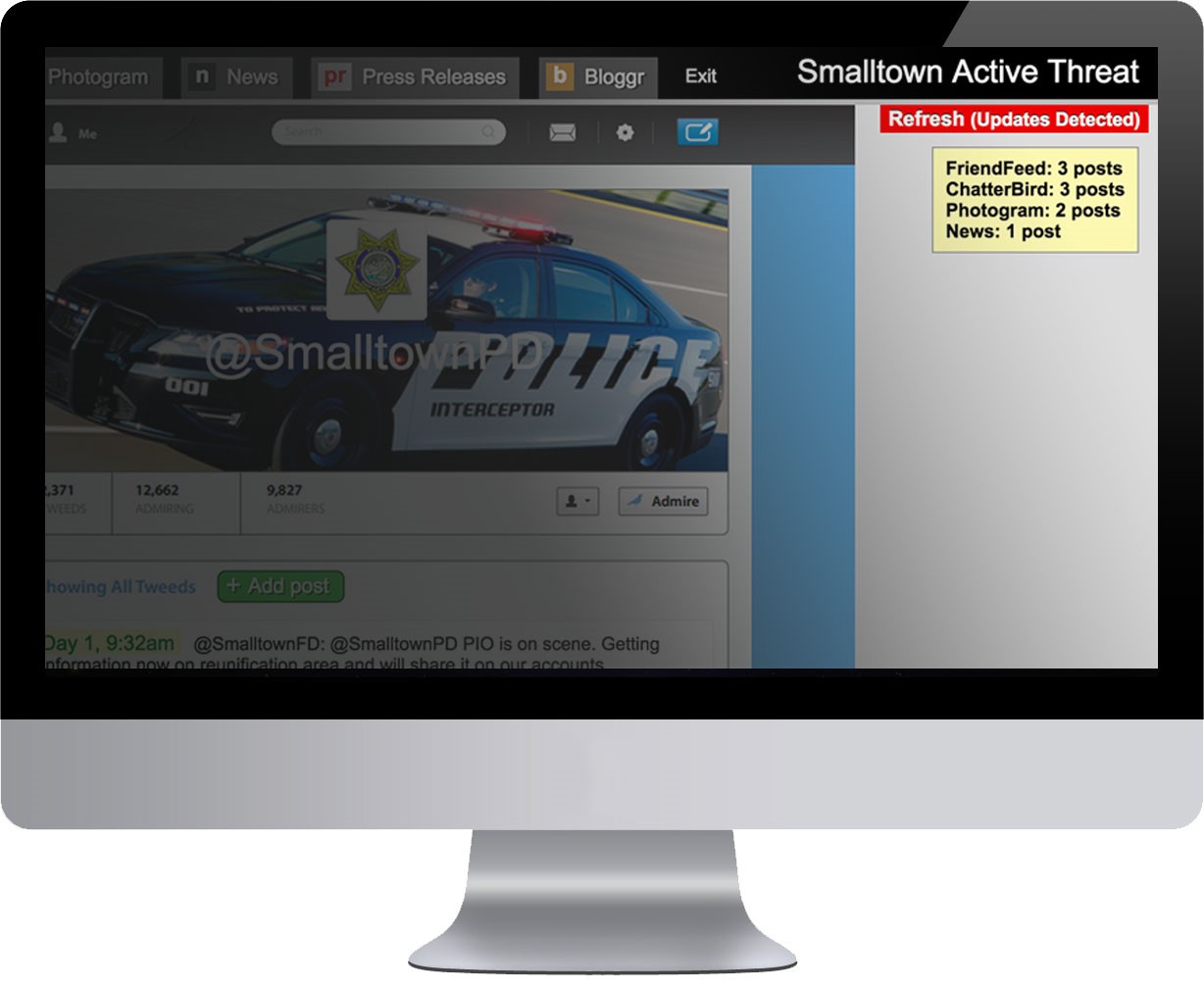
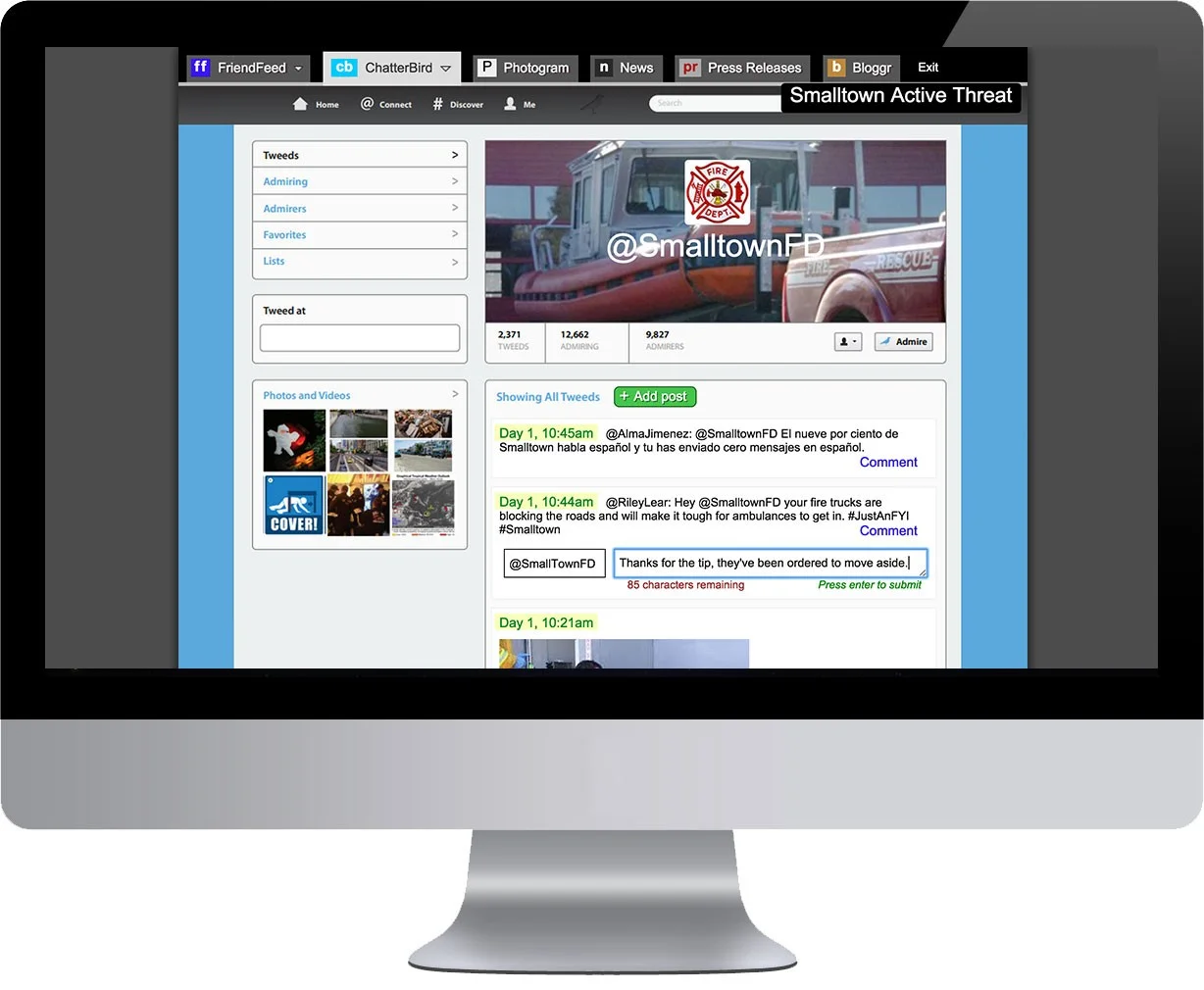
If you want to test different types of social media accounts such as all the Twitter accounts in your jurisdiction, EMSocialSimulation makes it easy to create multiple accounts on each simulated social media platform. It has accounts for FriendFeed (Facebook), ChatterBird (Twitter), Photogram (Instagram), News (Simulated Media Posts), and Press Releases.
Many of you in the public sector may be asking if the tool is aligned with HSEEP as you may be required to follow this methodology. Because EMSocialSimulation is just a simulation platform (not a methodology), this is the wrong question to be asking. EMSocialSimulation merely helps you execute HSEEP designed and developed exercises or other types of exercises related to social media. As such, it is aligned with HSEEP, but is certainly not an HSEEP methodology tool. You would plan an exercise just like you would normally and then use EMSocialSimulation to simulate the social media capabilities under the Public Information / Public Affairs emergency support function.
Hagerty has mostly been using EMSocialSimulation to support their existing clients and as a result is not as self-service oriented I would have liked to see it, especially as it has been in use for over twelve months. For example, you still have to go through a sales process with them and have them bulk upload injects, unless you want to do each one by hand. They also have inject templates available and are creating more for different hazards and scenarios; but again, you must still go through your Simulation Coordinator in order for these templates to be accessed and uploaded.
The video below walks you through EMSocialSimulation as well as Hagerty's social media exercise design and development process.
I am excited to see, though, that they allow the export of all simulation data for analysis. Most of the data can be analyzed by someone with some basic Excel data and analytic skills. However, Hagerty will also provide this type of analysis as a service. One data point they capture that might be useful is the response time between when a message was posted vs. responded to. This can help you identify if response times are within your guidelines or help you determine if there was a problem with the social media response timing as a whole.
Overall, I would recommend this tool to organizations and jurisdictions just beginning their foray into social media messaging and response. I would not say this is your Cadillac platform for social media simulation and it won't scale to thousands of tweets easily. But it should suffice and be all that is needed for many in the emergency management community. Just don't be scared off by the design of the tool looking like it was built in 2005. It still has the power you need it to have.
In the comments below, I would interested in knowing your social media training and exercise challenges? What has been your experience with other tools?
I also asked Corey to answer some additional background questions you might finding interesting:
What is your name and role in the Organization?
My name is Corey Mulryan and I am the Simulation Coordinator and simulation content developer for EMSocialSimulation (EMSS). I work with clients to develop the simulation, and if needed, help run the application on the day of the exercise.
What does your tool do?
EMSS helps users practice the use of social media in a realistic, safe, and secure environment. EMSS helps identify gaps in plans and operational structures where internal policies and procedures. Finally, EMSS is scalable, which results in cost effectiveness and customization.
What/who inspired you to create this?
Social media is here to stay and its role in emergency management has become a matter of expectation, not the exception. As an example, a client of ours asked if there was a way that we could incorporate social media into their exercise. We questioned our typical response and that sparked the innovation. We researched current solutions and found that they were not meeting the need. Some examples observed included low tech options like sending a fax or email with simulated social media messages or creating private accounts on live systems, but that is not realistic and is risky, not to mention a lot of work for our clients. Other high tech solutions seemed overdone, expensive, and outside of clients reach.
The Hagerty team started discussing social media and that its inclusion should be the standard, the same way we don’t think twice about following or including Homeland Security Exercise Evaluation Program (HSEEP) in every exercise. We wanted to provide our clients with an opportunity to practice social media, familiarize themselves with process and approach, and see how social media could be incorporated into what they do during normal operations and response.
What challenge does your tool help customers overcome?
Emergency Managers and first responders know they should be using social media. The University of San Francisco’s 2013 study on using social media identified that “80% of Americans expect emergency response agencies to monitor and respond on social media platforms, additionally, 33% expect help to show up within just 60 minutes of a post.”
Those numbers are a wake-up call. A public expectation has been established and EMSS helps meet this challenge by training staff and demonstrating to management the benefits of using social media in disaster response. During Hurricane Sandy, “the American Red Cross had 23 staffers monitor over 2.5M Sandy-related social media posts.” Agencies cannot hope that one person will be able to handle social media alone, EMSS allows them to cross train multiple staff members to build knowledge and trust within an agency. EMSS allows players to remain engaged during a longer exercise with a steady flow of information that we try to keep interesting.
How does it do this?
EMSS hosts replicas of common social media platforms that can be customized based on the objectives of the engagement. Players are able to make posts and comment in a way that looks and feels real. Of course, all of this is controlled in a secure environment by the Simulation Controller. EMSS does not link to any social media platforms so there is zero chance that any messages sent or posted during a simulation will end up on an agency’s actual accounts. The Simulation Controller will develop injects to test various responses from the players. This can be issuing information, responding to requests, monitoring traffic, or anything else. The Simulation Controller will then upload injects in accordance with the exercise timeline and be able to respond to players in real time. After the simulation is complete, the Simulation Controller can export the data to an After-Action Report/Improvement Plan.
What is next for the tool?
This tool can really help people, we have seen it firsthand. We want to continue to help users experience social media in their training and exercise endeavors, and to bring the whole concept to life. We want this to foster the development of internal procedures and integration of social media into communications standards. We want to continue this process and work to better identify how social media is used to monitor situations, communicate with residents and stakeholders, share information, and reach the whole community. EMSS has been used geographically across the country, with events ranging from a tabletop to a full-scale exercise. This tool is available for an affordable price and can include multiple stakeholders or formats, such as training, exercise, or simulation.
How can people get in touch, learn more or test the tool?
If anyone is interested in EMSS they can go to our website for more information www.emsocialsimulation.com. On the website they can fill out the contact us form at the bottom or send an email directly to emsocialsim@hagertyconsulting.com. We will quickly respond and schedule a demo and discuss the application.

The Different Types of Technology for Disaster
A couple weeks ago I presented yet again on technology trends for disaster management. There seems to be a great demand to understand the technology landscape, namely what is out there. I am glad to see this interest and want to share the work I have done.
This week, I decided to create a dedicated webpage that will highlight the different technologies available. I will continue to add new technologies as I come across them! Feel free to send any leads you may have!
Also, check out the webinar I gave a couple weeks ago on Technology Trends in Disaster Management. Due to a technical glitch, the recording started a few minutes in...
A couple weeks ago I presented yet again on technology trends for disaster management. There seems to be a great demand to understand the technology landscape, namely what is out there. I am glad to see this interest and want to share the work I have done.
This week, I decided to create a dedicated webpage that will highlight the different technologies available. I will continue to add new technologies as I come across them! Feel free to send any leads you may have!
Also, check out the webinar I gave a couple weeks ago on Technology Trends in Disaster Management. Due to a technical glitch, the recording started a few minutes in...

Disaster Technology is Built All Wrong
Technology is a great asset for organizations. It facilitates communications and helps simplify complex tasks. This is great when you have complete or majority control of your operating environment, which is common in business and day-to-day operations.
The problem in disaster response, though, is that unique and temporary organizational structures (e.g., ICS, JFO, ESF, etc.) form during a disaster that differ significantly from day-to-day operational structures. And roles within these temporary structures are filled by various people at different times, some professional and some volunteer.
For example,
Technology is a great asset for organizations. It facilitates communications and helps simplify complex tasks. This is great when you have complete or majority control of your operating environment, which is common in business and day-to-day operations.
The problem in disaster response, though, is that unique and temporary organizational structures (e.g., ICS, JFO, ESF, etc.) form during a disaster that differ significantly from day-to-day operational structures. And roles within these temporary structures are filled by various people at different times, some professional and some volunteer.
For example, a Public Health Analyst at the Public Health Department may move to ESF-8 Lead in the County EOC for Shift A, which has a different operational structure from the Analyst's day-to-day job. And another Analyst from the Hospital Association will likely support ESF-8 during Shift B. Now the analyst is part of two different organizational structures (employment and response) with separate technologies for communicating and fulfilling functional responsibilities.
But many technologies on the market today are developed for and sold directly to single organizations for their given missions and responsibilities. Little attention is paid to when the Public Health Department needs to collaborate with and share data with Law Enforcement or vice versa. Significant time and effort ends up being spent on reconciling information inconsistencies between systems as well as ensuring one has the most up-to-date information...by hand.
Or, these technical systems end up being back-hacked for a fee to the vendors or consultants. However, "back-hack" connections are mere patches to larger information sharing problems. They may solve your immediate information sharing problem, but not the systemic problems. This is critical in disasters where many different organizations need to work together as one or in coordination with each other.
My main argument is that technology products in the disaster response industry are geared toward a single enterprise deployment. This is not representative of the way disaster responses are managed or coordinated. The next generation of technology needs to recognize that it needs to serve both organizational AND inter-organizational information needs with relative ease and reliability.
In addition, in looking to the immediate future, technology needs to incorporate citizen participation in disaster response in practical and process-reducing ways. The public are key assets to response that are underutilized in part because technologies don't address the additional process burdens that naturally occur with managing and coordinating volunteers and using information from the public. I see way too many analytic and visualization tools that give little thought to how the information can be collected and leveraged in a compressed time frame in a way that adds value to the response.
Technology of the future needs to give more thought to how it captures organizational affiliations while still enabling inter-organizational and citizen collaboration in less process-intensive ways (e.g., not having to administrate five different systems with different sets of users).
What do you think? What are you gripes with buying and administrating new technology?

Talking Tech, #SMEM & Nepal with the Dukes of Hazards
On Tuesday, May 5th, I had the pleasure of being interviewed by Mitch and Andrew on their Dukes of Hazards Podcast. We talked about technology, social media, and the recent Nepal earthquake. You can listen to the full Podcast here:
The Dukes of Hazards Podcast is put on by two very funny guys, Mitch Stripling and Andrew McMahan. Mitch is the Assistant Commissioner for Agency Preparedness & Response at the New York City Department of Mental Health and Hygiene. Andrew is the Deputy Director of Emergency Operations Support for the NYC MTA (Metropolitan Transportation Authority).
On Tuesday, May 5th, I had the pleasure of joining Mitch and Andrew on their Dukes of Hazards Podcast. We talked about technology, social media, and the recent Nepal earthquake. You can listen to the full Podcast here:
The Dukes of Hazards Podcast is put on by two very fun guys, Mitch Stripling and Andrew McMahan. Mitch is the Assistant Commissioner for Agency Preparedness & Response at the New York City Department of Mental Health and Hygiene. Andrew is the Deputy Director of Emergency Operations Support for the NYC MTA (Metropolitan Transportation Authority).
Mitch + Andrew drink Shandies and break down all things tech+disaster w/ Brandon Greenberg of @disasternet. Avocado? http://t.co/QfYb8ZXpah
— Dukes of Hazards (@hazardspodcast) May 6, 2015![How Disaster "Mesh" Networks Provide Critical Value in Disasters [A Primer]](https://images.squarespace-cdn.com/content/v1/53a9cfb7e4b0ac3522f6060f/1430856341703-0VM0M4Y450TF0C11NOTY/image-asset.jpeg)
How Disaster "Mesh" Networks Provide Critical Value in Disasters [A Primer]
Mesh networks have been around since the Department of Defense starting playing around with the idea of exchanging data and information in remote and infrastructure-compromised locations. In recent years, mesh networks have been applied to disaster operations to enable the exchange of data and information regardless of Internet access.
However, mesh networks are quite technical to setup and use. A non-profit and open source technology called LDLN makes this a lot less technical so nearly anyone with some basic tech skills can set up and use a mesh network. Before I dive into how LDLN does this, I want to provide a primer on mesh networks, how they work, and the problems they solve.
A couple weeks ago, I published a post extolling the virtues of a nonprofit and open source technology called LDLN. I wanted to highlight the importance of such an endeavor, which is more than most people realize.
After publishing the post, a colleague and long-time emergency manager I greatly respect replied to me, "Whereas I love the fact that you bring new technology to the forefront of disaster management, I often find myself not really understanding what exactly is being discussed. The average non techy emergency manager like myself, who may want to further explore options like LDLN, needs to have an example of its use in the hospital or other environment that is concrete and that can put the technology in prospective."
In reflecting on this, I could have done a better job explaining the problem and how mesh networks such as LDLN play a critical role. This is a complicated but important subject that I want to make sure people understand. So I decided to write another post explaining mesh networks and the value of LDLN.
Mesh networks have been around since the Department of Defense starting playing around with the idea of exchanging data and information in remote and infrastructure-compromised locations. In recent years, mesh networks have been applied to disaster operations to enable the exchange of data and information regardless of Internet access.
However, mesh networks are quite technical to setup and use. A nonprofit and open source technology called LDLN makes this a lot less technical so nearly anyone with some basic tech skills can set up and use a mesh network. Before I dive into how LDLN does this, I want to provide a primer on mesh networks, how they work, and the problems they solve.
The Relationships Betwen Networks, Servers, Routers and the Internet
Let's talk networks, servers, routers and the Internet in a very over-simplified way. Servers are basically supped up computers that can manage the storage of and access to data and information. In some ways, your personal computers access as a server, but when I say server I am talking of machines whose sole purpose is to store and manage access to its data and information. You know that share drive you have access to at work? It is hosted on a server. You know that application that you have access to on the web or only when you are at work? It is hosted on a server. Servers host and store applications with their associated data and information.
In order to access the applications as well as data and information, servers are connected to networks, both wired and wireless. Think of your home network where you can connect your computer, mobile phone, tablet, etc. (also called a "client" in tech terms) via an Ethernet cable or via WiFi. Corporate networks are principally the same, but a bit more complicated in practice. What you need to know is that networks connect you to servers. You rely on this access almost 90% of the time, though you may not realize it. Connecting to your employers wireless network creates an unspoken relationship between your personal computing device and the servers. Outlook is a classic example where the application and the data and information can live on your computer, but all that information is backed up and synced to servers operated by your organization or a third-party vendor.
Now what happens when multiple networks exist or you have to keep an network up across a wide geographic area? It is not so simple for the application with its data and information on your computer to find the relevant server that it needs to sync with. To help direct this digital traffic are routers. The professionals who typically manage this traffic for organizations are called "network engineers." You are an amateur network engineer when you set up your home wireless router, which helps you print to your printer wireless and connect to the Internet. Routers operate in the background to help manage the digital relationship between your computer and servers, printers, the Internet, etc. Routers are especially important when you have many computers and devices on a network that need to exchange data and information. Otherwise, the network would be overloaded and no one would be able to access the servers.
The Internet is like a meta-network that gives you access to the outside world. Many web-based applications live on servers hosted by vendors (or third-party data centers), but are accessible via the Internet because they allow such access. When it comes to Internet access, though, you may have access to your servers via your network, but unless the network is connected to the Internet, you will not be able to access anything external such as web-based applications. For example, you can input patient records into your computer, but you won't be able to access TMZ.com to get the latest dish on Kardashians. So you need to remember that network access and Internet access are related, but separate. You can have network access without Internet access, but not the other way around.
If you don't understand what networks, servers, and routers are and how they work together, the following may be a little harder, but not impossible to follow.
Options for Accessing and Syncing Data and Information
In disasters (and in most of the world), their are generally two ways to exchange data and information no matter what applications you use: 1) a private network, and 2) or the Internet.
Private Network. Before the Internet was a thing, this is where organizations focused their efforts. Organizations set up their own servers, networks and routers at their employment locations to ensure employees have access to and could exchange data and information. All applications along with their data and information remained in complete control of the company and separate from the Internet.
In modern times, a private network plays an important role in data security and control by being able to create a digital wall around data and information (does "firewall" ring a bell?). As you can image, when such an ecoystem is set up with the goal of keeping information in, trying to share data and information across networks becomes extremely challenging. Virtualization and VPNs help mitigate these challenges, but are not perfect and can create some critical and complicated interdependencies. Disaster recovery managers (the IT-focused kind) help plan for and manage these interdependencies so they do not impact operations.
The Internet. The Internet acts much like the networks mentioned above, but in a more public way. Servers are still there and routers help manage the digital traffic in the meta-network called the Internet. The exchange of data and information across the meta-network becomes significantly easier as their are less geographic restrictions. However, using the Internet to exchange data and information creates an extremely critical interdependency. For example, many applications that we have come to love and enjoy on our phones or through our web browser are dependent on Internet access and consume a lot of bandwidth. No Internet means no exchange. Period.
The Problem. These are basically two terrible options for exchanging data and information in a disaster! You can either build applications that work on your private network or build them to work via the Internet. The former limits how far away you can exchange information or across networks, such as hospital-to-hospital or hospital to EOC, and requires the application live on a physical server in your network (e.g., bring a server to the disaster location). The latter creates a critical interdependency on Internet access, which can be a luxury in a disasters.
Mesh Networks in Disaster
Mesh networks allow for the sharing of data and information across wireless networks when no Internet is present. The "mesh" part comes because of the way these networks are typically deployed. A typical deployment model is to "daisy-chain" networks together in such a way that each network shares the data and information with the network it is next to, which then shares it to the next one, and the next one, etc. (think overlapping WiFi signals that link up to each other). And sometimes, if another network has Internet access, you may be able to get Internet access in your network. But the quality of wireless signal drops dramatically the further away you go. Setting up this type of environment is also very technical and difficult in practice!
LDLN and Mesh Networking
LDLN's software and hardware acts as a combined network, router and server. Instead of having to have data and information sync from your computer or mobile device to "the cloud" (servers accessed via the Internet) or internal servers (servers accessed only through your private network), LDLN becomes the best of both worlds. LDLN provides the technology that lets you physically move your phone or computer from one private network to another private network and seamlessly exchange data and information regardless of Internet access.
For example, you have information on your computer that was created while you were in your hospital's network. Now you moved to the municipal EOC that is on a different network, but neither network has Internet access to sync up data and information. With LDLN, as you move to the other network, your computer or mobile devices automatically uploads the data and information on your device to the hardware in that network.
That part is not exactly innovative. What happens next is more innovative:
- If other devices are on the new network, your data and information will automatically be synced to their devices and their data and information will automatically be synced to your devices (regardless of the Internet situation)
- If the new network is connected to the Internet, your data and information will also automatically be synced to the "cloud" for people in other networks to access and their data and information will automatically be synced to your devices.
- If your network is connected to other networks (called daisy-chaining), your data and information will also automatically be synced to those networks and all the devices in those connected networks.
In essence, LDLN has mastered issues that arise when syncing occur asynchronously and distributed across different networks and servers. It will not produce errors when all devices become synchronized with their own as well as each others data. This is huge. Many software solutions don't know what do with conflicting or asynchronous data and information, which causes lots of problems. The software can't reconcile what is the latest information or that it is the same information from different locations such as two receiving hospitals tracking patients.
Gmail handles data conflicts well, but still relies on the Internet for syncing. For example, I might run through my email on my mobile phone while on a plane with no WiFi. I archive some emails, star others, etc. Then I forget and compose an email in my tablet and archive some of the same emails. When I get to the ground, Gmail reconciles what I did on my phone as well as my tablet and doesn't produce any errors. But what if I was in the air with no Internet access and wanted my Gmail on my phone to sync with my Gmail on my tablet? LDLN solves this problem in a disaster environment.
LDLN's Value Proposition
The biggest value for LDLN is to be embedded in various applications, servers and routers. For example, during Hurricane Sandy, this technology could have been integrated with NYU's electronic health records system to share critical patient information stored on their servers with the other receiving hospitals. A person could have physically moved to one of the receiving hospital locations with his or her laptop that had the latest data and information automatically downloaded and synced. That person could have then have electronically shared health records with the receiving hospital. Simultaneously, that person could have kept track of who is at what hospital and have that information be automatically shared back to NYU emergency management personnel.
This is of course a hypothetical example that is over simplified. It merely demonstrates the power of LDLN. Issues such as technical integration, HIPAA and data security would still have to be navigated when setting up this technology. However, I think that can be worked out in the future.
Questions, comments, concerns? I would love any feedback you have on this topic and article.