
Data and Info Sharing with No Power or Internet? - Meet LDLN
There is an organization that I have wanted to introduce people to for a while. It is a game changer, provided it can be applied more and baked into operations and various technologies.
In disaster operations, the Internet is the predominate way to share data and information across people, organizations, and geographies--when it is available. It is a critical failure point to inter-organizational and region-wide operations that need to share across wireless networks. When access to the Internet is compromised, cascading effects occur such as having to reconcile what the latest data and information is. In fact, data and information sharing is often reduced to files on USB sticks that are physically traded. Version control becomes essential, but hard to maintain.
There is an organization that I have wanted to introduce people to for a while. It is a game changer, provided it can be applied more and baked into operations and various technologies.
In disaster operations, the Internet is the predominate way to share data and information across people, organizations, and geographies--when it is available. It is a critical failure point to inter-organizational and region-wide operations that need to share across wireless networks. When access to the Internet is compromised, cascading effects occur such as having to reconcile what the latest data and information is. In fact, data and information sharing is often reduced to files on USB sticks that are physically traded. Version control becomes essential, but hard to maintain.
LDLN
LDLN (pronounced "landline") is a robust open source mesh network that goes beyond network reliability issues for connecting to the Internet. LDLN combines the best of sync technology to enable data and information sharing with or without Internet across networks, organizations and geographic areas. Most importantly, this is all done without duplicating content or complicating reconciliation efforts. Simply said, it is designed to just work without the need for constant management and oversight. Pretty cool, huh?
Normally, I would limit conversation of this type of technology to the techies among us who work to maintain network operations. But I believe everyone should be aware of its existence and capabilities to inform strategic and operational thinking before and during disasters. There are two key components to LDLN's potential success, it's software and it's hardware. These two aspects are are discussed below in the Q&A with LDLN's founders.
This technology is not a far cry from Ushahidi's BRCK, which is a small all-in-one portable router (wired and wireless), server, and multi-modal Internet connection device with a long-lasting battery back-up. However, BRCK's focus is on single-point data and information exchange while LDLN allows the carrying of data and information on any device to another access point, which then automatically shares the most current data and information with all devices connected to the new access point.

BRCK and LDLN are complementary technologies that enhance each other's value proposition. LDLN could potentially be implemented on BRCK as well as any other hardware such as existing servers and routers. The hardware, though, does not need to be limited to the RaspberryPi devices mentioned below. While these possibilities are not yet in LDLN's current product, they could be a next step for them.
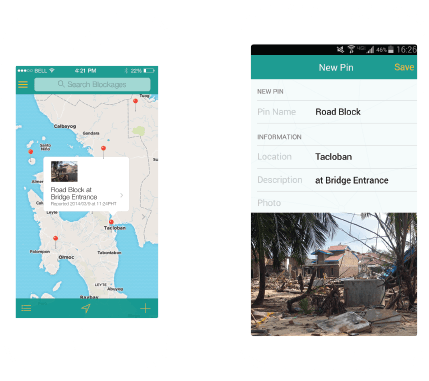
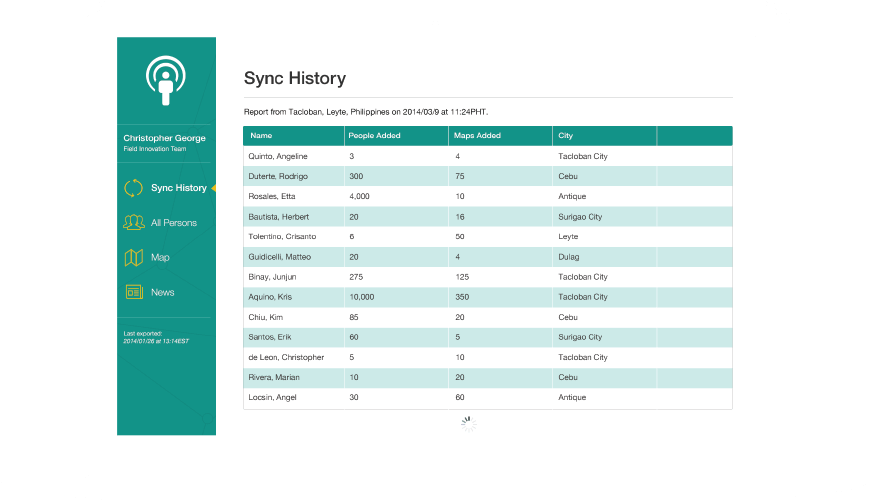
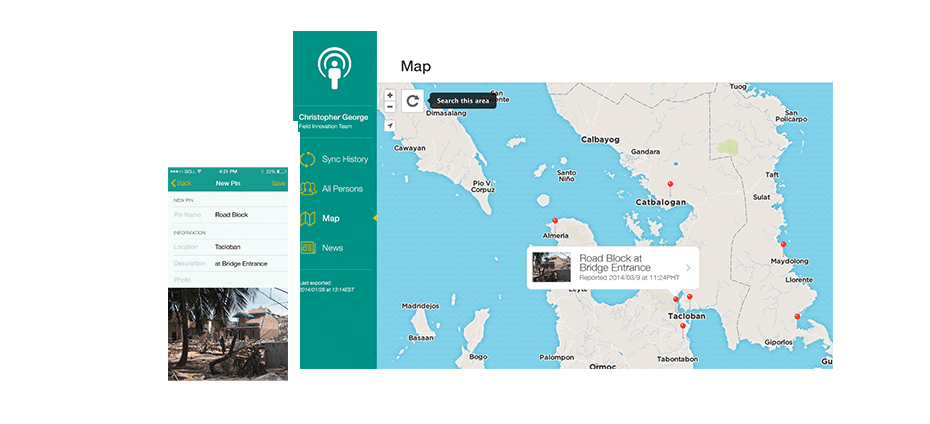
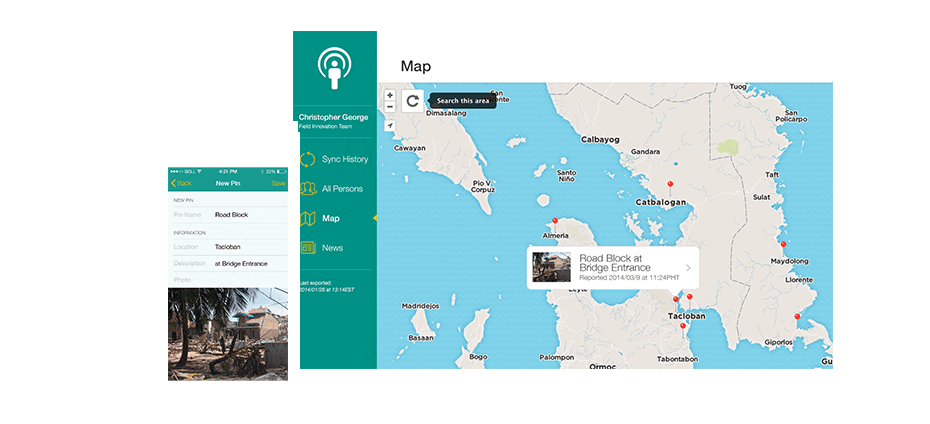
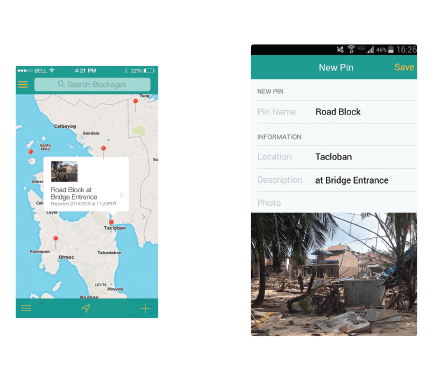
I am glad LDLN was able to respond to my Q&A request. Check out the entire Q&A below, which includes pictures of LDLN's software.
LDLN Question & Answer
What is your name and role in the product/solution/company?
- Matt Grasser - CEO
- Emily Duong - CCO
- Sam Krueckeberg - Engineering Lead
- Arthur Chen - Chief Legal Counsel
- Joyce De Vera - Head of Marketing
- Nick Ihm - CTO
- Christopher Guess - COO
- Kristine Austria Sanchez - Designer
What does LDLN do?
LDLN is a communications system for disaster relief organizations when there is no power, internet or wireless connectivity. LDLN allows organizations currently reliant on notebooks and pencils to have a fully synced, fully backed up, reliable communications system over any size of operation theater.
What/who inspired you to create LDLN?
We were inspired by our team members’ experiences across the world. Chris first conceived of the idea while working with Occupy Sandy during the Hurricane Sandy response, and suggested it up as an idea at a Philippines resilience hackathon. From there the team pooled ideas and skills to create a system responders would want to, and easily be able to use in the field with minimal training.
What challenge does LDLN help users overcome?
When a disaster relief organization deploys to the field in 2015, they are for the most part still equipped with the same tools that were available in 1991. Every major tool and recovery method used today currently relies on two things that are, to put it mildly, in short supply: electricity and internet connectivity. In absence of connectivity, relief workers fall back to the stalwarts of pads of paper and pencils.
In short, we provide the software and hardware necessary to form a modern backbone for communications and document synchronization. This resilient, decentralized, "designed-for-disasters" network does not depend on cellular technology, Internet connectivity, satellite up-links, or even an external power grid where others would.
How does it do this?
The LDLN Base Station, a tiny computer about the size of a deck of cards, combines the networking features of a traditional decentralized mesh network node with the reliability and storage capabilities of a traditional web server. Standing in stark contrast to expensive, bulky, custom-built satellite trucks and enterprise solutions, the Base Station is inexpensive, extremely portable, and consists of open hardware.
Building on this network of Base Stations, mobile apps powered by LDLN's SDK afford the familiar interfaces of a modern mobile experience, using of peer-to-peer protocols to skirt the need for a centralized network. Apps and Base Stations work in harmony to push and pull pieces of encrypted data across the network, ultimately displaying information in a natural and easy-to-read format.
What is next for LDLN?
LDLN is very proud to be have accepted into The GovLab Academy Coaching Program at New York University for the spring of 2015. We are looking forward to engaging with thought leaders and experts in the fields of disaster relief and government action.
In parallel, LDLN is currently developing our second generation of base station and mobile technology. This will allow in-the-field customization of the data collected and reported along with massive speed improvements on the base station side.
How can people get in touch, learn more or test LDLN?
Anyone interested can get in touch with our team through our website or social media, or via email.
- Website: http://www.ldln.co
- Facebook: https://www.facebook.com/ldln.co
- Twitter: https://twitter.com/landlineph
- Email: info@ldln.co
Since our software is open source you can also take a look at the code at our Github site: https://github.com/LDLN/

Curate Dashboards NOT Documents in Disasters
The goal of any information or intelligence unit in a disaster is to produce information useful for decision makers. Information managers, though, curate and analyze information into static and overly-standardized reports that are hard to interact with and update with new and different data and information.
Instead, information managers should focus on publishing information into dynamic dashboards that can be further manipulated by disaster decision makers at their convenience. This is because decision makers may want to quickly...
The goal of any information or intelligence unit in a disaster is to produce information useful for decision makers. Information managers, though, curate and analyze information into static and overly-standardized reports that are hard to interact with and update with new and different data and information.
Instead, information managers should focus on publishing information into dynamic dashboards that can be further manipulated by disaster decision makers at their convenience. This is because decision makers may want to quickly probe information directly if they find something potentially alarming. If it requires more analysis, sure, it can be sent back to the situation or intelligence unit. But a 1 minute prob may have just satisfied all of the disaster decision makers concerns, especially when time is a luxury.
On the plus side, your customer base likely won't change as you much as you think. In fact, most of what should change is your mindset on how to convey data and information. For example, instead of creating five reports for five groups of people, you are now working to curate five dashboards for the same five groups. The tools may differ, but the process of creating useful information outputs will be similar. Information managers may still need to collect, organize and analyze data and information, but now there are new and better ways to present it.

Tableau Dashboard
There are plenty of software solutions that support dynamic dashboards, both online and offline. Tableau, Splunk, and Palantir are some of the leading providers. The danger, though, comes when you develop a dashboard before a disaster and have no plans to optimize and update it during a disaster. This optimizing and updating must be incorporated into your response operations in order to provide more useful dashboards based on real-time feedback.
This real-time curation and updating mindset is a shift from the report publication cycles that are often aligned with operational periods. It enables information managers to provide the most up-to-date information to disaster decision makers. This is especially needed when operational periods differ across the many organizations involved in a response.

In many cases as well, you are able to develop automated processes that streamline the collection, organization and analysis of data an information. This allows information managers to focus on presenting available information that is most useful to disaster decision makers rather than spending significant amounts of time processing data and information.
Anyone who has dealt with data understands that data and information processing (e.g., obtaining, scrubbing, exploring, modeling and interpreting) is very time-consuming, but necessary. Any chance to automate processing allows you to focus more on presenting available information in more useful ways to the people who need it.
If dashboards are not yet an option or on your radar (for whatever reason), consider getting into this mindset in your next exercise or response. How would you become more "dynamic"? How would present information in more useful ways? What tools would you use?

Tech Trends for Digital Volunteerism - An Introduction
Recently, there has been a surge of groups and tools supporting digital volunteerism. Digital volunteers are "a new breed of people willing and able to respond is emerging — ones with technical skills. These are digital humanitarians who, whether they can code or simply use a computer or mobile device, are saying "I want to help, so help me help!" They generally fall into two categories: 1) I have a technical skill [novice to advanced] that could help, or 2) I am not near the disaster and can't be there in person, but I want to help. They are not mutually exclusive."
In the spirit of pushing this concept forward, I was recently asked to present on this topic to a number of non-profits that support disaster relief efforts. Below is the presentation that outlines existing digital volunteer groups as well as some common tools. There are of course many more tools, but this should provide a brief introduction.
Recently, there has been a surge of groups and tools supporting digital volunteerism. Digital volunteers are "a new breed of people willing and able to respond is emergencies — ones with technical skills. These are digital volunteers who, whether they can code or simply use a computer or mobile device, are saying 'I want to help, so help me help!' They generally fall into two categories: 1) I have a technical skill [novice to advanced] that could help, or 2) I am not near the disaster and can't be there in person, but I want to help. They are not mutually exclusive."
In the spirit of pushing this concept forward, I was recently asked to present on this topic to a number of non-profits that support disaster relief efforts. Below is the presentation that outlines existing digital volunteer groups as well as some common tools. There are of course many more tools, but this should provide a brief introduction.

To Make Better Decisions, Combine Datasets
The Harvard Business Review just published this excellent article about decision making and data. The key point it makes is that value and insights come from the ability to combine datasets. Two thoughts emerge:
First, when purchasing and using technology, ensure that data can be shared in real-time (if not, at least exportable in a non-proprietary format!). Otherwise, all you have is a fancy application that is good only for
The Harvard Business Review just published this excellent article about decision making and data. The key point it makes is that value and insights come from the ability to combine datasets. Two thoughts emerge:
First, when purchasing and using technology, ensure that data can be shared in real-time (if not, at least exportable in a non-proprietary format!). Otherwise, all you have is a fancy application that is good only for its intended purpose. The value is when you purchase technology that serves many more purposes. Today, that value is the ability to connect in real-time to other systems for better insights and information that is valid and current.
Second, we need more education on data science for every day disaster managers. Information is being used in increasingly complex ways to support disaster decision making and strategy. It is important that the workforce of today AND tomorrow can effectively harness this information to improve operations as well as their resilience and preparedness postures. Information will become an Achilles heel unless proper thought and consideration is given to this topic.
I am curious how you see these two topics. How do they affect you? Do you have more questions than answers about these topics?