![Public Health Emergency Canvassing Operations Planner [Job]](https://images.squarespace-cdn.com/content/v1/53a9cfb7e4b0ac3522f6060f/1430857574144-6GDE9ZB105I3FPRBM7DI/image-asset.jpeg)
Public Health Emergency Canvassing Operations Planner [Job]
A friend just forwarded me a great job opportunity in emergency health planning with the NYC Department of Health and Mental Hygiene. They are looking for Post-Emergency Canvassing Operation (PECO) Planner that has both health planning, management and data/tech skills.
This job is at the forefront public health emergency preparedness and I would encourage anyone who wants to be at the cutting edge of data in public health to apply for this position.
A friend just forwarded me a great job opportunity in emergency health planning with the NYC Department of Health and Mental Hygiene. They are looking for Post-Emergency Canvassing Operation (PECO) Planner that has both health planning, management and data/tech skills.
This job is at the forefront public health emergency preparedness and I would encourage anyone who wants to be at the cutting edge of data in public health to apply for this position.
Job Description
The New York City Department of Health and Mental Hygiene (DOHMH), an agency recognized worldwide for being a leader in public health and at the forefront of cutting-edge public health emergency planning initiatives, seeks a dynamic professional with excellent writing, project management, and facilitation skills, to serve as a PECO Planner within the Agency’s Office of Emergency Preparedness and Response (OEPR), Post Emergency Canvassing Operations project. The selected candidate will develop and maintain the operational plans relevant to the Post Emergency Canvassing Operations (PECO).
The Post-Emergency Canvassing Operation (PECO) project will be a process initiated after the impact from an event, depleting electric power, and/or heat, and/or water to over 5,000 households, lasting at least, or anticipated to occur for more than 48 hours. Such events can be the result from, but not limited to, heat waves, coastal storms, localized earthquakes, and water main breaks. The canvassing is an operation meant to rapidly survey newly vulnerable populations to determine critical needs such as water, food, power, and medical care. These needs will be referred to appropriate partners and the services the City provides post-emergency to individuals who are unable or who have difficulty, because of their disability, to access services that the City will coordinate. This canvassing operation is targeted at those who did not evacuate and may need assistance to maintain their independence in a post-disaster scenario.
This candidate should be able to:
- Coordinate with city agencies’ leadership to resolve policy issues regarding the canvassing of NYC residents, such as privacy, security, and language issues.
- Collect large quantities of data from disparate sources and perspectives and develop written reports, protocols, and process documents.
- Coordinate and request information from subject matter experts and city agencies.
- Serve as a liaison with city agencies on the development of planning materials related to PECO program.
- Coordinate with DOHMH’s Community Resilience Unit to create plan components that leverage capabilities of non-profit and community-based organizations to determine how they can best integrate with PECO .
- Conduct data analysis and research on best practices utilized in NYC canvassing efforts.
- Develop several operations tools, including operational checklists and job action sheets.
- Maintain testing/evaluation plans and associated corrective actions to ensure that plans continue to be viable, effective, and fulfill the needs of NYC
- Coordinate and oversee PECO Program plan contract deliverables with consultants and vendors.
Minimum Qual Requirements
1. A baccalaureate degree from an accredited college and five years of full-time professional satisfactory experience acquired within the last fifteen years, in a health services setting such as a laboratory, hospital, or other patient care facility, or in a public health, environmental health, or mental hygiene program, at least 18 months of which must have been in a managerial capacity, consisting of managerial experience clearly demonstrating the ability to perform difficult and responsible managerial work, requiring independent decision-making concerning program management, planning, allocation of resources, and the scheduling and assignment of work
2. Education and/or experience equivalent to "1" above. Education may be substituted for experience on the basis that each 30 graduate semester credits from an accredited college in hospital administration, public health, public administration, business administration, management or administration can be substituted for one year of non-managerial experience up to a maximum of 60 semester credits for two years. However, all candidates must have a minimum of a baccalaureate degree and 18 months of managerial experience as described in "1" above.
Preferred Skills
- Proven experience conducting emergency preparedness planning and implementation within an Incident Command System environment
- Exceptional communications and interpersonal skills
- Be able to coordinate a large number of projects simultaneously under pressure with very tight deadlines
- Strong writing skills and presentation skills
- Experience working with New York City Agencies is preferred.
Can Evernote be a Planning Tool? Training? Evaluation?
I am usually very excited when new tools disaster tools come out on the market. But I am equally excited when everyday tools can be applied to the disaster context to better meet our needs and more often than not achieve significant cost savings.
In the past year, I have used Evernote religiously to capture my thoughts, research and any other type of information I can think of. I can then search Evernote with its powerful search features to inform my blog posts, support my PhD research and consulting clients, manage class assignments, and take notes...for everything.
Evernote has an easy capture tool for clipping things from the web (including PDFs) and an easy to use architecture that can easily link and/or publish notes within the program. Additionally, I can use it on ANY of my devices with online and offline capabilities and integrate it with MANY other applications. Needless to say, I am a big fan of the tool.

But I really wonder if Evernote can be used as an emergency response or continuity planning tool. According to Wikipedia:
Evernote is a suite of software and services designed for notetaking and archiving. A "note" can be a piece of formatted text, a full webpage or webpage excerpt, a photograph, a voice memo, or a handwritten "ink" note. Notes can also have file attachments. Notes can be sorted into folders, then tagged, annotated, edited, given comments, searched and exported as part of a notebook.
To put this a bit into perspective, Evernote 's motto is:
Remember everything. Capture anything. Access anywhere. Find things fast.
Hmmm....sounds a lot like a lot of our fundamental planning needs for disasters? We need to collaborate well and then access our information easily and fast. Evernote Business provides many of the collaboration features missing in the consumer product.
The incorrect approach, though, would be to ask Evernote to do everything our word processor does. Conceptually, it is an entirely different tool that must be approached in a new way.
For example, what if we could have each note represent a chapter and all linked back to a Table of Contents note? What if we could create a notebook solely for our base plans and then have other notebooks dedicated to our functional annexes? Add supplementary or supporting PDF, Word, PowerPoint, Excel Documents with ease?
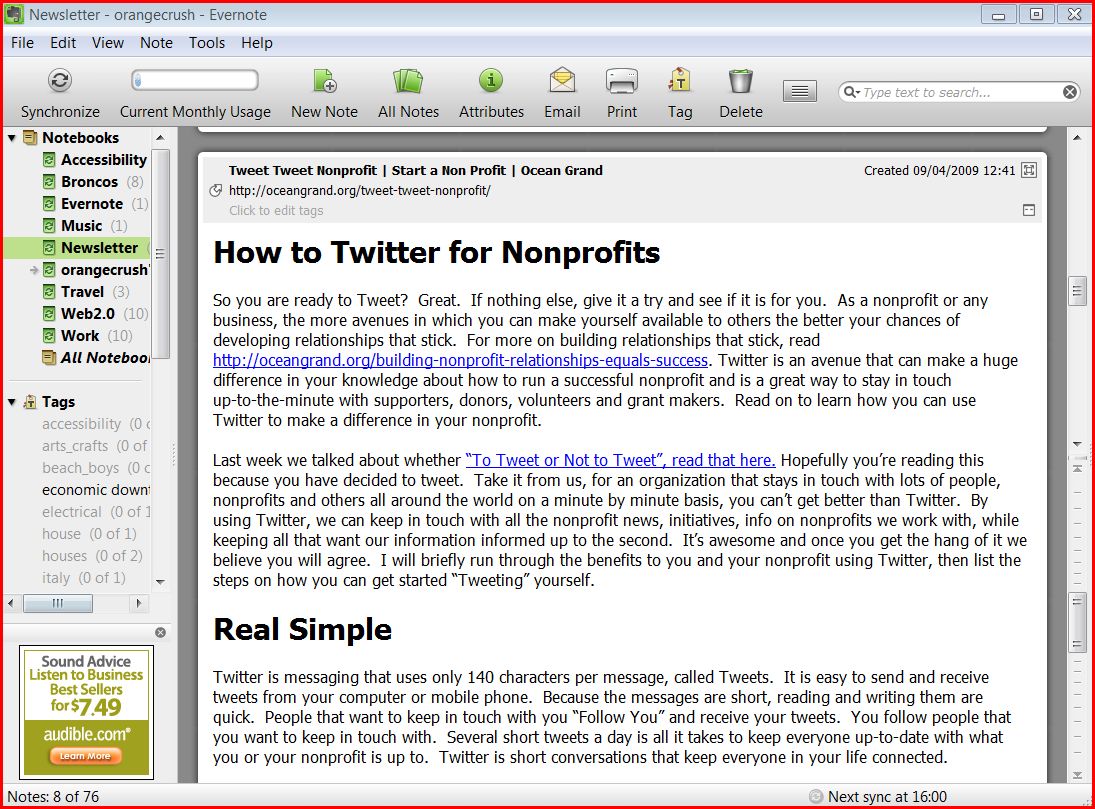
In another case, what if your incident commander could easily look up and reference relevant procedures and protocols directly on his or her phone or tablet? Better yet, can it provide a checklist for action within seconds?

Or what if you could get real time information back from the field by having them taking pictures, record audio or mark up a screen shot of a map directly from their phones and tablets?

Evernote is such a powerful repository of information that it can do all the things mentioned above. I am just wondering what the workflow is for organizations with emergency response and business continuity planning needs. Does it end up being more expensive than other tools or are there any work arounds?
What are your thoughts? Would you consider Evernote for your organization? Why or why not?
Related articles
- The All New Evernote Web Clipper 6 for Chrome (evernote.com)
- 5 Tips for Making the Most of Evernote (everything-pr.com)
- 7 IFTTT recipes to supercharge your use of Evernote (agbeat.com)
- Take note: Smart classroom tools for tech-savvy students (pcworld.com)
The 80% Disaster Solution?

Craig Fugate, Administrator of FEMA, spoke about this at the annual International Association of Emergency Managers Conference this past October. His keynote addressed how we shouldn't consider special populations "special" in our planning efforts. In community preparedness planning, all populations should be woven into the fabric of all disaster plans. Appendicies and annexes related to special populations or circumstances should be re-captured into comprehensive all-hazards planning.
I wholeheartedly agree with him, but can't imagine that we are ready for this shift with our current planning models. In a way, we use the appendicies and annexes to help ensure we cover our bases, like checklists, especially with our most vocal, critical, and sensational community members. But even in our best planning, I can't say we have gotten to a 100% solution.
So here is my my case...what if we:
- Shift to a comprehensive planning model not just for all-hazards, but for all populations?
- Aim to achieve only 80% success because we know we will achieve 100% in the end?
- Change our planning mindset to tackle what we can now and cover the rest later?
Will doing these things help us break down our most important issues and avoid being distracted by sensational issues? Will our plans be more effective and reflective of what we are trying to achieve?
What do you think?